

Seagate announced that its Mozaic hard drives built on heat-assisted magnetic recording (HAMR) and configured for shingled magnetic recording (SMR) have been added to Broadcom’s approved vendor list for its host bus adapters, which Seagate calls the first and only SMR drives on the list. Microsoft Azure Storage has qualified the Broadcom HBA with Seagate HAMR plus SMR drives for its fleet, which gives the pairing a hyperscale proof point. The practical effect is that a buyer can order the highest-capacity Seagate drives and a Broadcom controller as a supported combination without doing the interoperability work themselves.
Which Drives and Which HBAs
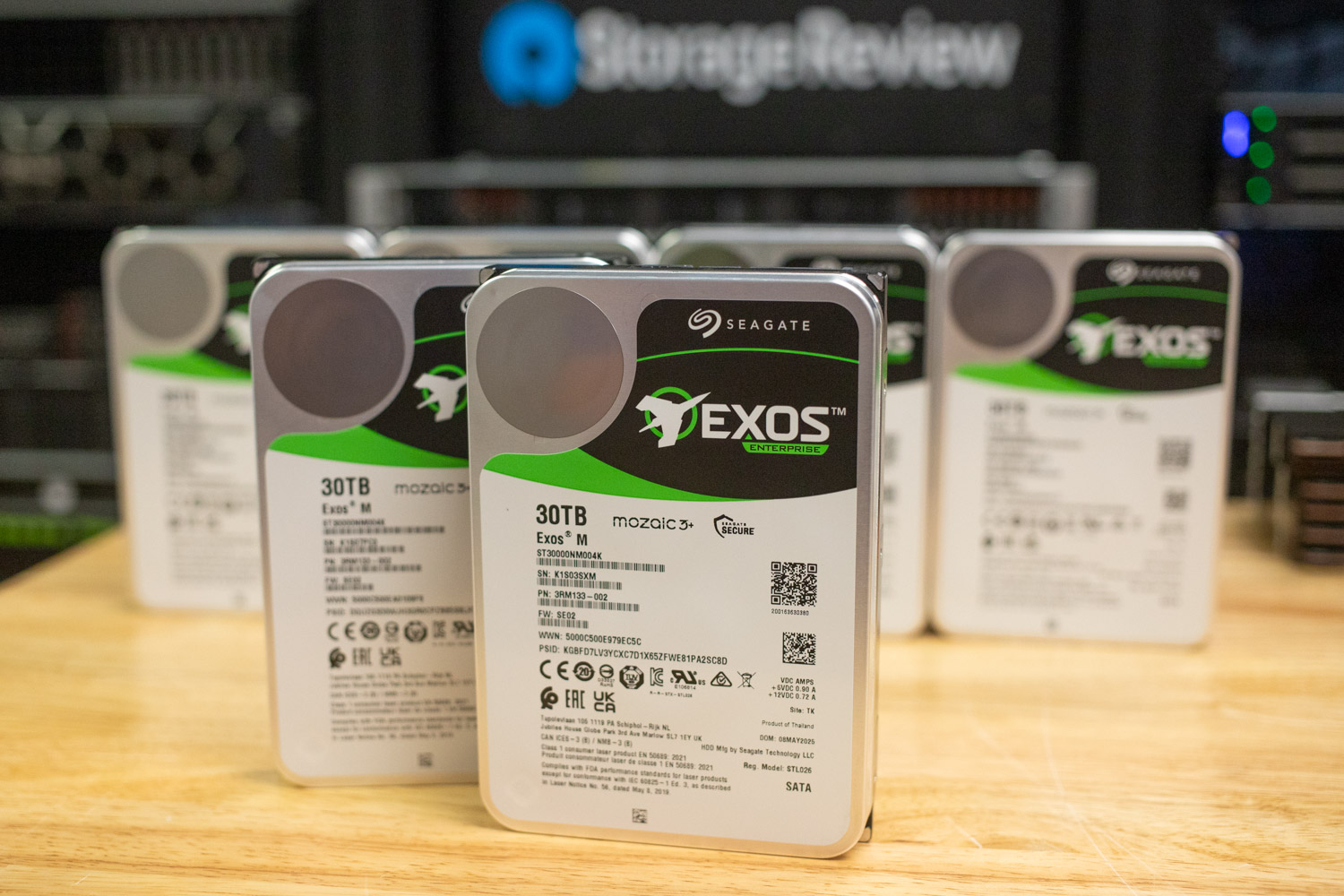
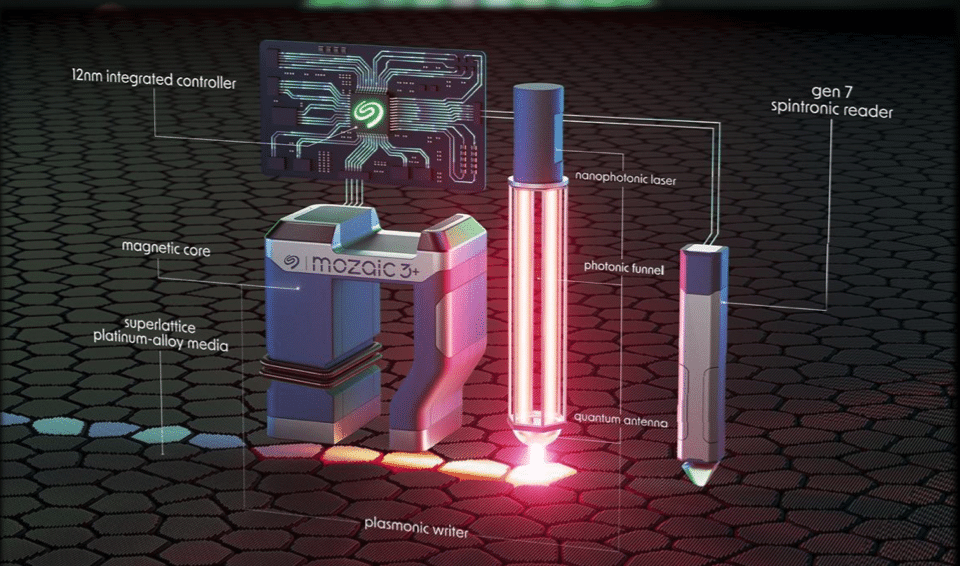
Seagate’s announcement names no part numbers, but Broadcom’s compatibility report for the eHBA 96xx family does. The new SMR section lists two Seagate SATA 6Gb/s models, the 32TB ST32000NM001F on firmware SR05 and the 36TB ST36000NM001M on firmware SR01, both qualified at Broadcom firmware phase MR8.17 with 512-byte logical sectors, against the eHBA 9620-16i, 9600-24i, and 9600-16i Tri-Mode adapters. Those are the SMR versions of the Exos M line on the Mozaic 3+ platform, the 3TB-per-platter HAMR design that Seagate took to 36TB with SMR.
The same report, updated the same day, also carries an SMR page for Western Digital, listing 17 Ultrastar DC HC690 models at Broadcom firmware phase MR8.18. Seagate’s drives sit one firmware phase earlier, which supports the “first” in Seagate’s claim, but Broadcom’s list no longer supports “only,” and buyers comparing the two SMR camps can now do it on the same adapter. Both lists are SATA only; no SAS SMR models appear for either vendor.
Why SMR Needed a Qualification
SMR overlaps adjacent tracks to raise capacity, which turns the drive into a zoned device: data is written sequentially inside zones, and the host or the drive has to manage the rewrites. Host-managed SMR drives in particular do not behave like conventional disks at the SCSI and ATA command level, and an HBA or RAID stack that does not pass the zone commands through cleanly will refuse the drive or corrupt it.
That is why SMR has lived almost entirely inside hyperscalers that write the host software themselves. When we tested the host-managed Exos X26z, Windows did not see the drive at all, a Supermicro server’s SAS bays did not detect it under Ubuntu, and it only appeared on a direct SATA cable with a zoned btrfs file system on top.
An AVL entry means Broadcom has run the drive through its interoperability suite on the named adapters and firmware, and will support the combination. Broadcom describes the HBA’s role as the communication path that lets large numbers of drives be connected, addressed, and managed by the host, and frames the SMR qualification as a path for more customers to integrate and manage high-capacity drive fleets. For an enterprise or a second-tier cloud that wants Azure-class density on a standard server, that support ticket is the difference between an SMR tier being a project and being a purchase.
Azure as the Reference Customer
Microsoft’s Azure Memory and Storage Center of Excellence completed the qualification of the Broadcom HBA with Seagate’s HAMR plus SMR drives. “At hyperscale, storage infrastructure has to meet demanding requirements for interoperability, manageability and infrastructure efficiency at scale,” said Pablo Ziperovich, general manager, Azure Memory and Storage Center of Excellence at Microsoft. “Microsoft Azure’s joint validation and qualification of Seagate and Broadcom’s SMR configuration demonstrates how these technologies can work together across large data center deployments, enabling greater storage density at a similar cost and power envelope.”
The cost and power clause is the business case, because the 36TB SMR drive fits the same 3.5-inch bay as the 30TB and 32TB CMR Exos M, so a rack of them adds capacity without adding slots or controllers, and Microsoft’s statement puts the cost and power envelope as similar. Seagate has not published pricing for the SMR models.
“High-capacity storage innovation delivers the greatest value when customers put that capacity to work efficiently,” said Jason Feist, Senior Vice President, Cloud Business at Seagate. “By pairing Seagate HAMR + SMR storage technology with Broadcom’s connectivity infrastructure, we’re helping make high-capacity SMR storage more accessible and easier to deploy as AI and cloud data demands grow.”


 Amazon