

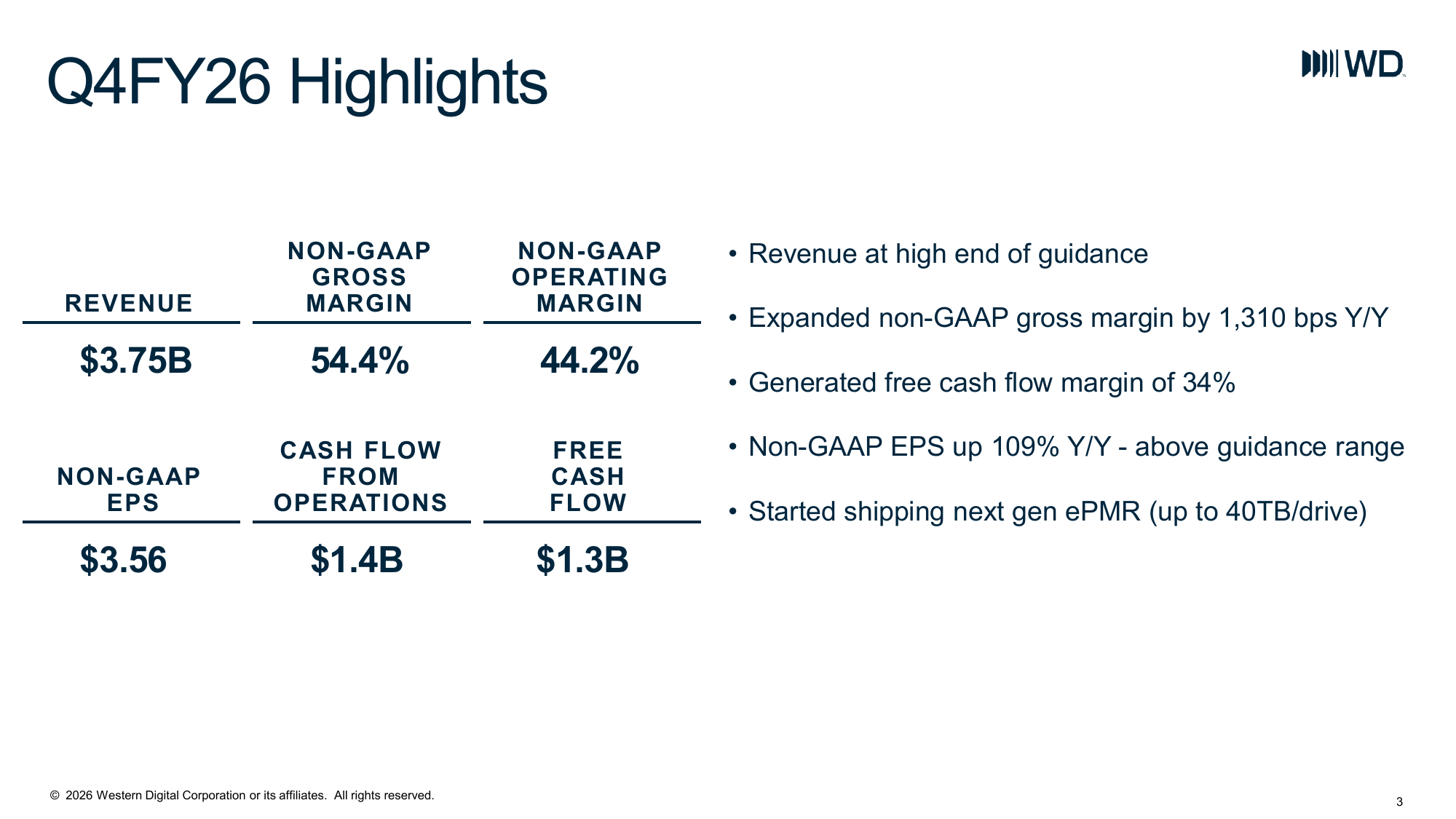
Western Digital started shipping its next-generation ePMR nearline platform at up to 40TB per drive during the quarter that ended July 3, and told investors on August 5 that its 44TB HAMR drive remains on track for the first half of calendar 2027. The company shipped 231 exabytes in the quarter, 209 of which were nearline, and expects the 40TB platform to account for more than half of nearline exabytes by the third quarter of calendar 2027. That is a lot of roadmap for a single earnings call, and it comes against Seagate, which is already shipping the capacity point that WD is still qualifying.
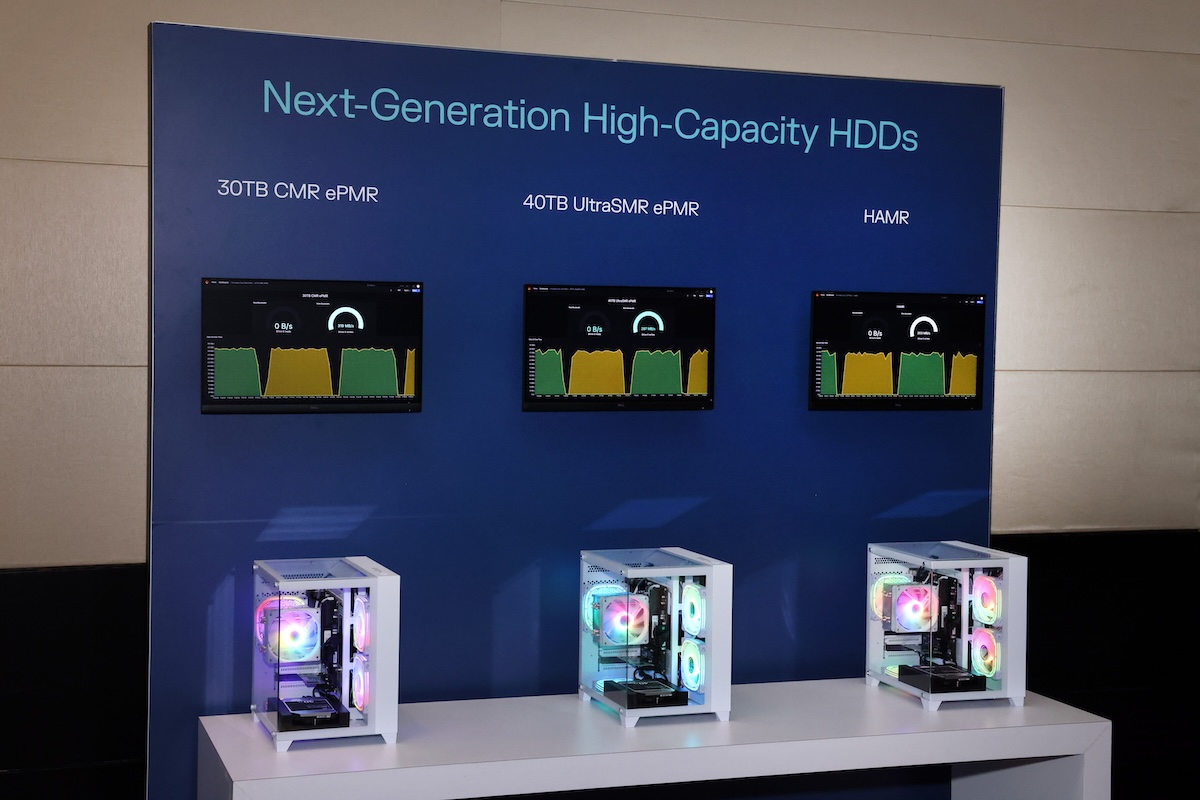
40TB ePMR and UltraSMR, Shipping Now
The 40TB drive is not a HAMR product. It combines ePMR with UltraSMR, WD’s shingled implementation, and it is the drive the company previewed at its Innovation Day in February, when it was described as in customer qualification with volume production targeted for the second half of calendar 2026; it arrived on schedule.
Two adoption targets came with it. WD expects the 40TB platform to exceed 50% of nearline exabytes by Q3 calendar 2027, and UltraSMR across all capacities to reach roughly 60% of nearline exabyte shipments by the end of fiscal 2027. The second number is interesting. Shingled media buys capacity without new recording physics, but it does so by making track rewrites more expensive, which is why UltraSMR adoption has always been gated by how much of a hyperscaler’s fleet can tolerate the write behavior. Sixty percent of nearline exabytes would be the highest share WD has committed to publicly.
44TB HAMR: 4TB Per Platter, 11 Disks
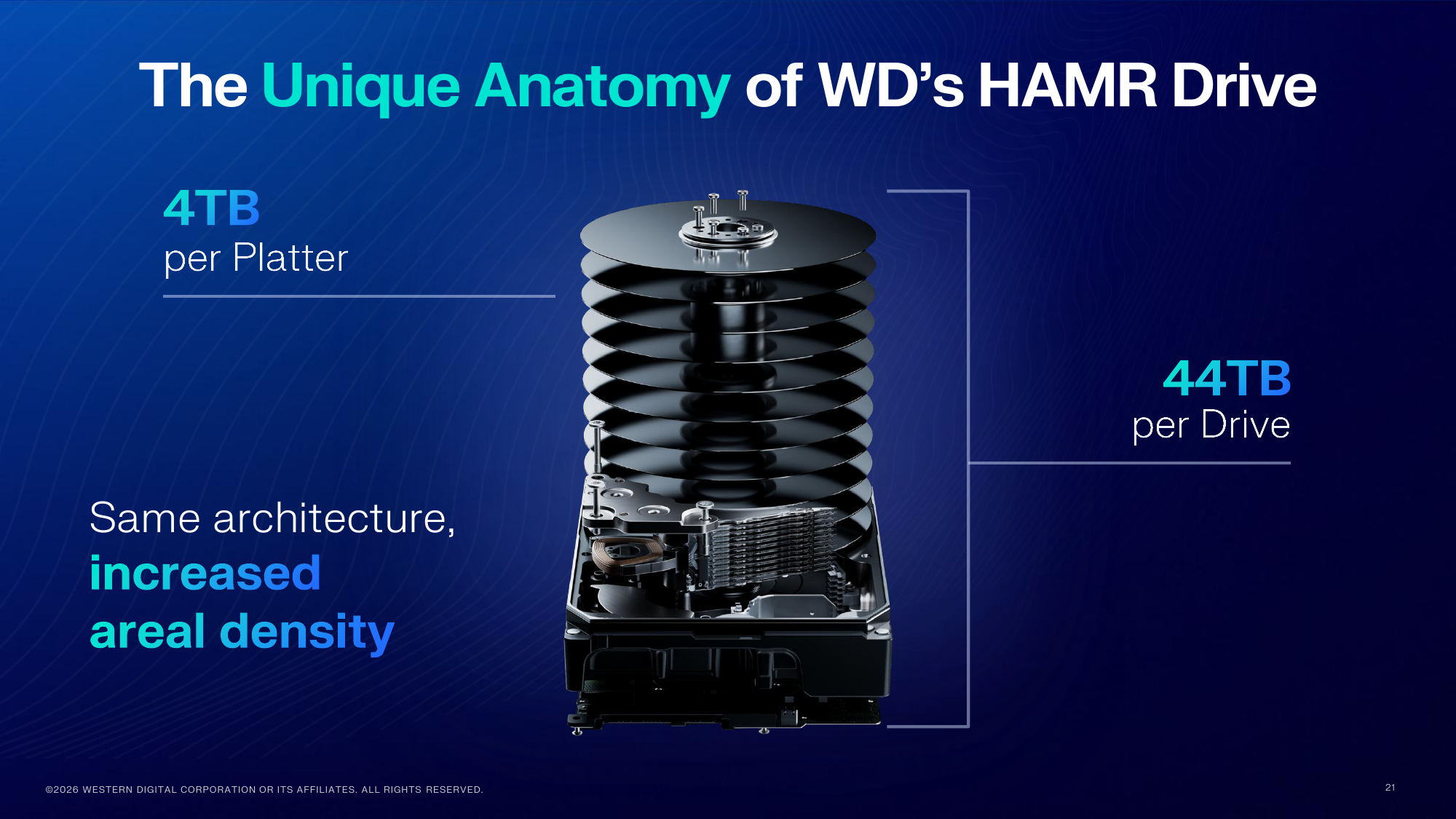
WD’s HAMR drive reaches 44TB with 4TB per platter across an 11-disk stack, and the company’s stated design goal is that customers see performance interchangeable with ePMR so the two can be deployed side by side. Management said qualifications are progressing with positive customer feedback and reiterated the first half of calendar 2027 for shipment. Seagate reaches the same 44TB with 10 disks at roughly 4.4TB each, which means Seagate is running a higher areal density per platter, and WD is closing the gap with an extra disk in the stack.
The Path Past 44TB
WD’s published roadmap runs two capacity lines in parallel through 2032. HAMR goes 40TB in 2026, 44TB in 2027, 60TB in 2028, and 100TB in 2029 with a dotted continuation past that. ePMR runs 40TB in 2026 and 60TB in 2028, which is compelling: WD says it can take a non-HAMR recording technology to 60TB by borrowing HAMR-derived media and firmware work, moving to 14 platters, and holding power flat.
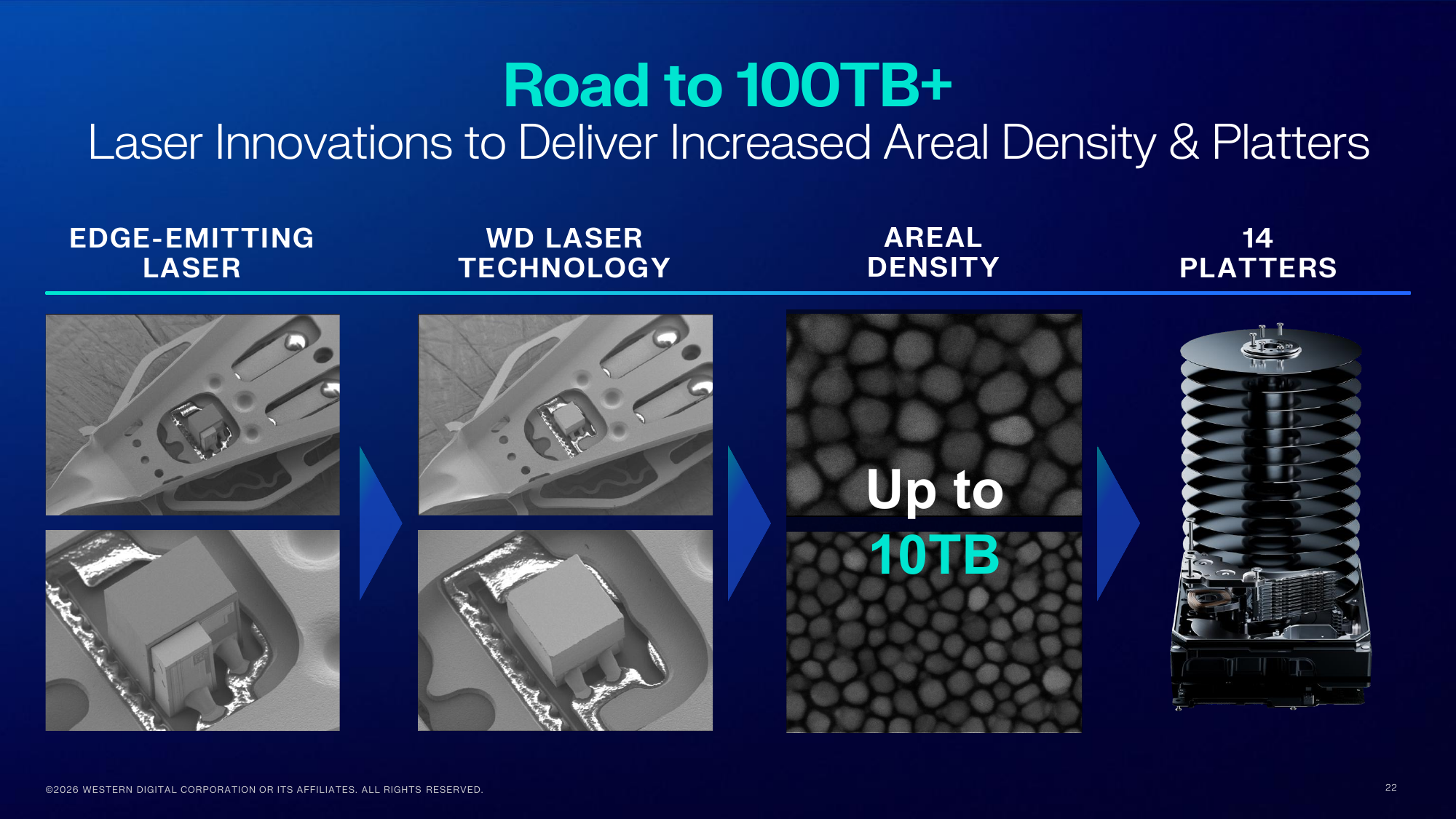
For the 100TB target, WD’s stated components are its own laser technology in place of a conventional edge-emitting laser, areal density supporting up to 10TB per platter, and a 14-disk stack. Fourteen platters at 10TB each would be 140TB, so the 100TB figure implies roughly 7.1TB per platter and leaves headroom in the stated ceiling. Whether that headroom survives contact with yield is a future WD question.
| Calendar Year | HAMR | ePMR |
|---|---|---|
| 2026 | 40TB | 40TB (UltraSMR, shipping) |
| 2027 | 44TB (H1) | n/a |
| 2028 | 60TB | 60TB |
| 2029 | 100TB | n/a |
Source: Western Digital Innovation Day, February 3, 2026, and Q4 FY2026 earnings call, August 5, 2026. Vendor-stated figures.
High Bandwidth Technology
WD said its High Bandwidth Drive technology is now sampling with five customers, offering up to 8x throughput with no corresponding increase in power. The company demonstrated 2x at Innovation Day and targets 8x by 2030.
Current nearline drives run roughly 250 to 275MB/s sustained; Seagate’s 44TB Mozaic 4+ is rated around 300MB/s. A 2x HBD drive clears 500MB/s. At 8x the theoretical range, it runs past 2,000MB/s, which puts a single spindle withing range of NVMe SSD territory for sequential work while keeping the HDD cost structure. WD frames the goal as maintaining a 6-10x cost advantage over QLC flash as capacities climb.
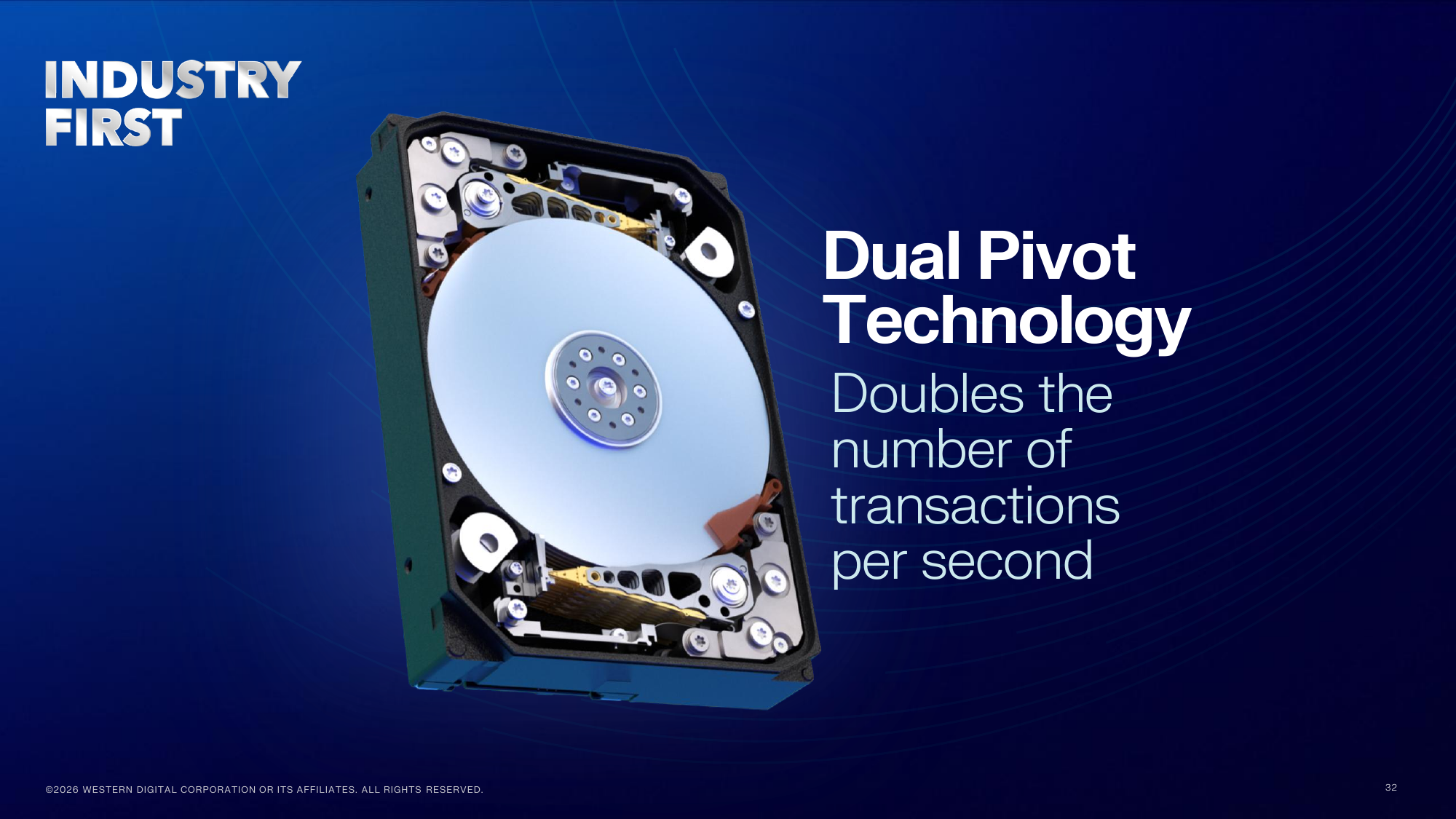
Sitting behind HBD on the roadmap is Dual Pivot, a second independently operating actuator set that WD says doubles transactions per second, something we’ve seen riffs on before. It is a lab technology today, with availability targeted for 2028, and it stacks with HBD.
The reason this matters more than another 4TB of capacity: AI training pipelines are increasingly bottlenecked on how fast data moves out of the capacity tier during ingestion and preparation, not on how much of it fits. Per-drive sequential bandwidth has been flat for years while capacity kept climbing, which quietly made every large-capacity fleet slower to rebuild and slower to drain. If WD ships 500MB/s-plus nearline drives at anything like current cost, that could change the arithmetic on where the warm tier ends and flash begins.
Power-optimized drives, due to start customer qualification in 2027, trade 5-10% performance for a 20% power reduction and 10% more capacity, aimed at the gap between warm and cold tiers. An intelligent platform layer combining SSD, HDD, and software-defined abstraction is targeted for 2027 for customers operating at 200PB and up.
Where This Leaves the Seagate Comparison
| Specification | Western Digital | Seagate |
|---|---|---|
| Capacity and Technology | ||
| Highest capacity shipping | 40TB ePMR / UltraSMR | 44TB HAMR (Mozaic 4) |
| Per-disk capacity at top node | 4TB (44TB HAMR, 11 platters) | 4+TB (Mozaic 4; platter count not disclosed) |
| 44TB status | H1 CY2027, in customer qualification | Shipping since March, ramped through June quarter |
| HAMR share of nearline exabytes | Not disclosed | About 40% exiting the fiscal year |
| Next capacity node | 60TB (44TB goes straight to 60TB on the published roadmap) | Mozaic 5 at 5+TB per disk, qualification shipments late CY2027 |
| Fiscal Q4 2026, quarter ended July 3 | ||
| Revenue | $3.747B, up 44% YoY | $3.629B, up 48.5% YoY |
| Fiscal year revenue | $12.919B | $12.195B |
| Non-GAAP gross margin | 54.4% | 52.7% |
| Total exabytes shipped | 231EB, up 22% YoY | 218EB, up 34% YoY |
| Data center exabytes | 209EB nearline, up 5% sequentially | 195EB, up 11% sequentially |
| Data center share of revenue | 90% | 89% |
| Blended revenue per terabyte | $16.22 | $16.65 |
| Q1 FY2027 revenue guidance | $4.1B +/- $100M | $4.1B +/- $100M |
Sources: Western Digital Q4 FY2026 earnings deck and press release (August 5, 2026) and Innovation Day (February 3, 2026); Seagate fiscal Q4 2026 press release and earnings call (July 28, 2026); Toshiba nearline HDD sampling announcement (March 30, 2026). Blended revenue per terabyte is our own calculation from each company’s reported quarterly revenue and total exabytes, and mixes nearline with non-nearline, so treat it as directional. Both companies ended their fiscal year on July 3, 2026.
Seagate is ahead in the field on HAMR, and Toshiba is not close. Toshiba began sampling its highest-capacity nearline drives, 30 to 34TB, in late March, and those use FC-MAMR with shingled recording rather than HAMR; its CMR models top out at 28TB with sample shipments slated for the third quarter of 2026. Toshiba says HAMR products are planned for “upcoming quarters,” which puts it a full recording generation behind both rivals while it is still sampling capacities the other two shipped years ago. CEO Dave Mosley told investors that HAMR-based products represented roughly 40% of Seagate’s nearline exabyte shipment run rate exiting the year, and CFO Gianluca Romano confirmed the company hit its 40% milestone by June. Mozaic 4, the platform that carries Seagate toward 100TB, supports up to 44TB per drive and began shipping in March. WD gets to that capacity a year later on HAMR but is not conceding capacity in the meantime, because UltraSMR closes most of the gap at 40TB without requiring a new recording technology to yield at volume.
The two roadmaps converge on economics rather than capacity. Both companies guided next-quarter revenue to exactly $4.1B plus or minus $100M, both ended the June quarter with data center at roughly 90% of revenue, and both are selling every drive they can build. So the question is not who wins the capacity race, since neither is supply-constrained by demand, but who converts capacity into margin faster.
One caveat on the “Seagate is a year ahead” framing: WD’s own roadmap places a 40TB HAMR product in calendar 2026, and the company has not disclosed what share of its nearline exabytes ships on HAMR today. Its Q4 shipping disclosure was the ePMR drive. Until WD gives a HAMR mix number the way Seagate does, the comparison is between a disclosed figure and an unknown one. The exabyte trend cuts the other way, though: Seagate grew total exabytes 34% year over year against WD’s 22%, and lifted data center exabytes 11% sequentially, where WD managed 5%. Whatever HAMR is costing Seagate in yield, it is not costing it volume.
What to Watch
The capacity race gets the headlines, and on that count, Seagate is ahead: 44TB drives in production, roughly 40% of nearline exabytes already on HAMR, and a 5TB-per-disk platform lined up behind it. WD’s answer is that it doesn’t have to win that race on Seagate’s terms. UltraSMR closes most of the gap at 40TB without new recording physics, and the ePMR line runs to 60TB in 2028, which means WD can defer full HAMR dependence considerably longer than a side-by-side capacity chart suggests.
The bet worth watching has nothing to do with terabytes, though. Every drive on both roadmaps still reads at roughly 250 to 300MB/s. At that rate, a 100TB drive takes more than four days to read end to end, and a 60TB drive takes two and a half. Rebuild windows, ingestion throughput, and how long a pipeline waits on the capacity tier are what increasingly decide whether hard drives stay in the AI data path at all, and none of those improve when the only thing that grows is areal density. High Bandwidth Drive is the one item on either company’s public roadmap aimed squarely at that problem. WD has demonstrated 2x and is targeting 8x by 2030, which would pull that 100TB full-drive read down from four days to about half a day.
That said, It’s also the least proven thing WD showed. HBD is sampling with five customers, not shipping broadly, and Dual Pivot is a lab technology with a 2028 target. If they release as expected, the capacity ladder becomes a secondary question, and the warm tier argument may win out. If they slip, both vendors spend the rest of the decade building larger drives that take proportionally longer to fill and empty, and flash keeps eating into the capacity tier regardless of who reaches 100TB first. Our Micron 6600 ION report makes the flash side of that case in watts, replacing eight 30TB hard drives with one 245TB SSD in the same server.



 Amazon