

Simplyblock’s Container Storage Interface (CSI) driver and Kubernetes operator now carry Red Hat certification and are listed in the Red Hat Ecosystem Catalog, which gives OpenShift Virtualization customers a validated storage layer for VMs moved off VMware vSphere. The software-defined platform runs on servers customers already own, provisions NVMe block volumes for containers and KubeVirt VMs, and includes the replication and disaster recovery features simplyblock added to the platform in September.
NVMe over Fabrics Architecture and Storage Services
Simplyblock runs as a distributed storage engine inside Kubernetes, pooling NVMe devices across nodes into one block storage pool that serves both containerized services and KubeVirt VMs. Hosts reach volumes over NVMe/TCP or NVMe over RDMA (RoCEv2), and the I/O path is built on the Storage Performance Development Kit (SPDK), which runs in user space to avoid the Linux kernel’s storage overhead. Simplyblock targets sub-millisecond latency and grows capacity by adding nodes to the cluster.
Data is protected with distributed erasure coding, which simplyblock says provides the fault tolerance of three-way mirroring at lower raw cost: a 4+2 scheme stores usable capacity at 1.5x raw against 3x for triple replication. The platform also handles thin provisioning, copy-on-write snapshots, writable clones, per-tenant quality of service limits, and volume-level encryption. The Red Hat Ecosystem Catalog lists five certified simplyblock container images, with the operator bundle at version 26.3.0 supporting OpenShift 4.19 through 4.22 and the CSI driver at 26.2.4.
Zero-RPO Metro Replication and Disaster Recovery
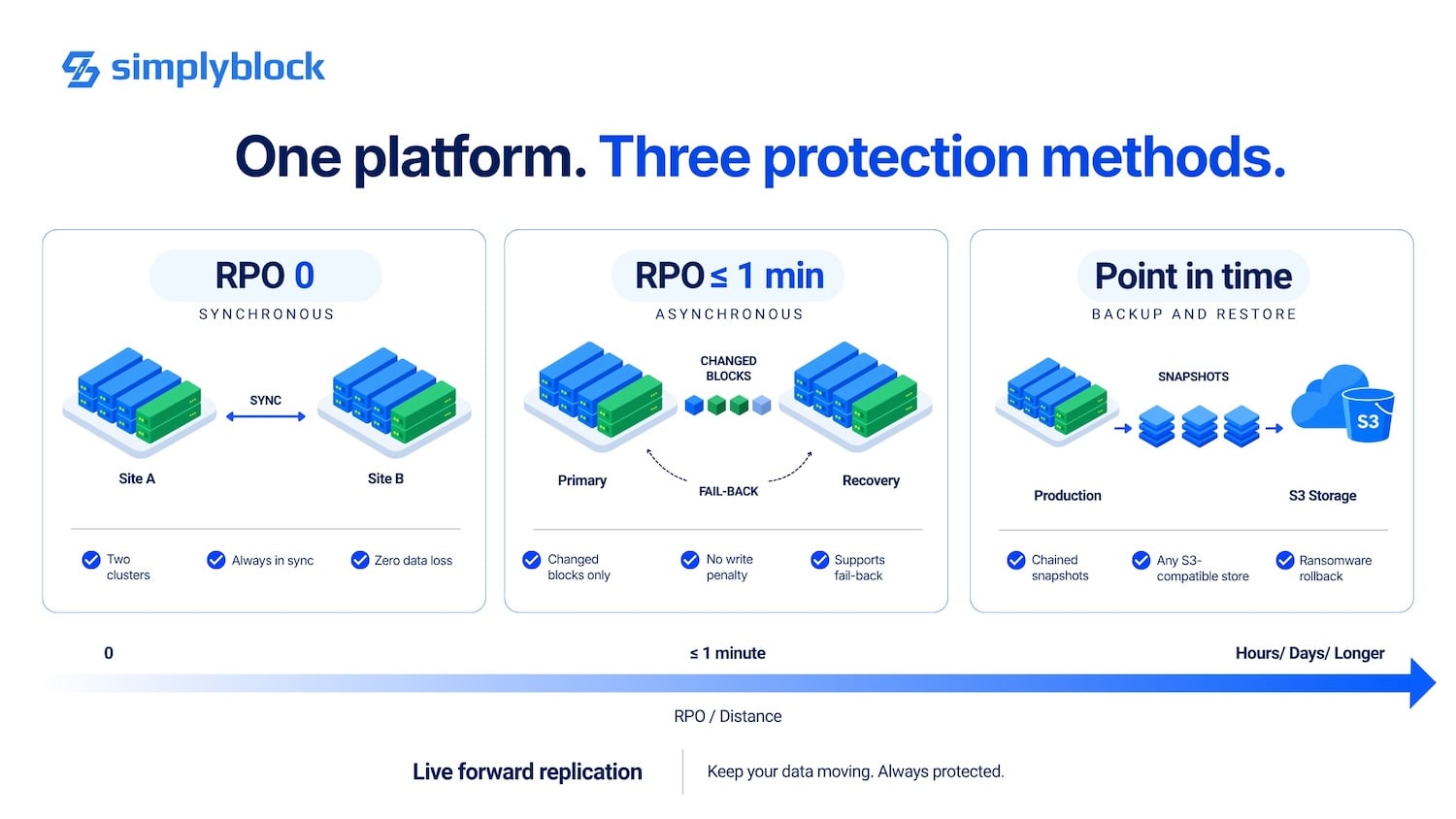
The replication and recovery features simplyblock added in September are part of the certified stack. Synchronous replication across a metro-distance stretch cluster delivers a zero recovery point objective (RPO), and asynchronous replication between clusters reaches RPOs as low as one minute, with delta-based transfers and automated failback. Live forward replication moves running volumes, including VM disks, between clusters without disruption, and point-in-time backups go to any S3-compatible object store for off-site protection.
Simplyblock CEO Rob Pankow says organizations leaving VMware need an OpenShift storage design that covers what vSAN, vMotion, and Site Recovery Manager did for them, and that certified storage with integrated disaster recovery provides it without a separately licensed DR product.
| Specification | Simplyblock for OpenShift |
|---|---|
| Certified Components | simplyblock Operator and Operator Bundle simplyblock CSI Driver simplyblock Control Plane simplyblock Storage Plane |
| Certification | Red Hat certified, listed in the Red Hat Ecosystem Catalog |
| OpenShift Compatibility | Red Hat OpenShift 4.19 to 4.22 (operator bundle 26.3.0) CSI driver 26.2.4 |
| Target Environments | Red Hat OpenShift Virtualization Red Hat OpenShift Container Platform |
| Transport Protocols | NVMe/TCP NVMe over RDMA (RoCEv2) SPDK-based data path |
| Data Protection | Distributed erasure coding (4+2 at 1.5x raw) Copy-on-write snapshots and clones Thin provisioning Volume-level encryption |
| Replication | Synchronous stretch cluster, zero RPO Asynchronous cross-cluster, RPO as low as one minute |
| Mobility and Backup | Live forward replication across clusters Backup and restore to S3-compatible object storage |
| Hardware | Standard servers (software-defined deployment) |


 Amazon