

SK hynix used Future of Memory and Storage 2026, held August 4 to 6 at the Santa Clara Convention Center, to showcase a comprehensive “full-stack” AI memory portfolio spanning HBM, server DRAM, NAND, and CXL expansion. The company’s presence centered on the transition toward agentic AI and the need to shift from individual product performance to integrated memory architectures. It shared the show with Samsung’s 3D memory roadmap, which we covered separately.
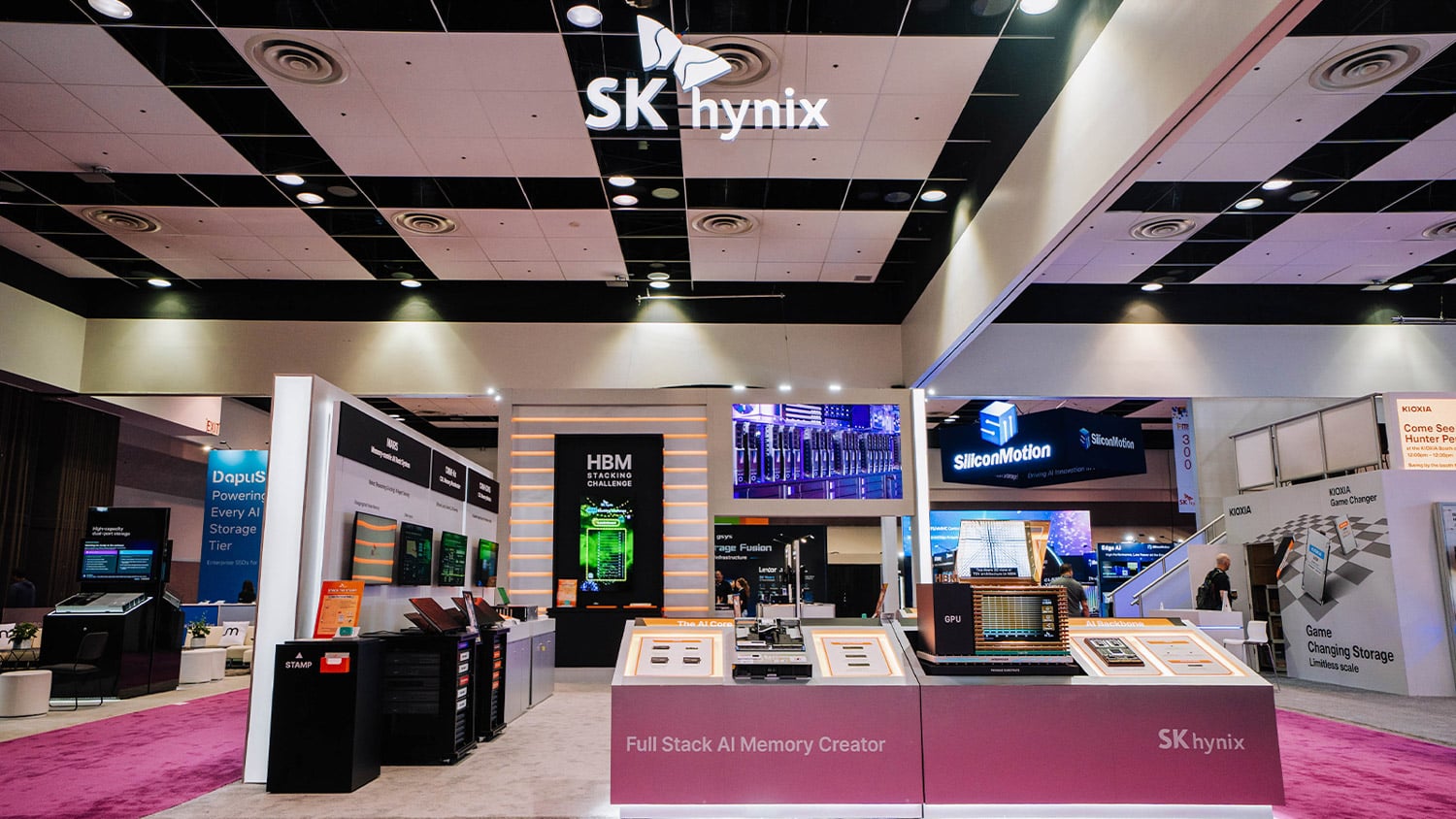
Tiered Memory and High Bandwidth Flash
SK hynix delivered the show’s third keynote under the theme “Orchestrating Efficient AI Infrastructure through Tiered Memory in the Era of Agentic AI,” presented by Kim Chun-sung, executive vice president and head of Solution Development, and Kang Uk-song, vice president and head of Next Generation Product Planning. Their argument: as AI agents process exponentially larger datasets, memory architecture must evolve into a “Tiered Memory” system. “What determines overall efficiency is where each memory tier, HBM, DRAM, NAND (HBF), and SSD, is positioned and how it is connected to minimize data movement,” Kim said.
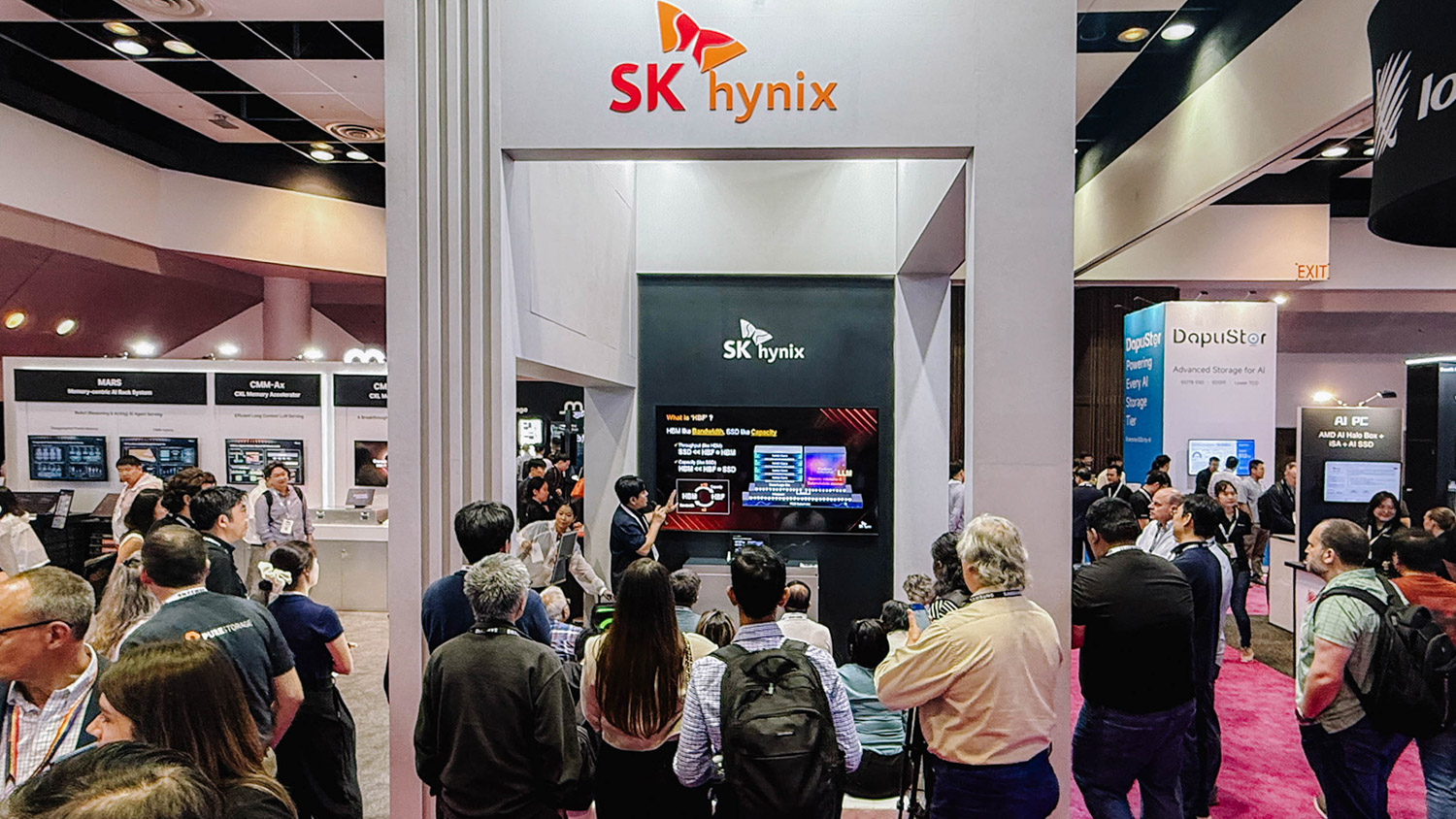
A significant part of this tiered strategy is High Bandwidth Flash (HBF). SK hynix describes HBF as a new memory category that applies TSV stacking, similar to HBM, to balance the capacity of traditional NAND with the bandwidth of DRAM. Positioned as a tier between ultra-high-speed HBM and high-capacity SSDs, HBF is intended to boost system scalability while lowering operational costs.
Exhibition Highlights: HBM4 and 375-Layer NAND
The exhibition floor featured several key hardware milestones:
- Next-Gen HBM: SK hynix placed an HBM4 model side by side with a model of NVIDIA’s next-generation Vera Rubin accelerator to show how the two companies’ technologies come together. Displays included physical units of the 12-layer 48GB HBM4E it began sampling in July, 16-layer 48GB HBM4, and 12-layer 36GB HBM3E.
- 375-Layer 4D NAND: This represents the company’s first NAND product utilizing wafer bonding. It delivers 2.5 times the performance per watt of the previous generation. Enterprise SSDs based on this NAND are slated for mass production in the first half of 2027.
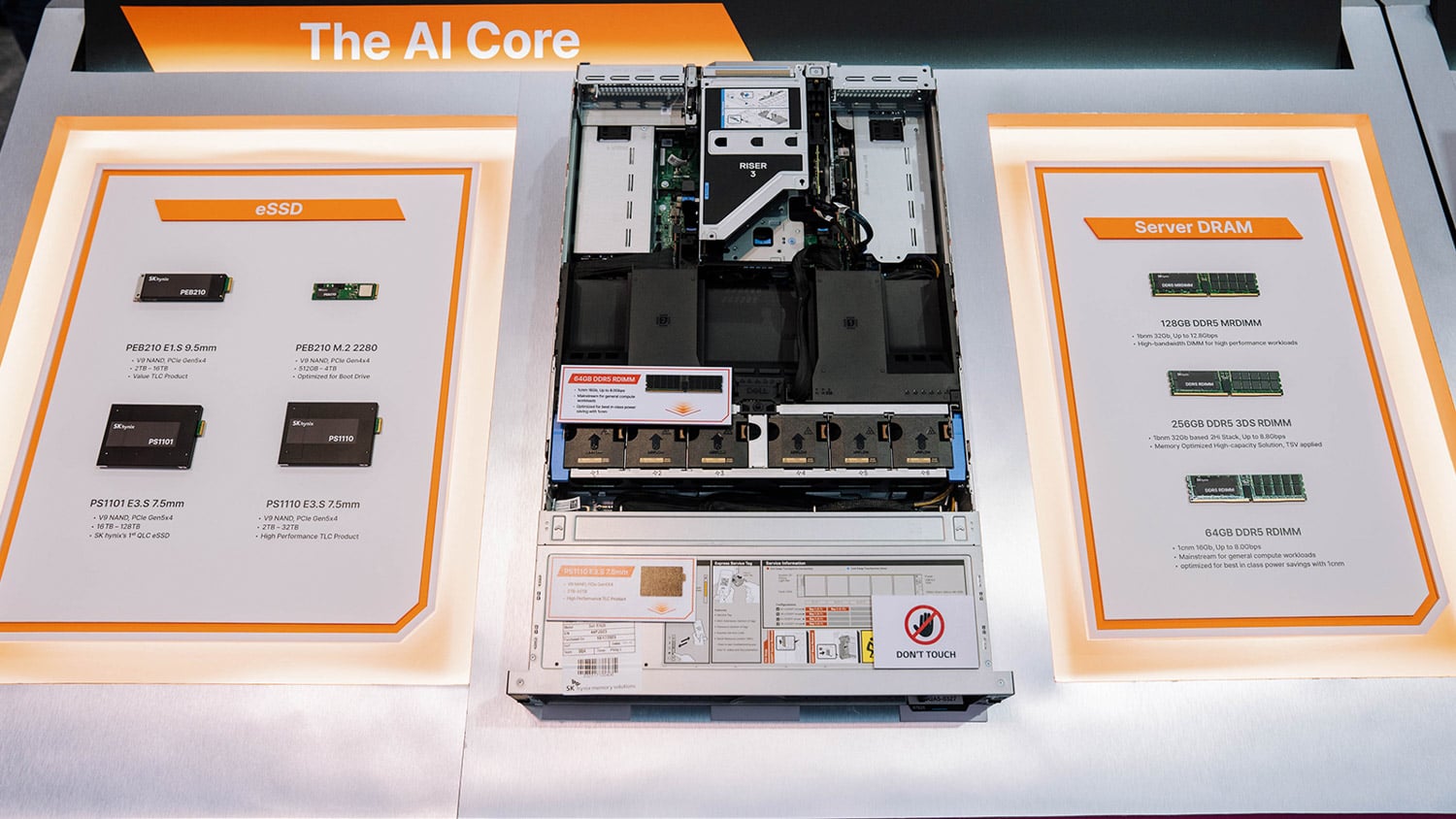
- High-Capacity eSSDs: The PS1101, a QLC-based eSSD, offers about 55% higher performance than the previous 176-layer generation. Sample shipments for major cloud service providers are scheduled to begin in August 2026.
- Edge AI Solutions: LPDDR6, LPDDR5/5X, UFS 4.1, and UFS 5.0 products were showcased as answers for Physical AI and low-power edge devices, with SK hynix saying it will apply data-aware placement and media-aware tiering in its mobile and client SSD products for edge inference.
CXL and Compute-in-Memory Demonstrations
SK hynix demonstrated the practical application of Compute Express Link (CXL) through multiple live scenarios. One demo featured CXL Pooled Memory to manage KV cache in distributed AI agent systems, significantly improving performance over traditional network-based communication. Another demonstration used CMM-Hybrid to prefetch KV cache into DRAM while maintaining the primary cache on SSD for high-capacity storage.
The company also introduced CMM-Ax, a compute-in-memory solution that embeds computing capabilities within memory to accelerate long-context LLM inference. SK hynix’s supporting research on efficient long-context LLM serving was accepted by MICRO 2026, which the company notes is the most prestigious conference in computer architecture.


 Amazon