

VDURA and Wasabi Technologies have formed a technology alliance to connect GPU-adjacent AI data infrastructure with predictably priced, S3-compatible cloud storage.
The partnership targets AI factories, neoclouds, and enterprise high-performance computing environments that need to keep active datasets and model checkpoints close to GPUs while moving inactive data to lower-cost cloud capacity. The approach is intended to support long-term retention, data protection, governance, and reuse without consuming performance storage capacity.
The core operating model is to keep data near compute resources while it is active and move it when it becomes idle. AI infrastructure teams frequently retain inactive datasets, checkpoints, and model artifacts on high-performance systems because data migration can introduce operational complexity, access constraints, and uncertain cloud costs. This can leave expensive performance capacity occupied by data that no longer requires low-latency access. It can also make retained data more difficult to secure, govern, and reuse.
VDURA provides the performance tier for active AI workloads. Its platform supports dataset staging, model loading, training, checkpointing, and inference through GPU-adjacent parallel file system performance, RDMA data paths, and POSIX compatibility. The platform combines NVMe flash and HDD storage with a native S3 interface under a unified global namespace.
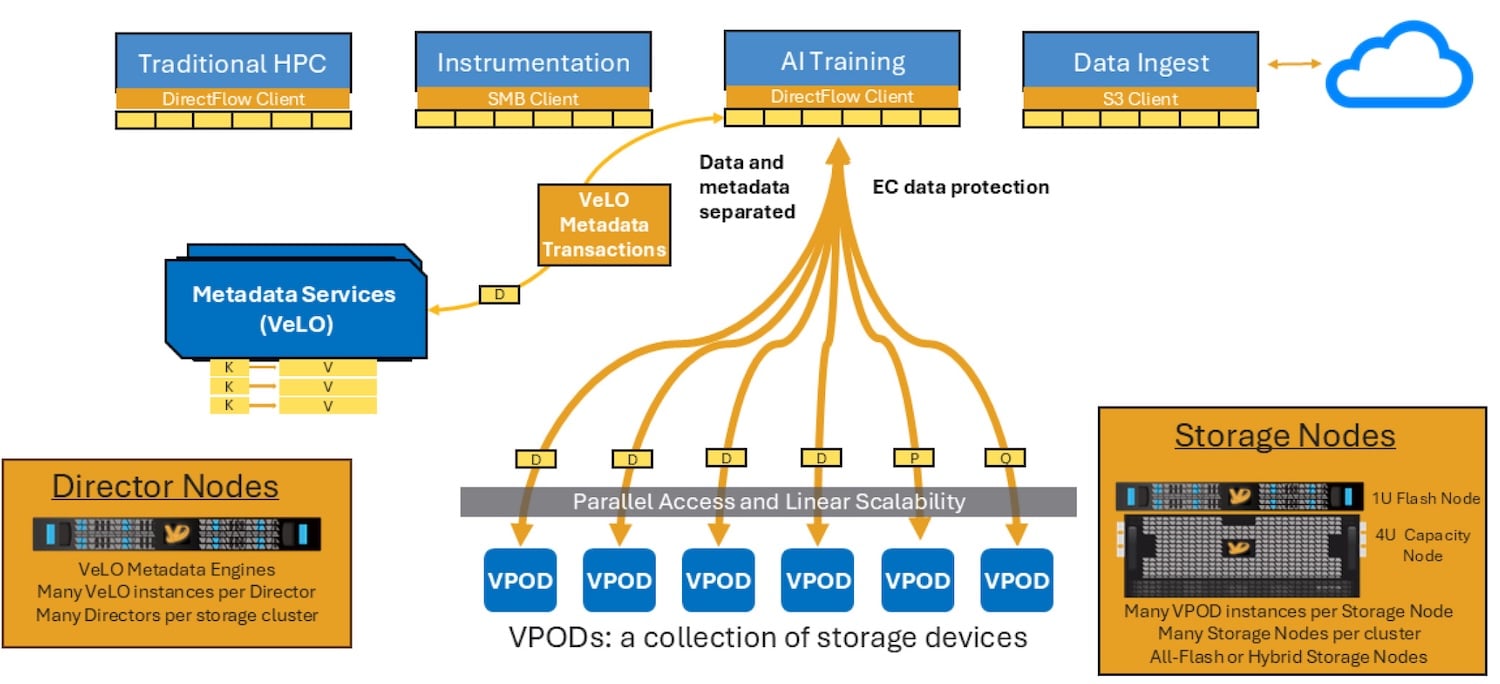
Wasabi supplies the cloud storage tier for active archiving and long-term preservation. Data no longer used directly by GPUs, including datasets, checkpoints, model versions, and derived artifacts, can be stored in Wasabi for protection, compliance, disaster recovery, and sharing across sites or computing environments. The data remains available for future retraining, model comparison, and governance activities.

Under Wasabi’s standard plan, the service does not charge per-GB egress or API request fees. The company positions this pricing model as a way for organizations to forecast the cost of retaining and reusing AI data without variable retrieval charges.
Tiered data placement is already common in large-scale cloud infrastructure, where high-performance systems are paired with cost-efficient capacity platforms. VDURA and Wasabi are applying the same model to AI infrastructure through two specialized systems connected by open interfaces rather than a single closed platform.
VDURA CEO Ken Claffey said the performance infrastructure used for GPU processing is optimized for speed and active workloads. At the same time, checkpoints, dataset versions, and model artifacts require secure and predictable long-term storage. He described the partnership as a way to integrate data movement into the AI lifecycle while combining VDURA’s high-performance storage with Wasabi’s cloud object storage.
Laurie Mitchell, senior vice president of global marketing at Wasabi Technologies, said AI data remains valuable after a training run. It can support future models, provide an audit trail for governance, and serve as a baseline for comparison. She said the alliance is designed to simplify connections between GPU-adjacent infrastructure and independent, S3-compatible cloud storage, letting organizations keep control of their data and costs without locking either into a hyperscaler.
The alliance will be on display at Ai4 2026, running August 4 to 6 at The Venetian in Las Vegas, where Wasabi is exhibiting at booth #935.


 Amazon