

The BLUETTI Elite 300 is a 3kWh portable power station intended for home backup, RV travel, camping, remote work, and jobs where dependable AC and DC power may not be nearby. Its 3,014.4Wh LiFePO₄ battery places it above the smaller units mainly used for phones, laptops, and campsite lighting, providing enough stored energy to power refrigerators, networking equipment, desktop computers, televisions, pumps, and other larger devices. It can also serve as a temporary household power source during an outage, especially when the goal is to keep food cold, internet access online, and a few essential electronics running. For RV owners, the inclusion of dedicated RV connections gives the Elite 300 a more travel-focused design than a basic power station with only standard household outlets.
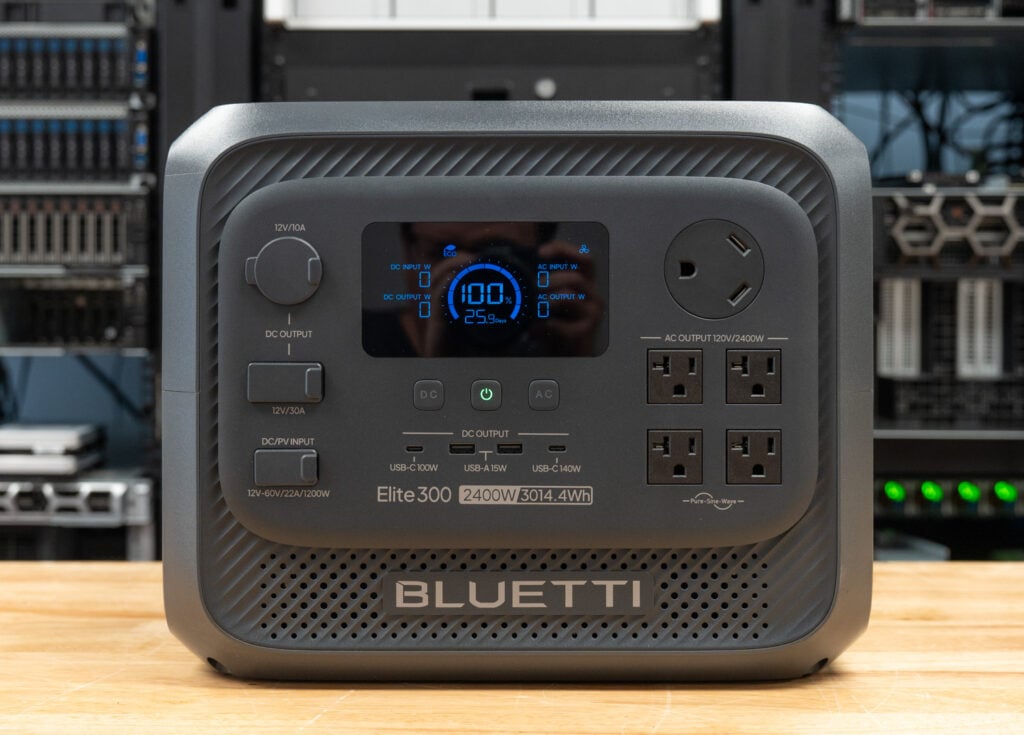
The inverter delivers up to 2,400W of continuous AC output. That output level covers most common household appliances and a good selection of corded tools, though the total load across every connection still needs to stay below the inverter limit. A refrigerator, router, television, lights, and several chargers could run together, while appliances such as an induction cooktop, electric kettle, microwave, or heat gun would consume a much larger share of the available output on their own.
BLUETTI also advertises a 4,800W figure, which it calls Power Lifting mode (some of its retail listings label it surge). The mode is disabled by default and is intended only for pure resistive loads rated between 2,400W and 4,800W, such as electric kettles, heating blankets, hair dryers, and space heaters. It does not turn the Elite 300 into a full 4,800W power source; BLUETTI’s manual explicitly states that the actual output power remains at 2,400W when the mode is engaged. It is also not a startup allowance for motors or compressors. BLUETTI’s own FAQ warns that those devices can draw two to four times their rated power at startup and could overload the unit, so anything with a motor or sensitive electronics should be sized against the normal 2,400W limit.
The port selection is diverse enough to support household, mobile, and RV equipment without constantly swapping cables. There are four standard 20-Amp AC outlets, a NEMA TT-30 outlet for connecting an RV, a 12V/30A DC output, and a 120W cigarette-lighter socket. One detail from the manual worth knowing: the cigarette-lighter socket and the 12V/30A port are wired in parallel, so their combined DC draw is capped at 30A rather than 30A plus another 10A. Smaller electronics can use the two 15W USB-A ports, while the 100W and 140W USB-C ports provide enough power for many modern laptops, tablets, cameras, and handheld gaming systems. The 140W USB-C connection is particularly useful for higher-performance notebooks that would otherwise need their AC charger, leaving the household outlets available for appliances and other equipment. Across the AC, USB, and DC connections, the Elite 300 offers 11 output ports, which should be sufficient for a mixed setup, provided the combined power draw is monitored.
Recharging options include up to 1,800W from a household outlet and up to 1,200W from compatible solar panels, with a BLUETTI rating of up to 2,400W for combined AC and solar input. The solar input accepts 12V to 60V at up to 22A, giving owners room to use a larger panel array for camping, RV use, or longer outages. BLUETTI also supports its optional Charger 2 system, which can draw from a vehicle alternator and solar panels at a combined rate of up to 1,200W while driving. That could be valuable on longer road trips, since a standard 12V vehicle socket would take far longer to refill a battery of this size. Charging speed can be adjusted through the power station’s controls and app, with three AC charging modes (Standard, Turbo, and Silent) that allow faster charging when time is limited or a slower, quieter setting when fan noise and electrical load are concerns. Pass-through charging is also supported, so connected devices can continue operating while the battery is charging.
The Elite 300 can also work as a UPS, switching to battery power in 10 milliseconds or less when incoming AC power fails. That transfer time should be quick enough for many desktop PCs, routers, network switches, security systems, televisions, and home-office devices, although especially sensitive equipment should always be tested before being trusted with important workloads. Worth noting for this audience: BLUETTI’s manual states the UPS feature is not intended for data servers or workstations that require a high-performance UPS, and the company disclaims liability for that use, so our workstation switchover test below should be read as a characterization of the unit rather than a vendor endorsement. Wi-Fi and Bluetooth connectivity provide access through the BLUETTI app, where battery level, charging input, output consumption, and individual power sections can be monitored or controlled (more on that below). Scheduling also allows connected equipment, such as lights, heaters, coffee makers, and aquarium pumps, to run at selected times.
BLUETTI Elite 300 rates the LiFePO₄ battery for more than 6,000 cycles before it drops to 80 percent of its original capacity, which is a strong figure for anyone expecting regular use. Actual runtime will still vary with temperature, inverter losses, load changes, and appliance cycling, so the full 3,014.4Wh rating will not be available as usable energy at the AC outlets. Overall, the combination of battery capacity, 2,400W output, RV connections, solar charging, and UPS support gives the Elite 300 a pretty extensive range of uses beyond occasional emergency charging.
Bluetti Elite 300 Pricing and Warranty
Backed by a 5-year warranty, the Elite 300 lists for $1,199 on BLUETTI’s site as of this writing, after debuting at a $1,099 promotional price when it launched in March 2026. BLUETTI also sells it in bundles with its 200W, 350W, and 500W solar panels, as well as with the Charger 1 and Charger 2 alternator chargers.
Bluetti Elite 300 Specifications
| Specification | BLUETTI Elite 300 |
|---|---|
| Battery | |
| Model | Elite 300 |
| Battery Capacity | 3,014.4Wh (314Ah) |
| Battery Chemistry | LiFePO₄ (Lithium Iron Phosphate) |
| Cycle Life | 6,000+ cycles to 80% capacity |
| Power Output | |
| Continuous AC Output | 2,400W Max. (120V, 50/60Hz) |
| Bypass Output | 1,800W Max. (120V, 50/60Hz) |
| Surge Power | 4,800W |
| Lifting Power | 4,800W |
| Output Ports | |
| AC Outlets | 4 × NEMA 5-20R (Normal AC Outlets) |
| TT-30 | 1 × NEMA TT-30 |
| 12V Output | 1 × 12V / 30A Port (XT90) |
| USB-A | 2 × 15W |
| USB-C | 1 × 100W, 1 × 140W |
| 12V Cigarette Port | 1 × 120W Max. |
| Charging | |
| AC Input | 1,800W Max., 15A, 120V, 50/60Hz |
| Solar Input | 1,200W Max., 12-60V, 22A Max. |
| General | |
| Dimensions | 366 × 305 × 297.5 mm (14.41 × 12.01 × 11.71 in) |
| Weight | 26.3 kg (57.98 lbs) |
| Charging Temperature | 0°C to 40°C (32°F to 104°F) |
| Discharging Temperature | -20°C to 40°C (-4°F to 104°F) |
| UPS Switching Time | ≤10 ms |
| App Connectivity | Bluetooth & Wi-Fi |
| Pass-through Charging | Supported |
| Warranty | 5 Years |
Build and Design
The BLUETTI Elite 300 uses a compact, boxy enclosure with a dark gray finish, rounded corners, and a reinforced frame surrounding the front panel. At 366 × 305 × 297.5 mm (14.41 × 12.01 × 11.71 in), it takes up about as much space as a compact desktop PC, which is impressive for a power station with a 3,014.4 Wh battery. Like several other BLUETTI models, the Elite 300 feels very dense for its footprint, with most of its weight concentrated low in the chassis. This gives it a low center of gravity and helps it stay planted when heavier cables are connected. The textured outer panels and ribbed front trim help break up the large surfaces, while broad ventilation openings across the top and sides give the internal cooling system plenty of room to move air during charging and heavier use. For toting an extra kWh of capacity, the Elite 300 comes in at 57.98 lbs versus 53.4 lbs for its smaller Elite-series sibling, the Bluetti Elite 200 V2 we reviewed last year, a difference of about 4.6 pounds in an enclosure that is roughly two inches wider but an inch shorter.
Two deep handles are recessed into the sides of the chassis, so they do not add any extra height or width to the enclosure. This keeps the overall shape compact and makes it easier to store in a vehicle, RV compartment, garage, or closet. Since it weighs almost 60 pounds, the Elite 300 is still a heavy device and requires some care when moving it, especially up stairs or into a raised storage bay. The large handle openings offer a secure grip, though, and their placement makes lifting it from either side much easier. Its low, wide shape also helps reduce the risk of tipping when thicker AC, RV, or charging cables are attached.

Most of the controls and outputs are grouped across the front, with the LCD positioned near the center for quick access to battery level, input power, output draw, and operating status. Separate buttons control the main system, AC output, and DC output, so unused sections can be switched off while other connected devices continue running. The buttons are easy to identify and feel firm and durable when pressed, which gives confidence that they should hold up well when the unit is moved between home, garage, RV, and outdoor use.
The NEMA TT-30 outlet is located in the upper-right corner of the front panel, with four standard AC receptacles directly below it. The outlets are placed fairly close together, so a wide wall adapter or oversized power brick may cover the adjacent outlet, while regular plugs should fit without issue. The lower half of the front panel houses the smaller connections, including two USB-A ports, 100W and 140W USB-C ports, the 12V/30A output, and the cigarette-lighter socket. The higher-power USB-C ports are especially useful for laptops, tablets, cameras, and gaming handhelds, since they can charge these devices without using an AC outlet. The 12V connections also have protective covers that help keep dust and debris away from the contacts when they are not in use, which is useful for a unit likely to spend time in garages, vehicles, RVs, and campsites.

Although there are no ports or interfaces on the rear of the Elite 300, we felt it was worth mentioning that there is a removable dust filter at the fan inlet to prevent dust and debris from entering the unit. This is beneficial for preventing the charging circuitry from getting covered in dust and preventing heat transfer. Below the dust filter is the product label with the regulatory information, operating conditions, and model information.

BLUETTI places the AC charging input, circuit protector, and grounding terminal on the right side of the enclosure. This keeps incoming power cables away from most of the front-facing device connections and reduces cable crowding around the display and controls. The top is free of ports and buttons, giving the Elite 300 a tidy shape and avoiding any protruding hardware that could catch during transport. It should still be left uncovered, however, since the upper ventilation area needs room to release heat during charging and heavier output loads.

Usability and Interface
The Bluetti landing page for battery management immediately gives you a thorough idea of where power is going on the unit. Here we can see the unit charging back up from 54% and drawing ~1300 watts from the wall, while outputting 100w to the workstation connected on the other side.

When scrolling down a little in the interface, we can see the estimated time to recharge to 100%, assuming the input and output remain at or near the same values. If you have a heavy or wildly variable load on the other end, you will likely see a significantly higher recharge time.

Here we are letting the Elite 300 stretch its legs a little, with nearly 1 kilowatt of output and 1.3 kilowatts from the wall while it tries to top off the battery at the same time. At this load level, the fans ramped up quite a bit because it was charging as fast as it could from the wall and dissipating a significant amount of heat during the AC-to-DC conversion, whilst still pushing over 900 watts to the output.

Power Testing
During power testing, we plugged the Elite 300 into our Kill-A-Watt tester and recorded the charging and output power usage from full charge to empty. When charging the Elite 300 from 0% to 100%, we recorded a total usage of 3.49 kWh, and on the output side, a total draw of 2.67 kWh before the battery was fully depleted. This is fairly close to the battery’s 3 kWh rating, though some variance is expected due to AC and DC conversions, running fans, and keeping the controller alive.
We also tested the Elite 300 as a UPS, with a workstation machine connected to the output and being fed through our Quarch power analyzer. We use the Quarch to view the AC waveforms, confirm that it outputs a pure sine wave, and measure the cutover time between line and battery power. Below is a screenshot from our Quarch showing an 8ms switchover time from line power to battery/inverter power when line power is removed from the unit. This is well within the requirements for PC or workstation power supplies, where the hold-up time of the capacitors is around 16ms before interruptions may occur.

When reintroducing line power to the Elite 300, the switchover time from inverter or battery power back to line power is 8.25ms. Again, this is well within the standard and should not introduce any issues. This switchover time is often what differentiates an EPS (emergency power supply) from a UPS (uninterruptible power supply), since an EPS focuses on keeping appliances and lights on and is less concerned with devices like computers and their uptime.

Conclusion
Overall, if you are looking for a fairly durable yet compact power solution, the Elite 300 can serve you well in many scenarios. Compared to others in its class, this is one of the smallest we have seen with over 3 kilowatt-hours in such a compact footprint. As a result, the Elite 300 is deceptively heavy, weighing nearly 60 pounds. Despite its weight, the handles are fairly comfortable and do not dig into your hands during transport. However, for some individuals, it may be best to have a helping hand for transporting this unit. For anything from power-outage use to RV and off-grid use, the Elite 300 is an extremely versatile and capable power station featuring 30 amps of RV output, 20 amps of typical AC output, and 30 amps of DC output. The addition of the XT 90 connector for DC output is less common on other units, but it is nice to see for additional versatility, such as powering lights, water pumps, or DC appliances without efficiency losses from another AC-to-DC conversion. If you are looking for extended runtime while still maintaining a smaller footprint, the Bluetti Elite 300 has proven itself to be a more-than-capable unit.


 Amazon