

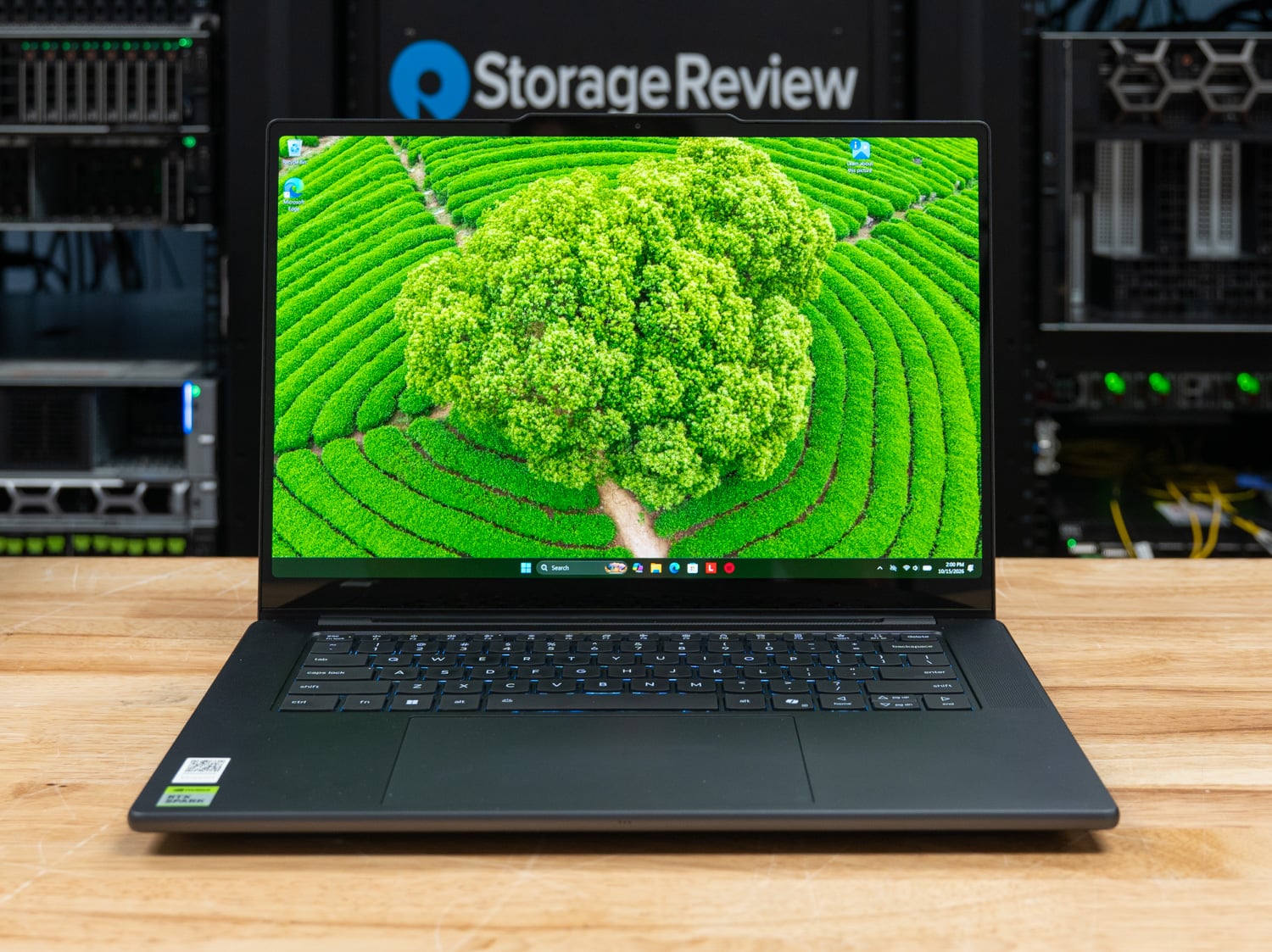
The Lenovo Pro 9n 15 is Lenovo’s 15.3-inch NVIDIA RTX Spark clamshell for creators, with a 165Hz 2.5K OLED display, a pen-enabled haptic touchpad, and an aluminum chassis 0.66 inches thick. Our unit carries the entry silicon: the 18-core N1X with a 5,120-core Blackwell GPU, 32GB of LPDDR5X, and a 1TB Gen4 SSD on Windows 11 Pro. Lenovo lists the Pro 9n from $2,999.99 for an 18-core, 32GB model with a 512GB SSD. Pricing for our 1TB, Windows 11 Pro configuration was not listed at the time of this review.
This review covers the Pro 9n’s build and design, then its results in local AI, CPU, memory, gaming, thermals, and storage. We compare it with the HP OmniBook Ultra 16 with 32GB, which runs the same 12GB GPU split on the 20-core chip; the Lenovo Yoga 9n 2-in-1 16, its Lenovo sibling with the 20-core chip and 64GB; and the Razer Blade 16, whose RTX 5090 was the strongest x64 notebook in our Surface Laptop Ultra review. Battery testing is still in progress and will be added when it finishes.
The Pro 9n runs its N1X cooler than the 20-core OmniBook at the same clocks. Lenovo rates it at up to 80W, and it held all-core clocks within about 1 percent of the 32GB OmniBook’s in every CPU test while peaking at 93 C, which puts its 18 cores 8 to 11 percent behind the 20-core OmniBook in most multi-threaded work and level with it in Stockfish and the N=20000 OpenBLAS solve. The smaller GPU gives up 2 to 5 percent in LLM token generation.
With all systems, memory is the constraint and should inform the sizing decision when buying. It can’t load the 12.8GB gpt-oss:20b model, for instance. While users might opt to force it, the NVIDIA app is quick to point out that minimum and maximum allocations may cause issues. There is also a practical element of loading in a model that takes up all your VRAM, leaving nothing for KV cache.
The fixed split is a Windows limitation, not an NVIDIA one. Windows does not yet support unified memory across the CPU and GPU the way the Linux stack on DGX Spark does, which is why the allocation has to be set in advance; we understand that support is in the works between NVIDIA and Microsoft.

Key Takeaways
- Small-model AI at full speed: MLPerf Llama 3.1 8B ran at 55.1 tokens per second on the 5,120-core GPU, 2 percent behind the 20-core OmniBook, and RAG answers took 0.252 seconds. The 12GB GPU split keeps it out of our model-load and coding agent tests.
- Fewer cores, higher clocks: the Pro 9n held 3,288MHz through the 30-minute sustained loop at a 92 C peak and scored 6,394 in Cinebench 2026 multi-core, 8 percent behind the OmniBook and 23 percent ahead of the Razer Blade 16.
- Level with 20 cores in Stockfish and OpenBLAS: the all-core OpenBLAS LU solve at N=20000 reached 318.1 GFLOPS against 322.4 on the OmniBook, and Stockfish searched 15.20 Mnps against 15.12.
- A display and input built for color work: the 15.3-inch OLED runs at up to 165Hz with a Delta E under 0.5, and the 95 x 150mm haptic Force Pad doubles as a drawing surface for the Yoga Pen Gen 2, in a 0.66-inch aluminum chassis with a 92.5Wh battery.
- Gen4 storage, room for Gen5: the Samsung Gen4 SSD read 7,024MB/s and ran the hottest of the group at 78 C, and Lenovo specifies support for a second M.2 2242 drive at Gen5.
Build and Design
The Pro 9n is a conventional clamshell with an aluminum lid and bottom in a color Lenovo calls Thunder Grey. It measures 13.66 x 9.53 x 0.66 inches at its thinnest and starts at 3.64 pounds, which makes it the lightest notebook in this comparison. Lenovo says it passed MIL-STD-810H testing, carries Carbon Neutral certification, and uses 50 percent recycled aluminum in the bottom cover.

In the hand, the Pro 9n shares its rounded edges, port layout, and build with the Yoga 9n 2-in-1, and the lid holds closed with a magnet. The keyboard is narrower than the Yoga’s, without a number pad, and the space on either side goes to the speakers; it has a solid feel and a backlight. The glass Force Pad is smooth and large enough almost to work with both hands at once, and the chassis is slightly narrower than the Yoga’s, which Lenovo built as a 16-inch convertible.
Lenovo redesigned the internals for the N1X, with a new thermal system, larger vents, and a raised thermal bump on the underside that it says lets the Pro 9n run at up to 80W. The underside shows a large intake grille across the rear half.

With the cover off, two fans flank a heatsink with several heat pipes running across the center of the board, with the battery filling the front of the chassis. Our results support Lenovo’s thermal claims: the Pro 9n ran cooler than the OmniBook at higher clocks, as the thermals section details. One unique design decision compared to other NVIDIA mobile platforms, at least so far, is that Lenovo opted for twin 2242 M.2 drive bays. The others have gone with a single 2280. So Lenovo offers a second drive option, but the 2242 SSDs are smaller capacity and tend not to perform as well as the 2280.

The 15.3-inch PureSight Pro OLED touchscreen runs at 2560 x 1600 with variable refresh from 48 to 165Hz. Lenovo calibrates it with X-Rite Pantone and rates it at a Delta E under 0.5, 1,100 nits peak in HDR, and 100 percent sRGB and P3 coverage, with Dolby Vision and VESA DisplayHDR True Black 1000 certification. Four speakers, two 2W woofers and two 2W tweeters tuned with Dolby Atmos, flank the keyboard.

The keyboard has 1.5mm of travel, a backlight, and a Copilot key. Below it, the haptic Force Pad measures 95 x 150mm and works as a drawing surface with the Yoga Pen Gen 2, which supports 8,192 pressure levels over AES 3.0. The 9.2MP IR camera has an electronic shutter with a physical switch on the side of the chassis, and three noise-canceling microphones handle voice calls.
The right side carries the camera shutter switch, the power button, a UHS-II SD reader, a USB-C port, and an always-on USB-A port at 10Gbps; the left side has HDMI 2.1, a second USB-A port, a second USB-C port, and a headphone jack. Both USB-C ports run at 40Gbps with Power Delivery and DisplayPort 2.1, and Lenovo lists them as both Thunderbolt 4 and USB4. Wireless is Wi-Fi 7 with Bluetooth 5.4, and the 92.5Wh battery supports Rapid Charge Express; our battery results will follow when the new test harness is completed.


The RTX Spark N1X Platform
RTX Spark is NVIDIA’s name for the Windows PC family built on the N1X superchip, the laptop sibling of the GB10 in DGX Spark, and our Surface Laptop Ultra review covers the platform in depth. The Pro 9n in our lab carries the second bin, which pairs an 18-core Grace CPU (nine faster cores and nine efficiency cores, with no SMT) with a 5,120-core Blackwell RTX GPU. Lenovo rates the faster cores at up to 3.9GHz and the efficiency cores at up to 2.8GHz, and offers the 20-core, 6,144-core-GPU part in other configurations.
The N1X’s LPDDR5X is shared between the CPU and GPU, with a setting in the NVIDIA app deciding how much Windows hands the GPU; it is a Windows-side change, not a BIOS option. We set our 32GB Pro 9n to 12GB GPU and 20GB CPU, the same split as the 32GB OmniBook, so the two compare directly. At 12GB, neither qualifies for our smallest local AI model tier, which needs 16GB of GPU-usable memory, and a larger allocation would come out of the memory Windows can use. Windows 11 26H1 runs on Arm64; x64 applications go through Prism emulation, and our suite uses native Arm64 builds of every open-source workload.
Lenovo Pro 9n 15 Specifications
| Specification | Lenovo Pro 9n 15 (83SS0003US) |
|---|---|
| Platform Overview | |
| Processor | NVIDIA RTX Spark N1X, 18-core CPU with 5,120-core Blackwell RTX GPU (as tested) NVIDIA RTX Spark N1X, 20-core CPU with 6,144-core Blackwell RTX GPU |
| Memory | 32GB soldered LPDDR5X-9400, 256-bit (as tested); up to 128GB 12GB GPU / 20GB system split (as tested) |
| Storage | Up to two M.2 2242 drives (one PCIe Gen4, one PCIe Gen5) Samsung MZAL81T0HFLB 1TB, Gen4 x4 (as tested) |
| Operating System | Windows 11 Home or Pro (Arm64); Windows 11 Pro as tested |
| Display and I/O | |
| Display | 15.3-inch 2.5K (2560 x 1600) PureSight Pro OLED touchscreen, 48-165Hz VRR, 16:10 1,100 nits peak (HDR), 100% sRGB and P3, Delta E <0.5, X-Rite Pantone calibrated Dolby Vision, VESA DisplayHDR True Black 1000, glass |
| Ports | 2x USB-C 40Gbps (Thunderbolt 4 / USB4, USB PD, DisplayPort 2.1) 2x USB-A 10Gbps (one always on) 1x HDMI 2.1 (up to 8K/60Hz) 1x SD card reader (UHS-II) 1x headphone/microphone combo jack |
| Wireless | Wi-Fi 7 (802.11be 2×2), Bluetooth 5.4 |
| Camera | 9.2MP + IR with electronic shutter and switch |
| Audio | Four speakers: 2x 2W woofers, 2x 2W tweeters; Dolby Atmos 3x microphones |
| Input | Backlit keyboard, 1.5mm travel, Copilot key 95 x 150mm haptic Force Pad with pen support Yoga Pen Gen 2 (AES 3.0, 8,192 pressure levels) |
| Power and Physical | |
| Battery | 92.5Wh, Rapid Charge Express |
| Thermal design | Larger vents and thermal bump; up to 80W TDP (Lenovo rating) |
| Dimensions | 13.66 x 9.53 x 0.66 in (347 x 242 x 16.7mm) |
| Weight | Starting at 3.64 lb (1.65 kg) |
| Color and material | Thunder Grey, aluminum top and bottom; MIL-STD-810H tested |
| Pricing | |
| Price (Lenovo.com) | From $2,999.99 (18-core, 32GB, 512GB); configuration as tested not listed |
Test Setup and Methodology
Our Pro 9n 15 runs the RTX Spark N1X with its 18-core CPU and 5,120-core Blackwell GPU, 32GB of LPDDR5X-9400 split 12GB GPU and 20GB system, and a 1TB Samsung Gen4 SSD on Windows 11 Pro 26H1 (Arm64). Benchmarks ran in Lenovo’s Performance mode. Battery life testing will be added when it finishes.
Every system in this comparison ran sr-client 1.2, our scripted Windows client benchmark suite, on its full run and Peak profile, using its factory Windows image with the OEM’s drivers and utilities. The suite applies the same lab settings everywhere: Windows power mode at Best performance, plugged in, display at 50 percent brightness, all sleep and display-off timers disabled, and Windows Firewall and UAC prompts off. Each result is the median of repeated passes, and the suite reruns a test whose spread exceeds 2 percent before accepting it.
| System | CPU | Memory | GPU used for GPU and AI tests | SSD | OS and performance mode |
|---|---|---|---|---|---|
| Lenovo Pro 9n 15 | NVIDIA RTX Spark N1X, 18C / 18T | 32GB LPDDR5X-9400 (12GB GPU / 20GB system split) | 5,120-core Blackwell RTX (integrated, 12GB usable) | Samsung MZAL81T0HFLB 1TB, Gen4 x4 | Windows 11 Pro 26H1 (Arm64), Lenovo Performance mode |
| HP OmniBook Ultra 16 (32GB) | NVIDIA RTX Spark N1X, 20C / 20T | 32GB LPDDR5X-9400 (12GB GPU / 20GB system split) | 6,144-core Blackwell RTX (integrated, 12GB usable) | KIOXIA KBG80ZNV 1TB, Gen5 x4 | Windows 11 Home 26H1 (Arm64), HP Performance |
| Lenovo Yoga 9n 2-in-1 16 | NVIDIA RTX Spark N1X, 20C / 20T | 64GB LPDDR5X-9400 (32GB GPU / 32GB system split) | 6,144-core Blackwell RTX (integrated, 32GB usable) | Sandisk PC SN5100S 1TB, Gen4 x4 | Windows 11 Home 26H1 (Arm64), Lenovo Performance mode |
| Razer Blade 16 | AMD Ryzen AI 9 HX 370, 12C / 24T | 32GB LPDDR5X-8000 | NVIDIA GeForce RTX 5090 Laptop GPU, 24GB | Samsung MZVL22T0 2TB, Gen4 x4 | Windows 11 Home 25H2 (x64), Razer Synapse Performance |
Two labels recur in the tables, and the first matters most for the AI section. Not run means the suite declined to start a test because the hardware does not qualify: the Pro 9n and the 32GB OmniBook, at 12GB GPU-usable, sit below both of our model tiers, while the Yoga’s 32GB and the Blade 16’s 24GB keep them below tier M. The same label marks the OpenBLAS N=40000 size, which needs 11.9GB and is skipped wherever that exceeds half of the memory Windows sees.
N/A means a test does not apply to that hardware, such as SMT single-core on a chip without SMT, or an emulation row on an x64 system that runs its native build. Where an RTX Spark system ran x64 software through Prism, the row says so.
Local AI Performance
The Pro 9n’s local AI story is short because its 12GB GPU split simply limits what it can do. On models that fit, the 5,120-core GPU runs within a few percent of the 6,144-core parts, since token generation at this size is limited by memory bandwidth more than GPU cores. On models that do not, it can’t run them at all, which leaves the model-load and coding agent tests to the Yoga and the Blade 16.
MLPerf Client v2.0
MLPerf Client runs Llama 3.1 8B and Phi-4-mini through five prompt categories and reports time to first token and the token rate after it, as a geometric mean. Every system here uses llama.cpp with CUDA, so the rows compare hardware. The agentic scenarios run Llama 3.1 8B as a software engineering agent and a data analyst agent that call tools over multiple turns.

| MLPerf Client v2.0 | Pro 9n 15 | OmniBook Ultra 16 (32GB) | Yoga 9n 2-in-1 16 | Razer Blade 16 |
|---|---|---|---|---|
| Llama 3.1 8B, time to first token, geomean (s, lower is better) | 0.303 | 0.275 | 0.353 | 0.149 |
| Llama 3.1 8B, token rate, geomean (tok/s) | 55.1 | 56.4 | 54.4 | 128.8 |
| Phi-4-mini, time to first token, geomean (s, lower is better) | 0.135 | 0.123 | 0.158 | 0.074 |
| Phi-4-mini, token rate, geomean (tok/s) | 95.2 | 96.8 | 91.8 | 222.7 |
| Data Analyst Agent, end-to-end (s, lower is better) | 56.2 | 52.4 | 59.7 | 27.8 |
| Data Analyst Agent, token rate (tok/s) | 46.9 | 49.0 | 45.3 | 108.3 |
| SWE Agent, end-to-end (s, lower is better) | 48.0 | 46.2 | 51.6 | 24.6 |
| SWE Agent, token rate (tok/s) | 44.5 | 46.6 | 43.0 | 102.5 |
The Pro 9n generated Llama 3.1 8B at 55.1 tokens per second and Phi-4-mini at 95.2, both about 2 percent behind the 32GB OmniBook despite 17 percent fewer GPU cores. Time to first token, which leans more on compute, showed a larger gap of about 10 percent, and the two agentic scenarios took 7 and 4 percent longer. The Pro 9n beat the Yoga on every MLPerf row because the Yoga’s lower power budget costs it more than the Pro 9n’s missing cores.
Model Loading and Coding Agent
Our model-load and coding agent tests need at least 16GB of GPU-usable memory for the smallest model we run, the 12.8GB gpt-oss:20b, so the Pro 9n’s 12GB split rules it out of both and we have left those charts out of this review. Our Yoga 9n 2-in-1 16 review shows what a 32GB GPU split buys on the same platform, and a Pro 9n configured with more memory would qualify for the same tests.
Retrieval-Augmented Generation
Our RAG test embeds 20,963 SQuAD v1.1 passages with nomic-embed-text, retrieves the top five passages for each of 2,000 questions, and answers 400 of them with Phi-4-mini, scoring exact match and F1. Both models fit in 12GB, so the Pro 9n runs the full test.

| RAG | Pro 9n 15 | OmniBook Ultra 16 (32GB) | Yoga 9n 2-in-1 16 | Razer Blade 16 |
|---|---|---|---|---|
| Ingest wall time, 20,963 passages (s, lower is better) | 191.8 | 195.2 | 188.8 | 131.0 |
| Retrieval query time, p50 (ms, lower is better) | 24.2 | 22.5 | 22.6 | 20.9 |
| Answer, Phi-4-mini time to first token, p50 (s, lower is better) | 0.171 | 0.156 | 0.181 | 0.109 |
| Answer, prompt processing (tok/s) | 6,268 | 7,139 | 5,837 | 11,560 |
| Answer, generation rate (tok/s) | 96.6 | 102.0 | 91.1 | 209.2 |
| Question to answer, p50 (s, lower is better) | 0.252 | 0.231 | 0.262 | 0.159 |
| Answer F1 (%) | 74.27 | 73.97 | 73.97 | 74.47 |
The Pro 9n ingested the corpus in 191.8 seconds, faster than the 32GB OmniBook’s 195.2, and generated answers at 96.6 tokens per second against the HP’s 102.0. A typical question took 0.252 seconds from query to answer, between the HP’s 0.231 and the Yoga’s 0.262, and the Blade 16 answered in 0.159 seconds. F1 landed within half a point on every system.
CPU Performance
Two fewer cores cost the Pro 9n less than the core count might suggest, because it holds higher clocks than the 20-core systems under all-core load. It trails the 32GB OmniBook by 8 to 11 percent in rendering, compression, and compiles, matches it in Stockfish and the N=20000 OpenBLAS solve, and trades wins with the 20-core Yoga, leading in Cinebench, Stockfish, primesieve, and OpenBLAS. On a single thread, it gives up about 8 percent to the 20-core parts in Cinebench and 2 to 6 percent elsewhere. Against the Razer Blade 16, the Pro 9n wins rendering, compression, and compiles, and loses GROMACS, Stockfish, all-core OpenBLAS, SVT-AV1, and most single-threaded tests.
Cinebench 2026 and Sustained Load
Cinebench 2026 renders a scene with Maxon’s Redshift engine on the CPU and scores single-core, SMT single-core (two threads on one physical core), and multi-core throughput. We follow it with a sustained loop that repeats the multi-core run for about 30 minutes and compares the steady state to the first pass.

| Cinebench 2026 (points, higher is better) | Pro 9n 15 | OmniBook Ultra 16 (32GB) | Yoga 9n 2-in-1 16 | Razer Blade 16 |
|---|---|---|---|---|
| Single core | 518.2 | 564.7 | 557.0 | 480.0 |
| SMT single core | N/A | N/A | N/A | 661.3 |
| Multi core | 6,394 | 6,934 | 6,292 | 5,179 |
| Sustained loop, first pass | 6,346 | 6,943 | 6,248 | 5,162 |
| Sustained loop, steady state | 6,416 | 6,929 | 6,256 | 5,206 |
| Steady state / first pass | 1.011 | 0.998 | 1.001 | 1.009 |
The Pro 9n scored 6,394 multi-core, 8 percent behind the 32GB OmniBook’s 6,934, 2 percent ahead of the Yoga, and 23 percent ahead of the Blade 16. Its single-core score of 518.2 trailed the 20-core systems by about 7 to 8 percent. The sustained loop rose over its half hour, finishing at 6,416, 101.1 percent of the first pass, with the CPU at a 92 C peak and 3,288MHz.
7-Zip, Blender, HandBrake, and LLVM
7-Zip’s built-in benchmark reports LZMA compression and decompression throughput on every thread and on one core. Blender 4.5 renders the Monster, Junkshop, and Classroom scenes with Cycles on the CPU. HandBrake encodes 60 seconds of a 4K60 clip in software with x265 and SVT-AV1, and the LLVM test compiles the full LLVM 21.1.4 tree with Clang and Ninja.

| 7-Zip, one thread (GIPS, higher is better) | Pro 9n 15 | OmniBook Ultra 16 (32GB) | Yoga 9n 2-in-1 16 | Razer Blade 16 |
|---|---|---|---|---|
| Total | 8.93 | 9.10 | 9.12 | 9.24 |
| Compress | 7.26 | 7.33 | 7.35 | 7.28 |
| Decompress | 10.59 | 10.87 | 10.88 | 11.20 |


These are the tests where core count shows up. The Pro 9n reached 138.1 GIPS in 7-Zip on all threads, 10 percent behind the OmniBook and 10 percent ahead of the Blade 16, and it trailed the HP by 9 percent in Blender’s Monster scene and 8 percent in Classroom. The LLVM build took 229.8 seconds against 211.1 on the HP and 327.0 on the Blade, and the x265 encode ran at 37.7 fps, 11 percent behind the OmniBook.
SVT-AV1 ran at about 15 fps on every RTX Spark system against 77.3 on the Blade 16, which points to SVT-AV1’s Arm64 code path since all four N1X configurations land within a frame of each other, and it is the clearest case in our suite of software driving the result.
Stockfish, primesieve, Python, and the Browser
Stockfish reports chess search speed in millions of nodes per second. primesieve counts the primes below 10^12 on all threads and below 10^11 on one thread. PyPerformance runs three CPython benchmarks pinned to one fast core, and Speedometer 3.1 measures web application responsiveness in Microsoft Edge. The last two rows run the x64 build of 7-Zip under Prism emulation.
| Test | Pro 9n 15 | OmniBook Ultra 16 (32GB) | Yoga 9n 2-in-1 16 | Razer Blade 16 |
|---|---|---|---|---|
| Stockfish bench, all threads (Mnps, higher is better) | 15.20 | 15.12 | 13.42 | 17.96 |
| Stockfish bench, one thread (Mnps, higher is better) | 1.70 | 1.73 | 1.72 | 2.04 |
| primesieve 1e12, all threads (s, lower is better) | 10.56 | 9.54 | 10.77 | 10.60 |
| primesieve 1e11, one thread (s, lower is better) | 12.34 | 12.02 | 12.01 | 6.67 |
| PyPerformance go (ms, lower is better) | 114.1 | 111.2 | 110.6 | 75.2 |
| PyPerformance nbody (ms, lower is better) | 82.5 | 80.6 | 80.5 | 60.8 |
| PyPerformance regex_compile (ms, lower is better) | 86.7 | 84.5 | 84.3 | 69.7 |
| Speedometer 3.1, Edge (score, higher is better) | 33.9 | 35.4 | 36.1 | 38.4 |
| x64 7-Zip under emulation, all threads (GIPS) | 117.6 | 127.8 | 124.3 | N/A (native x64) |
| x64 7-Zip under emulation, one thread (GIPS) | 7.94 | 8.36 | 8.25 | N/A (native x64) |
Stockfish is where the Pro 9n’s clocks pay off. On all 18 cores, it searched 15.20 Mnps, slightly ahead of the 20-core OmniBook’s 15.12 and 13 percent ahead of the Yoga, running at 3,292MHz, the highest Stockfish clock of any RTX Spark system we have tested. primesieve on all threads took 10.56 seconds against 9.54 on the HP.
The single-threaded rows put the Pro 9n a few percent behind the 20-core parts, with PyPerformance go at 114.1 ms against 111.2 and a Speedometer score of 33.9, the lowest here, and the Blade 16 led all of them except Cinebench single-core, where the Pro 9n’s 518.2 beat its 480.0. The x64 build of 7-Zip ran at 117.6 GIPS under emulation, 85 percent of the native result.
GROMACS, OpenBLAS, and Memory
GROMACS runs the benchMEM molecular dynamics case on 16 cores and reports nanoseconds of simulated time per day for the best layout. Our OpenBLAS test runs an HPL-style double-precision LU solve at three problem sizes and a DGEMM matrix multiply, on all cores and on the top core class alone, and it is the heaviest sustained floating-point load in the suite. STREAM measures sustained memory bandwidth, and the latency rows measure a single access to memory and between cores.
| Test (higher is better) | Pro 9n 15 | OmniBook Ultra 16 (32GB) | Yoga 9n 2-in-1 16 | Razer Blade 16 |
|---|---|---|---|---|
| GROMACS benchMEM, best layout (ns/day) | 16.88 | 17.43 | 17.15 | 26.41 |
| OpenBLAS LU N=10000, all cores (GFLOPS) | 303.4 | 326.9 | 281.3 | 400.9 |
| OpenBLAS LU N=20000, all cores (GFLOPS) | 318.1 | 322.4 | 298.6 | 454.4 |
| OpenBLAS LU N=40000, all cores (GFLOPS) | Not run (needs 11.9GB) | Not run (needs 11.9GB) | 282.5 | 498.5 |
| OpenBLAS LU N=20000, top core class (GFLOPS) | 403.8 | 432.2 | 273.2 | 240.4 |
| OpenBLAS DGEMM M=8000, all cores (GFLOPS) | 357.6 | 368.9 | 312.7 | 455.4 |
| OpenBLAS DGEMM M=8000, top core class (GFLOPS) | 448.3 | 488.7 | 346.7 | 252.4 |
OpenBLAS barely separated the Pro 9n from the 32GB OmniBook. Its all-core LU solve at N=20000 reached 318.1 GFLOPS against 322.4, its all-core DGEMM 357.6 against 368.9, and its nine fast cores alone solved N=20000 at 403.8 GFLOPS, which beats its own all-core result as it does on the HP. The Pro 9n led the Yoga on every OpenBLAS row it ran, and the Blade 16 led everyone on all cores. GROMACS put the Pro 9n 3 percent behind the HP at 16.88 ns/day, against 26.41 on the Blade.

| Test | Pro 9n 15 | OmniBook Ultra 16 (32GB) | Yoga 9n 2-in-1 16 | Razer Blade 16 |
|---|---|---|---|---|
| STREAM Copy (MB/s, higher is better) | 127,682 | 128,814 | 118,738 | 43,731 |
| STREAM Triad (MB/s, higher is better) | 120,272 | 121,662 | 112,067 | 48,298 |
| Memory latency, 1GiB buffer, 4KiB pages (ns, lower is better) | 143.4 | 143.5 | 141.8 | 129.6 |
| Core-to-core latency, mean of all pairs (ns, lower is better) | 160.6 | 160.9 | 162.8 | 57.0 |
Memory performance is the same platform result as on the 20-core systems. STREAM Triad reached 120,272MB/s, within about 1 percent of the OmniBook and 2.5x the Blade 16, with memory latency of 143.4 ns and core-to-core latency of 160.6 ns, both in line with the HP.
Gaming and GPU Encoding
SuperTuxKart 1.5 runs its built-in benchmark at 1080p fullscreen on the highest preset with vsync off, once with the game’s native Arm64 build and once with the x64 build under emulation. FFmpeg encodes the same 4K60 clip with NVENC HEVC at 8Mbps and with the Media Foundation HEVC encoder where it is available.

| Test (higher is better) | Pro 9n 15 | OmniBook Ultra 16 (32GB) | Yoga 9n 2-in-1 16 | Razer Blade 16 |
|---|---|---|---|---|
| SuperTuxKart 1080p Ultra, native, average (fps) | 218.4 | 236.1 | 216.4 | 200.0 |
| SuperTuxKart 1080p Ultra, native, steady (fps) | 140 | 147 | 131 | 115 |
| SuperTuxKart 1080p Ultra, x64 under emulation, average (fps) | 248.6 | 265.4 | 186.8 | N/A (native x64) |
| SuperTuxKart 1080p Ultra, x64 under emulation, steady (fps) | 94 | 143 | 93 | N/A (native x64) |
| FFmpeg NVENC HEVC, 4K60 at 8Mbps (fps) | 139 | 137 | 139 | 132 |
| FFmpeg Media Foundation HEVC (fps) | 55 | 55 | 65 | N/A |
The Pro 9n averaged 218.4 fps with the native build, 7 percent behind the 32GB OmniBook and level with the Yoga, and ahead of the Blade 16’s 200.0, which suggests the RTX 5090 is not what limits the game at 1080p. The x64 build under emulation averaged 248.6 fps, faster than the native build, though its steady frame rate of 94 fps shows worse pacing. NVENC is fixed-function, and the Pro 9n’s 139 fps in HEVC matched the 20-core systems.
Thermals
The Pro 9n’s thermal results are the strongest argument for Lenovo’s system design. It peaked at 93 C in HandBrake and 92 C in Cinebench and the sustained loop, its hottest tests, and between 83 and 92 C in the rest of the CPU suite, where the 32GB OmniBook peaked at 97 to 98 C in every CPU test. Its mean in the sustained loop was 87 C against the HP’s 98. RTX Spark systems report CPU temperature only through the Windows thermal zones, and the Pro 9n’s zone threw brief false readings of 100 to 130 C at idle clocks, which we exclude.
| CPU temperature, max / mean (C) | Pro 9n 15 | OmniBook Ultra 16 (32GB) | Yoga 9n 2-in-1 16 | Razer Blade 16 |
|---|---|---|---|---|
| Cinebench 2026 | 92 / 70 | 98 / 83 | 72 / 65 | 96 / 78 |
| 7-Zip | 83 / 63 | 98 / 77 | 76 / 62 | 99 / 84 |
| Stockfish | 88 / 83 | 98 / 96 | 71 / 69 | 92 / 90 |
| Blender | 91 / 80 | 98 / 97 | 80 / 75 | 95 / 87 |
| HandBrake | 93 / 74 | 98 / 87 | 86 / 71 | 92 / 86 |
| LLVM build | 87 / 79 | 98 / 92 | 81 / 75 | 98 / 93 |
| GROMACS | 89 / 85 | 98 / 96 | 84 / 81 | 97 / 94 |
| OpenBLAS | 92 / 83 | 97 / 93 | 85 / 74 | 91 / 87 |
| STREAM | 78 / 66 | 95 / 89 | 64 / 59 | 75 / 71 |
| SuperTuxKart | 74 / 68 | 94 / 86 | 68 / 62 | 89 / 82 |
| MLPerf Client | 76 / 66 | 93 / 85 | 72 / 60 | 97 / 76 |
| Coding agent | Not run | Not run | 71 / 67 | 91 / 84 |
| RAG | 76 / 71 | 94 / 90 | 84 / 75 | 88 / 83 |
| Sustained loop | 92 / 87 | 98 / 98 | 72 / 70 | 94 / 90 |
Running cooler didn’t cost the Pro 9n any clock speed: under all-core load, it held clocks within about 1 percent of the OmniBook’s in every CPU test and above them in Stockfish, GROMACS, OpenBLAS, and the sustained loop, including 3,288MHz in the sustained loop against 3,232MHz on the HP and 3,015MHz on the Yoga. Lenovo rates the Pro 9n at up to 80W and the Yoga at 70W, and with two fewer cores sharing that budget, the Pro 9n can run each core faster at a lower temperature. Like every RTX Spark system we have tested, it held its clock flat for the full loop.
| Mean CPU clock (MHz) | Pro 9n 15 | OmniBook Ultra 16 (32GB) | Yoga 9n 2-in-1 16 | Razer Blade 16 |
|---|---|---|---|---|
| Cinebench 2026 | 2,951 | 2,964 | 2,799 | 4,158 |
| 7-Zip | 2,849 | 2,862 | 2,722 | 4,014 |
| Stockfish | 3,292 | 3,269 | 3,057 | 3,645 |
| Blender | 3,216 | 3,241 | 3,111 | 3,729 |
| HandBrake | 2,834 | 2,865 | 2,687 | 3,814 |
| LLVM build | 3,197 | 3,193 | 3,083 | 3,697 |
| GROMACS | 3,367 | 3,315 | 3,226 | 3,874 |
| OpenBLAS | 3,192 | 3,057 | 2,890 | 4,274 |
| STREAM | 3,101 | 3,251 | 3,077 | 3,684 |
| SuperTuxKart | 2,017 | 2,008 | 2,002 | 4,349 |
| MLPerf Client | 2,027 | 2,241 | 1,935 | 3,593 |
| Coding agent | Not run | Not run | 1,945 | 3,789 |
| RAG | 2,760 | 2,724 | 2,707 | 3,764 |
| Sustained loop | 3,288 | 3,232 | 3,015 | 3,726 |
The SSD was the only warm component, with the Samsung drive peaking at 78 C during the storage test, the hottest of any system in this comparison and 14 C above the 32GB OmniBook’s Gen5 KIOXIA.
Storage Performance
Our storage test runs fio’s four corners against the boot drive at 5GB and 25GB footprints, through the file system and against the raw device, and reports the 25GB results here. The raw-device rows bypass NTFS and BitLocker, so the gap between the two shows how much of a drive’s ability survives the Windows I/O path. BitLocker protection was off on the Pro 9n and the Yoga, and on for the OmniBook.


| fio, 25GB footprint, QD32 | Pro 9n 15 | OmniBook Ultra 16 (32GB) | Yoga 9n 2-in-1 16 | Razer Blade 16 |
|---|---|---|---|---|
| Sequential read 128K, file system (MB/s) | 7,024 | 10,509 | 6,874 | 7,125 |
| Sequential read 128K, raw device (MB/s) | 7,165 | 10,047 | 6,975 | 7,134 |
| Sequential write 128K (MB/s) | 5,699 | 9,464 | 5,905 | 5,250 |
| Random read 4K, file system, peak (IOPS) | 338,936 | 289,024 | 394,468 | 694,597 |
| Random read 4K, raw device, peak (IOPS) | 973,106 | 1,412,982 | 765,766 | 993,050 |
| Random write 4K, peak (IOPS) | 192,000 | 226,661 | 68,923 | 648,446 |
| Raw / file system random read | 2.87x | 4.89x | 1.94x | 1.43x |
| Random read 4K, 4 jobs, p99 latency (us, lower is better) | 578 | 494 | 522 | 444 |
| Random write 4K, 4 jobs, p99 latency (us, lower is better) | 758 | 602 | 12,255 | 371 |
| Drive temperature, maximum (C) | 78 | 64 | 67 | 60 |
The Pro 9n’s 1TB Samsung Gen4 drive read 7,024MB/s and wrote 5,699MB/s sequentially, level with the Gen4 drives in the Yoga and Blade 16 and about two-thirds of the OmniBook’s Gen5 KIOXIA. Random reads through the file system reached 338.9K IOPS, ahead of the HP’s 289.0K, from a raw-device ceiling of 973.1K. That 2.9x gap is smaller than the OmniBook’s 4.9x, consistent with BitLocker’s software encryption costing the HP more.
Random writes reached 192.0K IOPS, below the HP’s 226.7K but nearly three times the Yoga’s QLC drive. Six of the Pro 9n’s fio configurations varied by more than our 2 percent limit after a rerun and are marked partial, spread across random reads, random writes, and one sequential read at the 5GB footprint. Lenovo specifies room for a second M.2 2242 drive at Gen5, which would be the upgrade path for buyers who want the sequential speed of the 20-core systems.
Conclusion
The Lenovo Pro 9n 15 makes a compelling case for the 18-core RTX Spark silicon. Lenovo’s thermal design and 80W rating let it hold higher all-core clocks than the 20-core clamshells at a 92 C peak, so it finishes within about 8 to 11 percent of the 32GB OmniBook Ultra 16 in rendering and compiles and matches it in Stockfish and OpenBLAS. Its smaller GPU costs 2 to 5 percent in LLM token generation, and it’s the lightest system here at 3.64 pounds, with a 165Hz OLED calibrated to a Delta E under 0.5 and a pen-enabled Force Pad.

Memory is really the only limit of this configuration, since a 12GB GPU split from 32GB can’t hold the 12.8GB gpt-oss:20b, so the Pro 9n sits out our model-load and coding agent tests, and its Gen4 SSD reads at about two-thirds the sequential speed of the OmniBook’s Gen5 drive, though Lenovo does offer a second drive option. The platform caveats apply too: the Windows on Arm I/O path, Arm64 ports such as SVT-AV1 that trail their x64 builds, and single-threaded work where the Razer Blade 16 leads. As always, we expect the software ecosystem to advance quickly now that these units are shipping.
For creators and developers who want the RTX Spark CPU and a color-calibrated OLED in the lightest chassis of the group, and whose local AI work fits in small models, the Pro 9n 15 gives up very little to the 20-core systems and runs cooler while doing it. Buyers who want to run 20B or larger models locally should configure it with more memory or look at a 64GB or 128GB system.
Leaderboard: The Lenovo Pro 9n 15 appears in the RTX Spark section of our Best Laptops for Local AI leaderboard, alongside the other N1X systems we have tested on our new client suite.



 Amazon