

AMD has posted the full SKU list for its 6th Gen EPYC 9006 series, the Zen 6 parts it launched as Venice at Advancing AI 2026 in July, and all of the processors offer 1Ku pricing guidance. There are 31 parts across the two sockets: nine for SP7, the 16-channel flagship platform, running from a 64-core CPU at $8,008 to the 256-core EPYC 9996 at $14,904, and 22 for SP8, the 8-channel enterprise socket, running from an 8-core EPYC 9016 at $700 to a 128-core EPYC 9746 at $11,679. AMD marks the list as subject to change, and the platform timing from July still stands: SP7 systems in the fourth quarter of this year, SP8 systems in the first half of 2027.
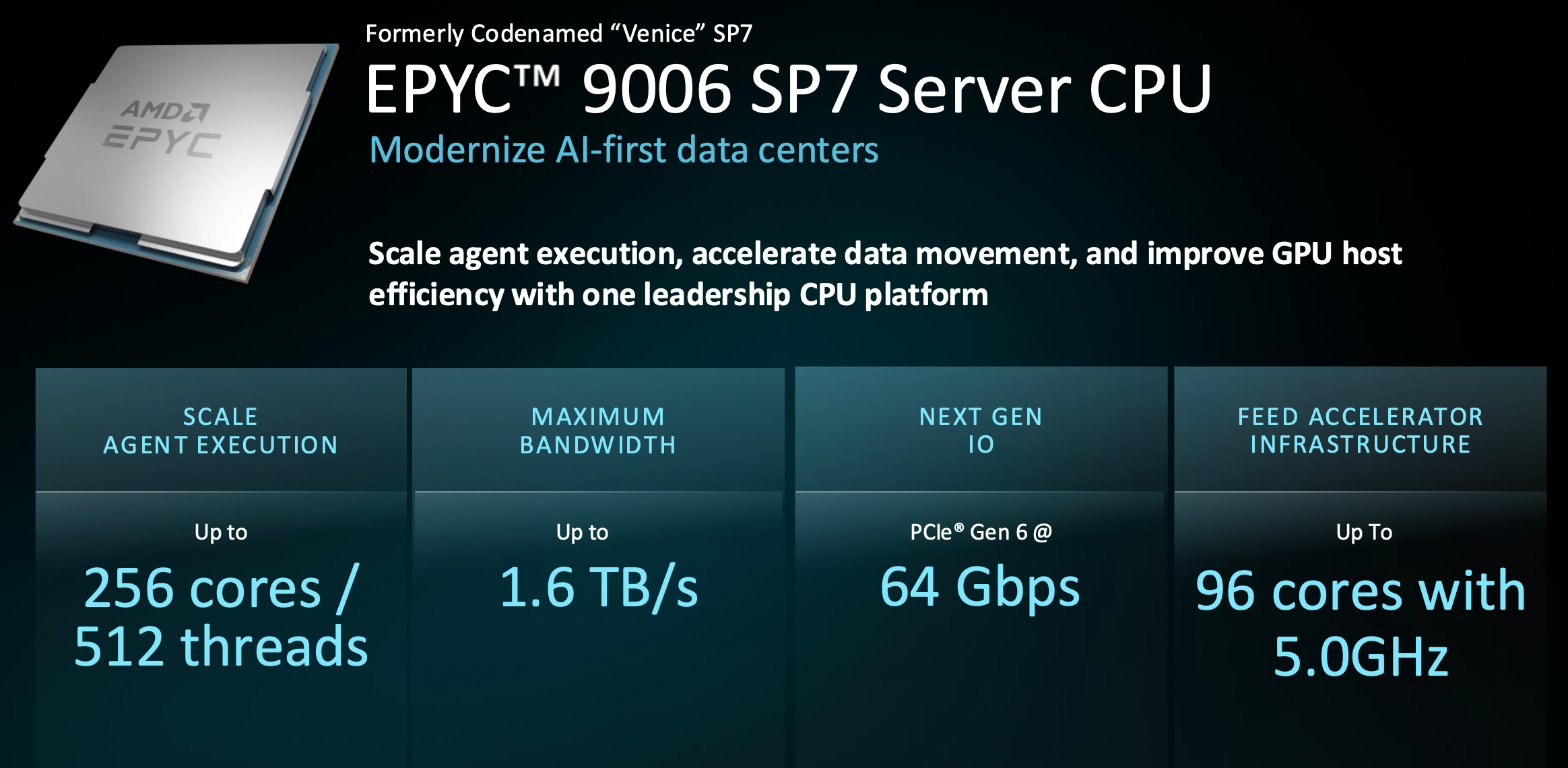
The naming carries over from Turin, so the first digit is the series, the middle digits track relative performance, the last digit is the generation, and the suffix tells you the bin: an F is a high-frequency part with a 5GHz boost, a P is single-socket only, and no suffix means a standard 1P or 2P part. One new label appears in the SP7 list: the EPYC 9G76, which is the host processor AMD builds into every Helios compute tray, now listed as an orderable part. AMD has also retired TDP as its power label; the product pages use “Default CPU Power,” which AMD defines as the total power consumed across the compute and I/O dies for the stated performance target, with a configurable range beside it.
SP7: 9 Parts From 64 to 256 Cores
Every SP7 part is a 1P or 2P processor with 16 channels of DDR5, rated at 1,024GB/s per socket with 8,000 MT/s RDIMMs and 1,638GB/s with 12,800 MT/s MRDIMMs, and AMD’s product pages list PCIe 6.0 x96 for the socket. Zen 6c carries core counts above 96; the standard Zen 6 core carries the 5GHz bins, and the 96-core tier is split three ways.
| Model | Cores / Threads | Base Clock | Max Boost | L3 Cache | Default CPU Power (Range) | Sockets | 1Ku Price |
|---|---|---|---|---|---|---|---|
| EPYC 9996 | 256 / 512 | 2.55 GHz | 4.1 GHz | 1024MB | 600W (400W-600W) | 1P / 2P | $14,904 |
| EPYC 9966 | 192 / 384 | 2.9 GHz | 4 GHz | 768MB | 600W (400W-600W) | 1P / 2P | $14,079 |
| EPYC 9846 | 168 / 336 | 2.85 GHz | 3.7 GHz | 768MB | 500W (320W-500W) | 1P / 2P | $13,114 |
| EPYC 9756 | 128 / 256 | 3.15 GHz | 4 GHz | 512MB | 500W (320W-500W) | 1P / 2P | $12,498 |
| EPYC 9G76 | 96 / 192 | 3.4 GHz | 4.8 GHz | 384MB | 500W (320W-500W) | 1P / 2P | $11,622 |
| EPYC 9686F | 96 / 192 | 3.4 GHz | 5 GHz | 384MB | 500W (400W-600W) | 1P / 2P | $11,434 |
| EPYC 9656 | 96 / 192 | 3.05 GHz | 3.7 GHz | 512MB | 400W (220W-400W) | 1P / 2P | $9,713 |
| EPYC 9586F | 64 / 128 | 3.75 GHz | 5 GHz | 384MB | 500W (400W-600W) | 1P / 2P | $9,701 |
| EPYC 9556 | 64 / 128 | 2.75 GHz | 4.3 GHz | 384MB | 300W (220W-300W) | 1P / 2P | $8,008 |
The 256-core EPYC 9996 sits at $14,904, the same figure AMD used in its July SPECrate comparison against Intel’s 128-core Xeon 6980P at $13,955, and it keeps 4MB of L3 per core with 1,024MB on the package. Each step down the density ladder costs less in total and more per core: the 192-core 9966 is $14,079, the 168-core 9846 is $13,114, and the 128-core 9756 is $12,498, which puts the flagship at $58 per core and the 9756 at $98. Two SKUs from the launch materials are worth noting. The 256-core EPYC 9956 at 400W, which AMD used in its rack-density endnotes in July, is not in the published list, and the 9G76 is, at $11,622 for 96 cores, a 4.8GHz boost, and a 320W to 500W range.
The 96-core tier is where the socket best shows its range. The 9656 is the standard part, at 400W with 512MB of L3 and a 3.7GHz boost for $9,713. The 9686F is the high-frequency host part AMD showcased in July, hitting 5GHz at 500W with a 400W to 600W range for $11,434. The 9G76 lands between them on price, with a 4.8GHz boost, a 320W floor to the F part’s 400W, and the same 384MB of cache. At 64 cores, the 9556 is the least expensive SP7 SKU at $8,008 and 300W, and the 9586F pairs the same core count and 384MB of L3 with a 3.75GHz base and 5GHz boost for $9,701.
SP8: 22 Parts From 8 to 128 Cores
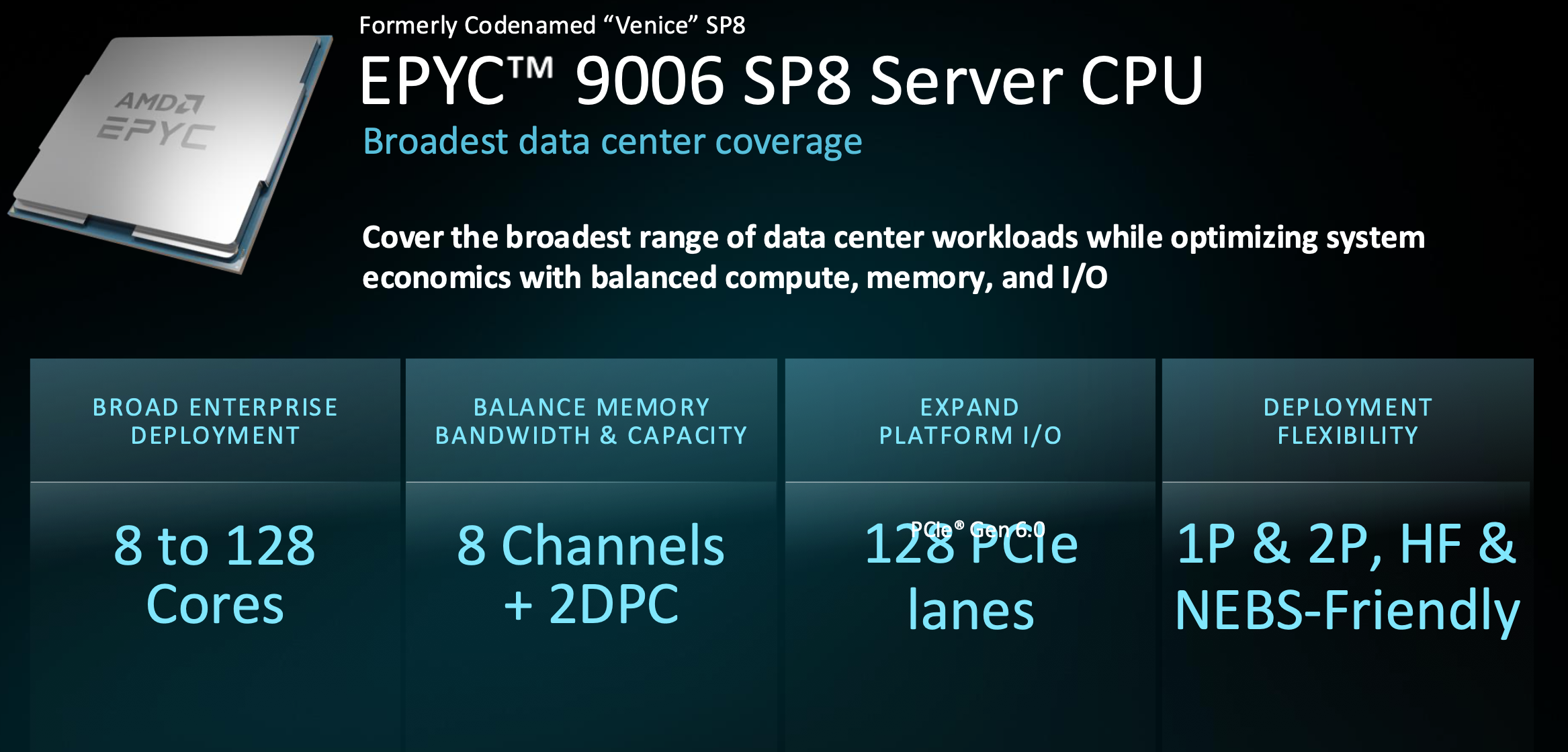
SP8 is the socket most enterprise buyers will see, and its list is more than twice as long. Every part carries 8 memory channels at 512GB/s with RDIMMs or 819.2GB/s with MRDIMMs, PCIe 6.0 x128, and a power range that starts as low as 130W. Six F parts run to 5GHz, five P parts are single-socket only, and the remaining 11 are standard 1P or 2P processors.
| Model | Cores / Threads | Base Clock | Max Boost | L3 Cache | Default CPU Power (Range) | Sockets | 1Ku Price |
|---|---|---|---|---|---|---|---|
| EPYC 9746 | 128 / 256 | 2.9 GHz | 4 GHz | 512MB | 400W (200W-400W) | 1P / 2P | $11,679 |
| EPYC 9736 | 128 / 256 | 2.7 GHz | 3.7 GHz | 256MB | 360W (200W-400W) | 1P / 2P | $10,639 |
| EPYC 9736P | 128 / 256 | 2.7 GHz | 3.7 GHz | 256MB | 360W (200W-400W) | 1P | $9,989 |
| EPYC 9676F | 96 / 192 | 3.1 GHz | 5 GHz | 384MB | 400W (200W-400W) | 1P / 2P | $10,116 |
| EPYC 9646 | 96 / 192 | 2.8 GHz | 3.7 GHz | 256MB | 300W (155W-300W) | 1P / 2P | $8,904 |
| EPYC 9646P | 96 / 192 | 2.8 GHz | 3.7 GHz | 256MB | 300W (155W-300W) | 1P | $8,001 |
| EPYC 9576F | 64 / 128 | 3.55 GHz | 5 GHz | 384MB | 400W (200W-400W) | 1P / 2P | $9,431 |
| EPYC 9536 | 64 / 128 | 3.25 GHz | 4 GHz | 256MB | 300W (155W-300W) | 1P / 2P | $7,837 |
| EPYC 9526 | 64 / 128 | 2.75 GHz | 3.7 GHz | 256MB | 220W (130W-220W) | 1P / 2P | $7,123 |
| EPYC 9536P | 64 / 128 | 3.25 GHz | 4 GHz | 256MB | 300W (155W-300W) | 1P | $6,595 |
| EPYC 9476F | 48 / 96 | 3.65 GHz | 5 GHz | 192MB | 330W (200W-400W) | 1P / 2P | $6,695 |
| EPYC 9456 | 48 / 96 | 3.2 GHz | 3.7 GHz | 256MB | 265W (155W-300W) | 1P / 2P | $5,252 |
| EPYC 9456P | 48 / 96 | 3.2 GHz | 3.7 GHz | 256MB | 265W (155W-300W) | 1P | $4,628 |
| EPYC 9376F | 32 / 64 | 3.8 GHz | 5 GHz | 192MB | 285W (200W-400W) | 1P / 2P | $4,849 |
| EPYC 9356 | 32 / 64 | 3.6 GHz | 4.5 GHz | 192MB | 250W (155W-300W) | 1P / 2P | $3,789 |
| EPYC 9336 | 32 / 64 | 3.15 GHz | 3.7 GHz | 128MB | 195W (130W-220W) | 1P / 2P | $3,320 |
| EPYC 9356P | 32 / 64 | 3.6 GHz | 4.5 GHz | 192MB | 250W (155W-300W) | 1P | $2,795 |
| EPYC 9276F | 24 / 48 | 3.8 GHz | 5 GHz | 96MB | 230W (200W-400W) | 1P / 2P | $3,512 |
| EPYC 9256 | 24 / 48 | 2.85 GHz | 4.5 GHz | 96MB | 190W (130W-220W) | 1P / 2P | $2,501 |
| EPYC 9176F | 16 / 32 | 3.9 GHz | 5 GHz | 192MB | 200W (200W-400W) | 1P / 2P | $3,787 |
| EPYC 9116 | 16 / 32 | 2.85 GHz | 4.5 GHz | 48MB | 160W (130W-220W) | 1P / 2P | $1,200 |
| EPYC 9016 | 8 / 16 | 3.05 GHz | 4.8 GHz | 48MB | 130W (130W-220W) | 1P / 2P | $700 |
The top of the SP8 stack overlaps the bottom of SP7 on core count but undercuts it on price. The 128-core 9746 is $11,679 with 512MB of L3 at 400W, against $12,498 for the 128-core SP7 9756, and the 96-core 9646 is $8,904 at 300W against $9,713 for the SP7 9656; the difference buys the bigger socket’s double memory bandwidth. The 128-core 9736 drops to 256MB of L3 and a 3.7GHz boost for $10,639, and its single-socket twin, the 9736P, is $9,989.
The P discount widens as the parts get smaller. At 128 cores the single-socket version saves 6%, at 96 cores 10%, at 64 cores 16%, at 48 cores 12%, and at 32 cores the 9356P is $2,795 against $3,789 for the 9356, a 26% cut for giving up the second socket. The F parts pay the opposite premium: the 64-core 9576F is $9,431, $1,594 over the standard 9536, for a 5GHz boost, 384MB of L3, and a 400W rating. The most curious part of the list is the 16-core 9176F, which carries 192MB of L3, 12MB per core, at $3,787, the profile of a CPU built for per-core software licensing, where cache per thread matters more than thread count. At the bottom, the 8-core 9016 is $700 at 130W, and the 16-core 9116 is $1,200.
What Changed Since July
Two details in the published pages update what AMD said in July. AMD’s launch deck listed PCIe Gen 6 as “up to 128 lanes (1P)” for the family; the SP8 slide claimed the full 128, and the SP7 slide gave no lane count at all. The processor pages now put numbers on both sockets: every SP7 part is listed at PCIe 6.0 x96, and all SP8 CPUs at x128.
The second detail is the 400W EPYC 9956, the 256-core CPU AMD used in its rack-density endnotes in July, which has no product page yet; either it arrives later, or the density case now rests on the 600W 9996. AMD’s footnote says the list is subject to change, so that one may resolve before SP7 systems ship. Our earlier coverage of the first Venice platforms from Giga Computing, ASUS, and Supermicro has the system side; Giga Computing expects SP7 systems to ship with AMD’s November launch and SP8 systems to follow in March 2027. We’ve also seen plenty of pre-production units from others; Dell, for instance, showed early designs at the AMD event and later at DTW.



 Amazon