

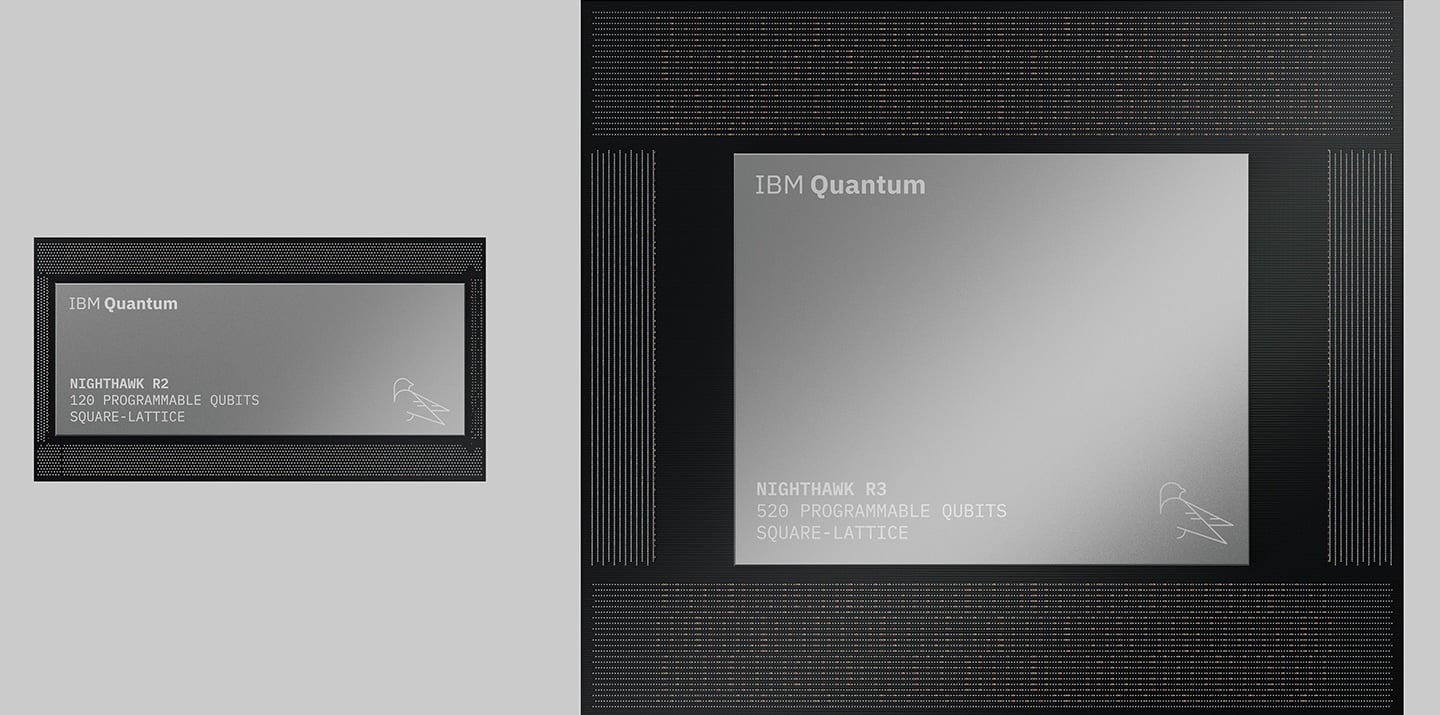
IBM has announced Nighthawk r3, its next quantum processor, designed to run 10,000 quantum operations accurately across 520 programmable qubits. The chip carries 2,034 physical qubits and adds 10 chip-to-chip interconnects, and IBM plans to link two of them into a single 1,040-qubit system in 2027. That is 4.3 times the programmable qubit count of the current Nighthawk r2 and a third more operations per circuit. IBM has not given an availability date for r3 beyond that 2027 plan.
Nighthawk r3 Architecture and Interconnects
Nighthawk r3 keeps the square-lattice connectivity and fast operations of Nighthawk r2, which has 120 programmable qubits out of 458 physical. The new element is the interconnect: r3 has 10 l-couplers, IBM’s term for the chip-to-chip links that join processors into larger systems. Modular scaling of this kind runs through IBM’s roadmap, and the company says Starling, the fault-tolerant system it plans for 2029, will need more than 100 l-couplers working together.
IBM linked two Nighthawk r1 processors through four l-couplers this year and measured 99 percent average quantum state transfer fidelity, with a best result of 99.3 percent, against a 99.9 percent target. The company also joined two cryogenic modules into one system for the first time, and that system reached operating temperature in under five days and cooled below 15 millikelvin. The 1,040-qubit system planned for 2027 depends on both results holding at r3 scale.
“Useful quantum computing hinges on whether results can be delivered with accuracy and speed; both are fundamental,” said Jay Gambetta, Director of IBM Research and IBM Fellow. “Nighthawk is already showing us what that looks like today. As we scale this architecture to larger and more powerful quantum computers, the capabilities of quantum computation will reach new levels as we integrate more closely with classical resources and march ahead to fault tolerance.”
Nighthawk r2 Workload Results
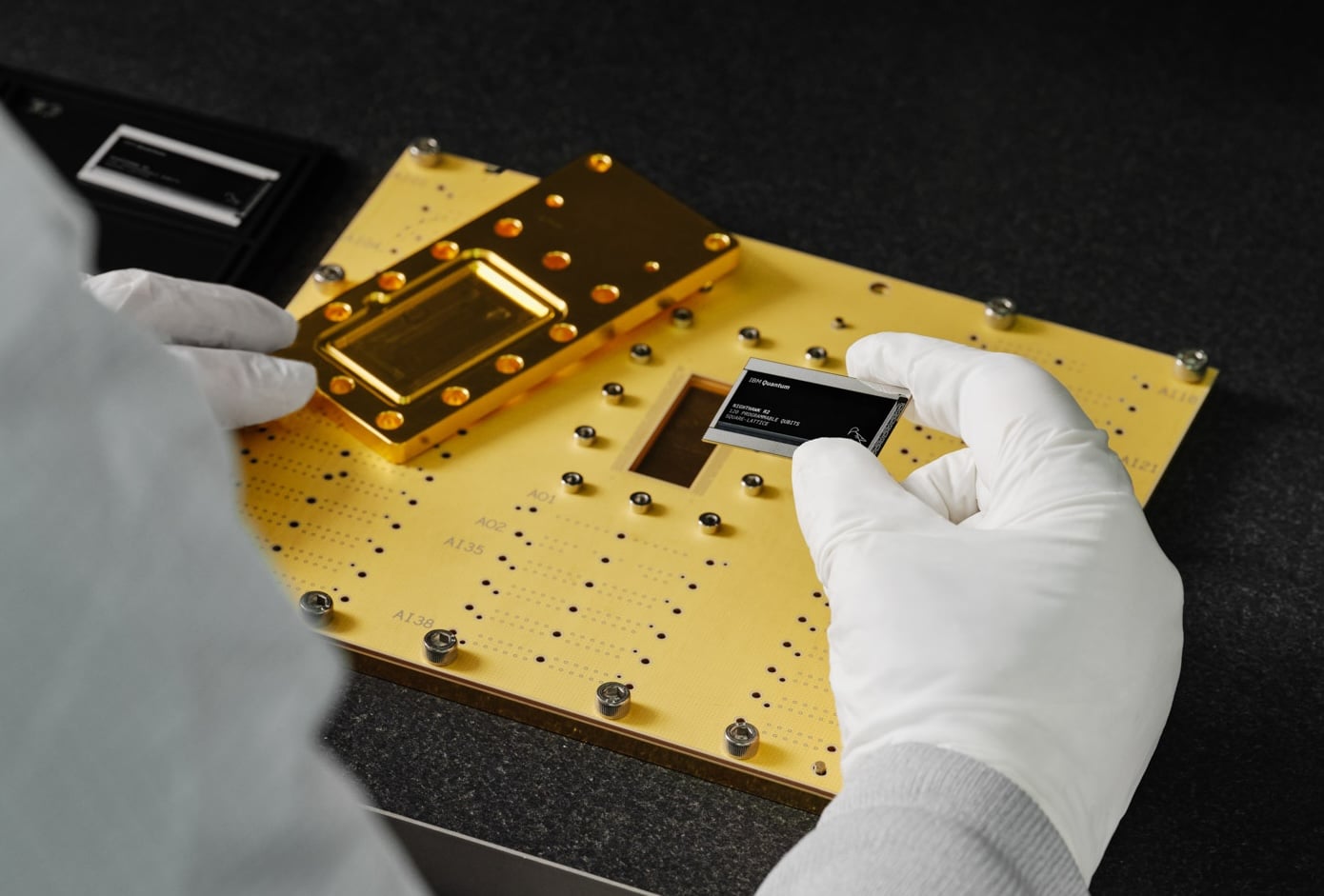
IBM says Nighthawk r2 delivers up to 100,000 samples per second, a 25x throughput gain over IBM Quantum Heron, and supports accurate computations with more than 7,500 quantum operations across its 120 qubits. Speed matters because each circuit run returns one sample, and the applications IBM describes need millions to billions of them. A fast qubit reset, which IBM puts at a 100kHz rate, shortens the time between runs.
Clients and partners, including E.ON, Algorithmiq, and Q-CTRL, have run 34 billion circuits on Nighthawk r2 and reported speedups of up to 19x over earlier IBM processors, according to IBM. E.ON reported a 15x speedup on a quantum machine learning workload for energy grid optimization. IBM measured 12x on an experiment with Oak Ridge National Laboratory that simulated magnetic materials and produced results consistent with neutron scattering experiments. Both figures are relative to earlier work on Heron.
An Algorithmiq experiment that simulates a heterogeneous quantum material, first run on Heron as part of the quantum advantage results IBM and its partners published earlier, now runs 8 times faster on Nighthawk r2. IBM says the r2 version is also harder to reproduce classically, with leading tensor-network methods needing an estimated 240 times more memory for comparable accuracy. These are vendor and partner results, and we did not run or audit them.
Classical Compute Integration
IBM Quantum Platform now offers HPC and classical compute alongside the quantum hardware in one managed environment, and users can connect quantum workflows to outside classical systems ranging from a laptop to a supercomputer. IBM delivers this as managed workflows in IBM Quantum Functions, the stack formerly called Qiskit Functions, with high-memory and GPU-accelerated compute, parallel parameter sweeps, persistent storage, and usage-based billing. Quantum workloads depend on classical systems for error mitigation, noise learning, and post-processing, and IBM expects that demand to grow as circuits scale.
In early use, IBM and RIKEN scientists ran their original sample-based quantum diagonalization workflow about 5 times faster while performing 100 times more computations than in the original study. Cleveland Clinic and RIKEN used the platform to process roughly 608 million samples for modeling biologically relevant structures, which IBM says was 33 times faster than running without workflow automation.
The platform also exposes pulse-level controls for quantum error correction research, covering operation timing, faster qubit reset, and measurement readout. That work ties into the co-design platform IBM built with Oak Ridge National Laboratory and AMD, which places Nighthawk beside ORNL’s Umbra HPC system and its AMD Instinct MI355X GPUs and 5th Gen AMD EPYC CPUs so researchers can develop error correction across quantum and classical hardware together.


 Amazon