

LiquidStack announced the general availability of its GigaModular coolant distribution unit platform, targeting high-density AI and HPC deployments requiring scalable liquid-cooling infrastructure. The system introduces a modular architecture that aligns with the requirements of the NVIDIA Vera Rubin platform. It supports deployments ranging from initial buildouts to multi-megawatt-scale environments, with validated capacity now expanded to 14 MW.
The GigaModular platform is built on a pay-as-you-grow model that allows operators to expand cooling capacity as compute capacity grows incrementally. This approach reduces the need for large upfront infrastructure investments and avoids disruptive redesigns as rack densities increase. LiquidStack positions the platform for environments where rapid AI cluster expansion is expected, and where cooling infrastructure must keep pace with evolving thermal profiles.
Modular Cooling for High-Density AI Environments
The CDU platform is designed to address the increasing thermal demands of modern AI systems, including both merchant GPU platforms and custom hyperscale silicon. It supports a range of application temperature profiles, giving operators flexibility as hardware architectures and cooling requirements evolve.
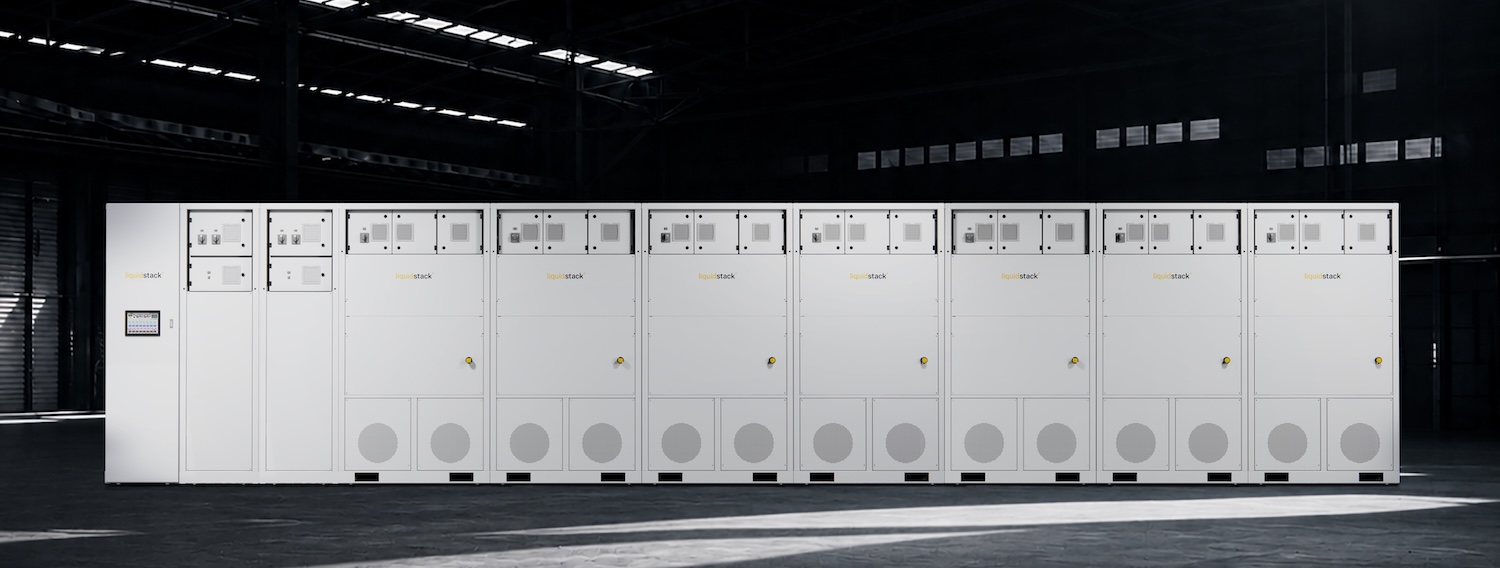
At a system level, GigaModular aggregates cooling capacity into coordinated modules rather than deploying isolated CDU units. This enables centralized control and management of the cooling infrastructure, reducing operational overhead and improving efficiency in large-scale deployments. The architecture also supports flexible fluid distribution, allowing integration into different facility layouts and rack configurations without extensive redesign.
LiquidStack emphasized that centralized controls simplify operations by reducing redundant systems and providing a unified management layer. This is particularly relevant in AI data centers where cooling infrastructure is increasingly complex and tightly coupled with compute performance and uptime requirements.
Deployment Flexibility and Lifecycle Integration
The platform is designed for phased deployment. Operators can deploy initial capacity and expand in multi-megawatt increments as demand increases. This aligns with how AI infrastructure is typically built, where clusters are added over time rather than deployed all at once.
GigaModular is also integrated into Trane Technologies’ broader thermal management portfolio, extending support across deployment, monitoring, and lifecycle services. This integration provides access to global service capabilities, which may be important for enterprise and hyperscale operators managing geographically distributed data centers.
Validation and Availability
First introduced in June 2025 with a 2.5 MW to 10 MW per-unit range, the GigaModular CDU platform has since completed multi-module integration and full load testing, with LiquidStack validating performance up to 14 MW and achieving ETL certification, indicating compliance with applicable safety and performance standards. That expansion from a 10 MW ceiling to 14 MW of validated capacity is the core of this release, paired with the move to general availability.
With commercial availability now underway, early orders suggest growing demand for liquid cooling systems that can scale with next-generation AI infrastructure. As GPU power densities continue to rise, modular CDU platforms such as GigaModular are becoming a core component of data center design, letting operators balance performance, efficiency, and deployment agility. LiquidStack will showcase GigaModular at the Datacloud Global Congress in Cannes, June 2 through 4, at booth #109, featuring live VR demonstrations of the platform.


 Amazon