

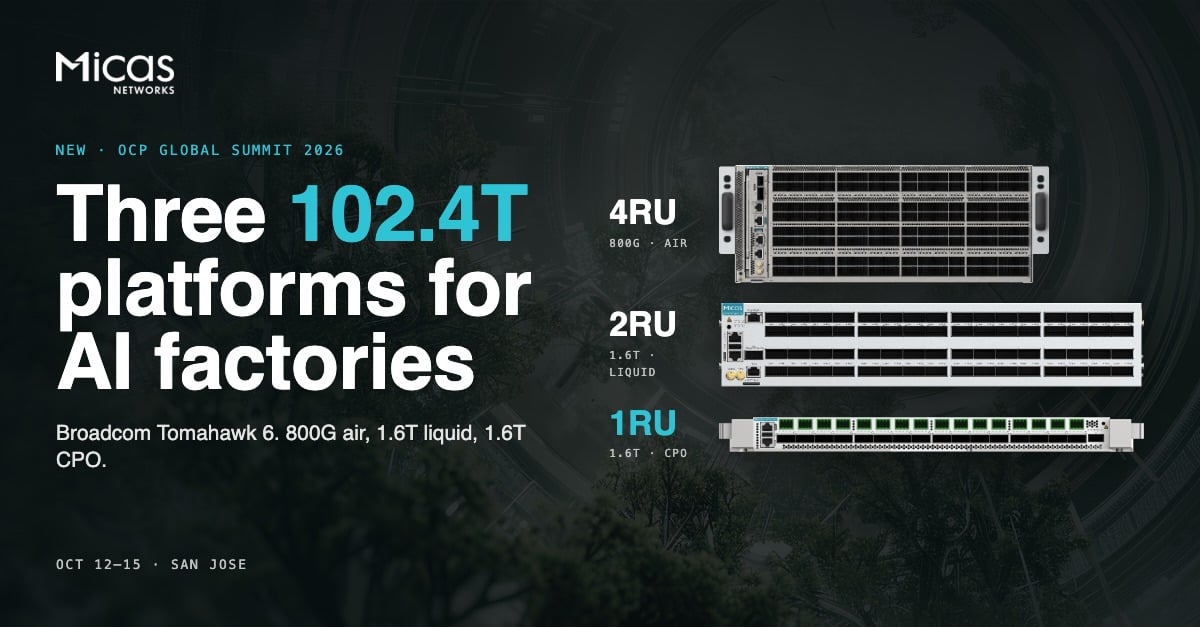
Micas Networks announced three 102.4Tb/s Ethernet switches today, all built on Broadcom Tomahawk 6 and all running SONiC: a 4RU air-cooled switch with 128 ports at 800G, a 2RU liquid-cooled switch with 64 ports at 1.6T, and a 1RU co-packaged optics switch on Broadcom’s Tomahawk 6-Davisson. The company is demonstrating the 4RU system at the OCP Global Summit in San Jose this week and previewing the other two. Production of the two pluggable-optics switches is scheduled for Q4 2026, and the CPO switch follows in Q1 2027.
Three Tomahawk 6 Switches, One Capacity
The M2-W6950-128OC-FA is the air-cooled 4RU model, with 128 OSFP ports at 800G on the BCM78910 Tomahawk 6P ASIC. Micas built it for high-radix AI fabrics in standard 19-inch racks, and it is the only one of the three with working hardware on the show floor. For an operator with 800G optics already in inventory, it is the direct route onto Tomahawk 6 with no change in cooling or transceivers, and it is the first of the three to go into production in Q4 2026.
The M2-W6951-64HC-CP reaches the same 102.4Tb/s in 2RU with 64 OSFP ports at 1.6T and liquid cooling, which Micas is aiming at dense liquid-cooled AI racks. Only the mechanical design is at OCP this week, with production also scheduled for Q4 2026. The M2-W6950-64X3-DR8-CP08-DC is the CPO switch, a 1RU system with 64 1.6T MMC DR8 optical interfaces on 200G SerDes and the Tomahawk 6-Davisson architecture. Micas is showing an early preview of it and plans production in Q1 2027.
“AI infrastructure operators should be able to choose how they build, scale, and operate their networks,” said Andrew Qu, CEO of Micas Networks. “By bringing Broadcom Tomahawk 6 pluggable and Davisson CPO systems into one portfolio, Micas is providing a practical path from 800G to 1.6T while preserving the openness customers need.” Micas positions the three as a single path from 800G to 1.6T and on to CPO, all on SONiC, as an alternative to a closed, vertically integrated networking stack.
Why a CPO Switch From Micas Carries Weight
Micas is a small vendor next to the switch OEMs, so the Broadcom relationship matters quite a bit, and the Davisson switch is its second generation of Broadcom CPO hardware. The company began building CPO systems in 2023 and was the first system vendor to commercialize a switch on Broadcom’s Tomahawk 5-Bailly CPO platform, the 51.2T generation that Micas says is now in volume production. Broadcom introduced Tomahawk 6-Davisson a year ago, and Micas is the first switch maker we have seen attach a part number and a production quarter to it. Micas owns and operates its factory in Malaysia and lists Broadcom and AMD as silicon partners.
“Co-packaged optics will play an increasingly important role as AI networks move to higher bandwidth and greater scale,” said Manish Mehta, vice president of marketing and operations in Broadcom’s Optical Systems Division. “Micas has built valuable system-level experience commercializing CPO, beginning with Tomahawk 5-Bailly and now extending to Tomahawk 6-Davisson.” Hasan Siraj, vice president of product management for Broadcom’s Core Switching Group, added that Tomahawk 6 supplies the 102.4Tb/s the next generation of AI infrastructure needs and that Micas’s 800G and 1.6T platforms give customers a way to scale while keeping control of their network architecture.
Most of the optics news at this OCP has been about getting more bandwidth through the front panel, from NVIDIA and Cisco’s USFP module on the pluggable side to NVIDIA’s Spectrum-X Photonics on the CPO side. Micas is offering the Broadcom and SONiC version of the same three options, which is the combination that white-box buyers and operators running their own NOS typically want, and it is doing so with production dates attached.
Those dates carry more weight than the demo, because Q4 2026 puts Tomahawk 6 in a white-box chassis at 800G, where optics are already shipping in volume, while the 1.6T system arrives as 1.6T pluggables ramp. The Davisson switch is perhaps the most interesting, since a 1RU CPO system from a vendor outside the typical hyperscaler supply chain is the first test of whether co-packaged optics will be sold to data centers that are not hyperscalers.



 Amazon