

NVIDIA has agreed to acquire Hugging Face for $12.93 billion, a transaction that would extend the company’s position from accelerated compute and AI infrastructure into one of the industry’s most widely used platforms for open models, datasets, and application development.
In an announcement published on the NVIDIA website, CEO Jensen Huang said the company plans to scale Hugging Face’s platform, strengthen its underlying infrastructure, and broaden access to AI development and deployment capabilities. The company said Hugging Face will retain its brand and continue operating as an open platform after the transaction.
Hugging Face has developed into a major distribution and collaboration layer for the open-model ecosystem. NVIDIA stated that the platform serves more than 18 million developers, researchers, and creators, hosting over 3 million models, 500,000 datasets, and 1 million applications. More than 200,000 companies use the platform to discover, evaluate, customize, and deploy AI capabilities.
The Neutrality Question
The central issue for existing Hugging Face users will be platform neutrality. NVIDIA said developers will continue to select their preferred models, frameworks, clouds, inference providers, and compute platforms. The company also said that NVIDIA hardware will not be required to build or deploy through Hugging Face, and that the platform will continue to support multi-cloud and multi-accelerator development.
That commitment matters because Hugging Face acts as a common layer across a fragmented AI stack. Enterprises use the platform to assess models, manage artifacts, access datasets, and move AI workloads between development and deployment environments. Maintaining support for non-NVIDIA hardware, alternative cloud providers, and models from other developers would preserve the flexibility that has helped make the platform foundational to the adoption of open AI.
Doubling Down on Open-Weight AI
The deal also reinforces NVIDIA’s investment in open-weight AI. Unlike proprietary AI services, open-weight models can be downloaded, adapted, and operated by organizations using their own infrastructure. NVIDIA positioned the model as a way for enterprises, public institutions, startups, and universities to apply advanced AI capabilities without training each model from scratch or relying exclusively on frontier-model APIs.
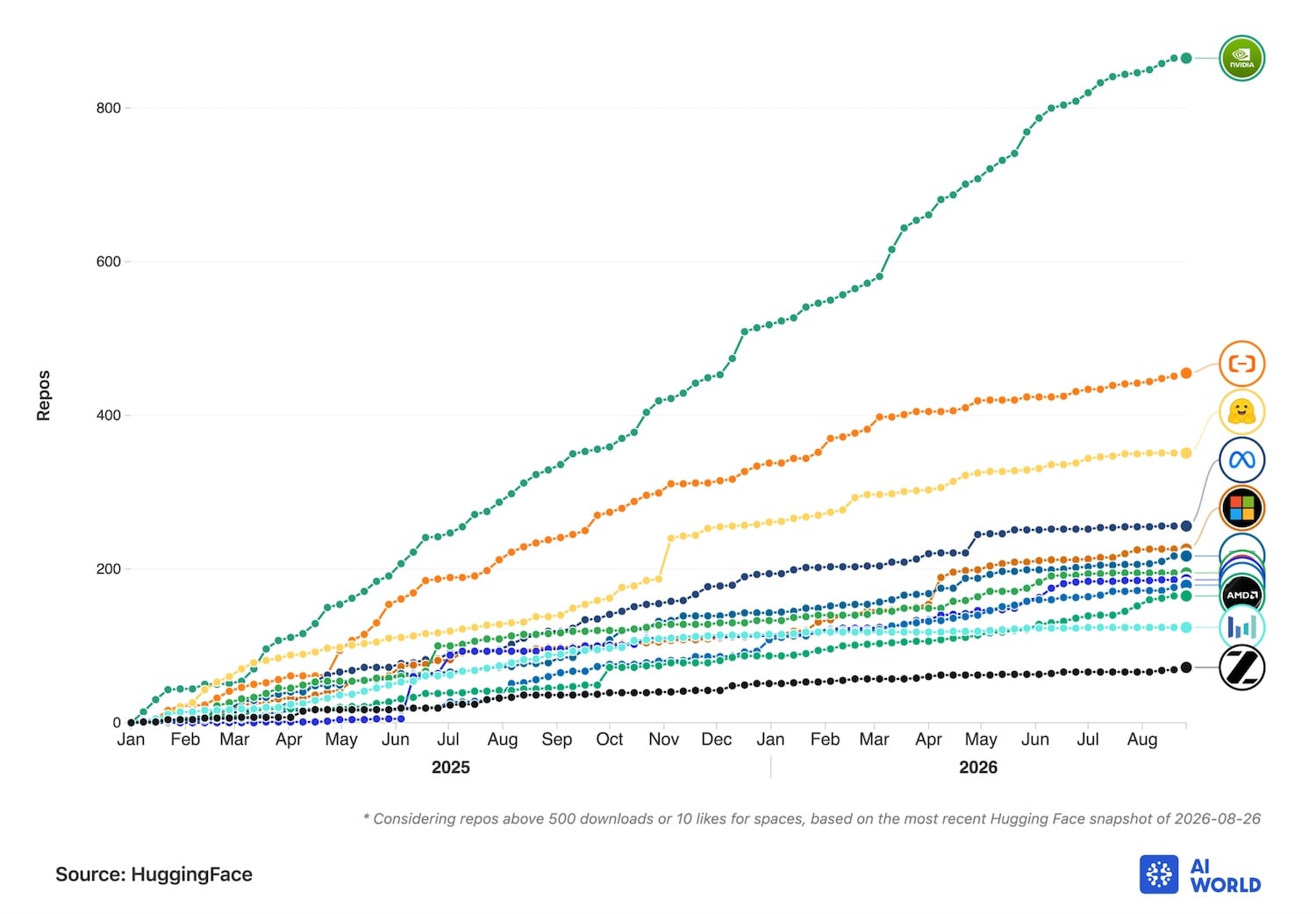
NVIDIA has already been an active contributor to Hugging Face. According to Huang’s post, NVIDIA has published more than 500 models and over 250 open datasets through the platform. NVIDIA characterized itself as the platform’s largest contributor of open models and data, and it was already an investor, having participated in Hugging Face’s $235 million funding round in 2023.
Deal Context and What Comes Next
Huang framed the deal in his post as a continuation rather than a takeover, crediting “Clem, Julien, Thomas and the team at Hugging Face” with having “built something remarkable,” and describing the platform as “a vibrant home for the open model developer community.” NVIDIA’s stated plan is to “scale Hugging Face’s platform, strengthen its infrastructure and expand access to AI,” with the Hugging Face team continuing on under its own brand. Huang closed the post on the ecosystem pitch: “Together, we will make AI more open, more capable and more accessible to people and institutions around the world.”
For NVIDIA, the acquisition provides control of a strategically significant developer channel at a time when AI infrastructure competition is moving beyond GPUs. The company’s 2020 acquisition of Mellanox helped establish its position in data center networking and full-stack infrastructure. Hugging Face would add a widely used platform at the model and developer layer, connecting NVIDIA more directly with organizations deciding which models, tools, datasets, clouds, and accelerators to use.
Neither company has given a closing timeline, and a transaction of this size will need regulatory sign-off. NVIDIA has said Hugging Face will remain open and hardware-neutral, a position that will be examined closely by the developer community and the enterprise customers that depend on the platform’s multi-vendor model.


 Amazon