

NVIDIA used IFA in Berlin to put Windows at the center of its local AI story. The company’s September 3 post covers a new Windows Agent framework for agents that run in the background under OS control, one-click Windows setups for OpenClaw and Nous Research’s Hermes Agent, a beta of an inference router called NVIDIA PAIR, a batch of new local models, and a firm October window for RTX Spark Windows PCs from Lenovo, Acer, and six other OEMs.
Something else happened this week that NVIDIA didn’t announce. After we applied the latest firmware update to a DGX Spark cluster in our lab this week, the fwupd device list picked up an entry we hadn’t seen on it before: Windows UEFI CA. That’s the Microsoft certificate a machine’s firmware uses to trust a Windows boot loader. Windows is almost here for Sparks, the #1 most requested feature for these devices.
What Changed in Our DGX Spark’s Firmware
The screenshot below is sudo fwupdmgr upgrade on one of our Sparks after this week’s update. The Embedded Controller, TPM, UEFI CA, and UEFI Device Firmware are all at the latest version. Further down, in the list of devices with no pending update, sits “Windows UEFI CA” alongside the BIOS DB key, the Key Exchange Key, SBAT, the UEFI dbx revocation list, and the ConnectX-7.
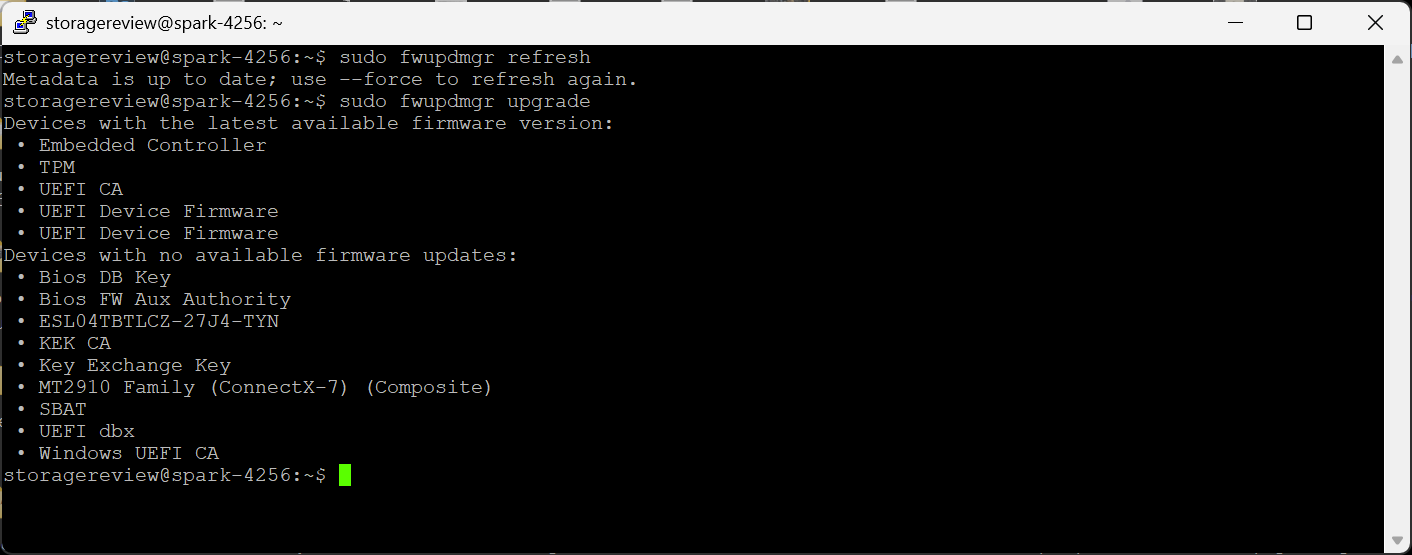
A quick primer on why that line matters. UEFI Secure Boot maintains a database of trusted certificates (.db) that the firmware uses to launch an operating system. Linux distributions boot through a shim signed by Microsoft’s third-party UEFI CA, which fwupd tracks as “UEFI CA.” Windows Boot Manager is signed under a different Microsoft certificate, the Windows production CA, which fwupd tracks separately as “Windows UEFI CA.” Since DGX OS only ever needed the third-party certificate, there was no reason for the Windows one to be in Spark’s db. After this week’s update, it is, and fwupd lists it with no update pending.
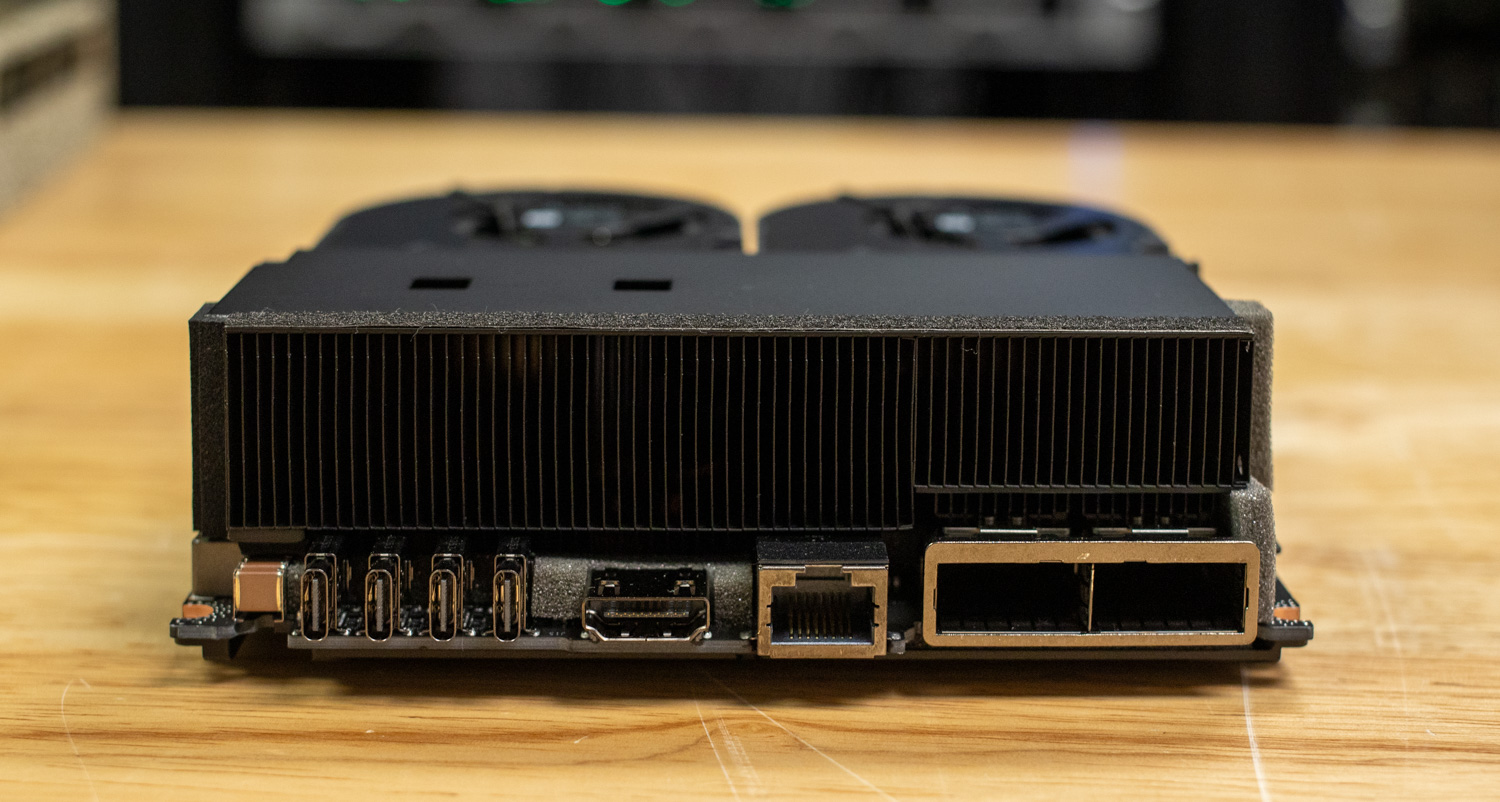
Booting Windows on Arm on this hardware still needs drivers for the Blackwell GPU, the Grace CPU’s platform devices, the ConnectX-7 NICs, and the rest of the board, plus an installer, and NVIDIA has said nothing about any of that for DGX Spark. What it has said is that the same GB10-class silicon will go into Windows PCs next month under the RTX Spark name, with a Windows stack that NVIDIA and Microsoft have been building together since Computex. Trusting Microsoft’s boot certificate in DGX Spark firmware is the kind of groundwork needed to make that happen.
Why we care: native Windows support was the single most common request we heard from people eyeing a Spark, and it is the main reason our AMD Ryzen AI Halo review hit where it did. The Halo supports Windows 11 or Linux on the same 128GB box; the Spark runs DGX OS exclusively. When Windows arrives on DGX Spark, the biggest gap in that comparison closes, and the machine’s audience widens well past AI developers who are comfortable living in Ubuntu.
RTX Spark Windows PCs Land in October
NVIDIA says RTX Spark PCs are “coming this October.” Lenovo showed the Yoga Pro 9n and the Yoga 9n 2-in-1 at IFA; Acer showed a compact desktop concept; and six more OEMs will ship in October. NVIDIA’s RTX Spark page populates the laptop list with the ASUS ProArt P16, Dell XPS 16, HP OmniBook X 14, Microsoft Surface Laptop Ultra, and MSI Prestige N16 Flip AI+, and includes desktops from Acer, ASUS, Dell, Gigabyte, HP, Lenovo, and MSI.
The spec sheet is the one NVIDIA outlined in June: laptops get up to a 6,144-core Blackwell RTX GPU, a 20-core Grace CPU, and up to 128GB of unified LPDDR5X in a 45W to 80W envelope, while the desktops are cut to 5,120 CUDA cores, 18 CPU cores, and 64GB at 140W. Both top out at 1 petaflop of FP4 AI performance and carry PCIe Gen5, HDMI 2.1b, and three DisplayPort 2.1b outputs. On the gaming side, NVIDIA lists Electronic Arts, Embark, Ubisoft, KRAFTON, NetEase, Riot Games, and Xbox as bringing titles to the platform. CyberLink will ship an AI PC mode for PhotoDirector 365 tuned for RTX Spark at launch using TensorRT-RTX and FP8.
Agents That Stay on the PC
The software portion of the post focuses on keeping agents local. NVIDIA describes a new Windows Agent framework that lets agents “run safely in the background under OS level control,” and it worked with Microsoft and OpenClaw, which it calls the largest AI project on GitHub at more than 380,000 stars, to simplify the OpenClaw Windows app setup on RTX GPUs with 24GB or more of VRAM. Nous Research’s Hermes Agent now offers one-click local model setup on Windows, with Linux support to follow, and Perplexity’s Portable Computer runs today on Linux with a 24GB-plus RTX GPU, with Windows support “coming soon.” NVIDIA’s pitch for all three is the same: complete workflows on the local machine, no cloud credits burned.
PAIR, Faster llama.cpp and vLLM, and a New Batch of Models
NVIDIA PAIR, for Personal AI Router, is a free, open-source tool that discovers compatible PCs on a local network and routes independent inference requests to whichever system has capacity; think of it as a homelab version of LLM-D. It works with Ollama and LM Studio, and the hardware list is broad: GeForce RTX 20 Series and newer, RTX PRO workstation GPUs back to Turing, DGX Spark, and Apple M4 or later Macs. The beta is now out for Windows, macOS, and Linux, with both a graphical and a terminal interface.
On raw inference, NVIDIA claims up to 1.9x higher llama.cpp throughput on a GeForce RTX 5090 from kernel optimizations and improved speculative decoding, and vLLM gains of 1.2x on the RTX PRO 6000 Blackwell and up to 1.4x on two-node DGX Spark clusters, all flowing through to LM Studio and Ollama. The model drop includes Nemotron 3.5 Lightning, a 30-billion-parameter model sized for RTX PCs, RTX PRO workstations, DGX Spark, and Jetson; Z.ai’s GLM-5.3-Flash multimodal MoE; Qwen3.8-Flash-Next and Qwen3.8-27B; LTX 2.5 and MiniMax-H3 for video generation; Meta’s 30B Muse Glimmer for coding and agentic work; and DeepSeek v4 Flash, a 284-billion-parameter MoE with 13 billion active parameters that NVIDIA says runs on a two-Spark cluster or a DGX Station.
We’ll keep an eye on fwupd. If a Windows path for DGX Spark opens up, the Spark sitting next to the Halo on our bench will be the first place we try it.



 Amazon