

ASUS is expanding its role in AI infrastructure, moving from individual AI servers to platforms for building, deploying, and operating entire AI factories. At AI Tech 2026 in Seoul, the company laid out a broader strategy that brings accelerated computing, networking, storage, deployment software, infrastructure management, and AI governance together under one platform.
That puts ASUS more directly alongside Supermicro and GIGABYTE, which are also expanding from server hardware into complete AI infrastructure platforms. The difference from a conventional server launch is that ASUS is extending its role into operations, with tools for infrastructure planning, resource management, MLOps, and governance covering the deployment lifecycle before and after the hardware is installed.
Storage is also an important part of their broader strategy, with new AI-native and object storage systems and an ecosystem that includes Samsung and WD alongside NVIDIA, AMD, Intel, IBM, Schneider Electric, Crusoe, Foxlink, and Aleria.
ASUS Takes AI Factory Planning Into Operations
ASUS is extending its involvement into the planning stage through the NVIDIA DSX Sim Blueprint, which can be used to create digital twins of proposed AI factories before the physical infrastructure is installed. Working with Schneider Electric, AVEVA, and IBM, the environment can model compute, networking, storage, power, cooling, and facility infrastructure during the design process.
Once the infrastructure is deployed, ASUS Control Center and ASUS Infrastructure Deployment Center handle deployment and infrastructure management. The ASUS AI software platform extends into day-to-day AI operations with Quota & Billing tools for resource management and an MLOps Portal for AI development and deployment workflows.
ASUS is also adding a governance layer that connects enterprise policies with AI services and autonomous agents. This extends the platform beyond monitoring the physical infrastructure and into how organizations manage access, resources, and AI workloads running on it.
At the rack level, the ASUS AI POD XA VR721-E3 is based on NVIDIA Vera Rubin NVL72. ASUS claims the system delivers 10 times the performance per watt of the previous generation. The company is also introducing the XA NR1I-E12LR and XA NR1I-E12L based on NVIDIA HGX Rubin NVL8 for AI training, inference, and post-training workloads.
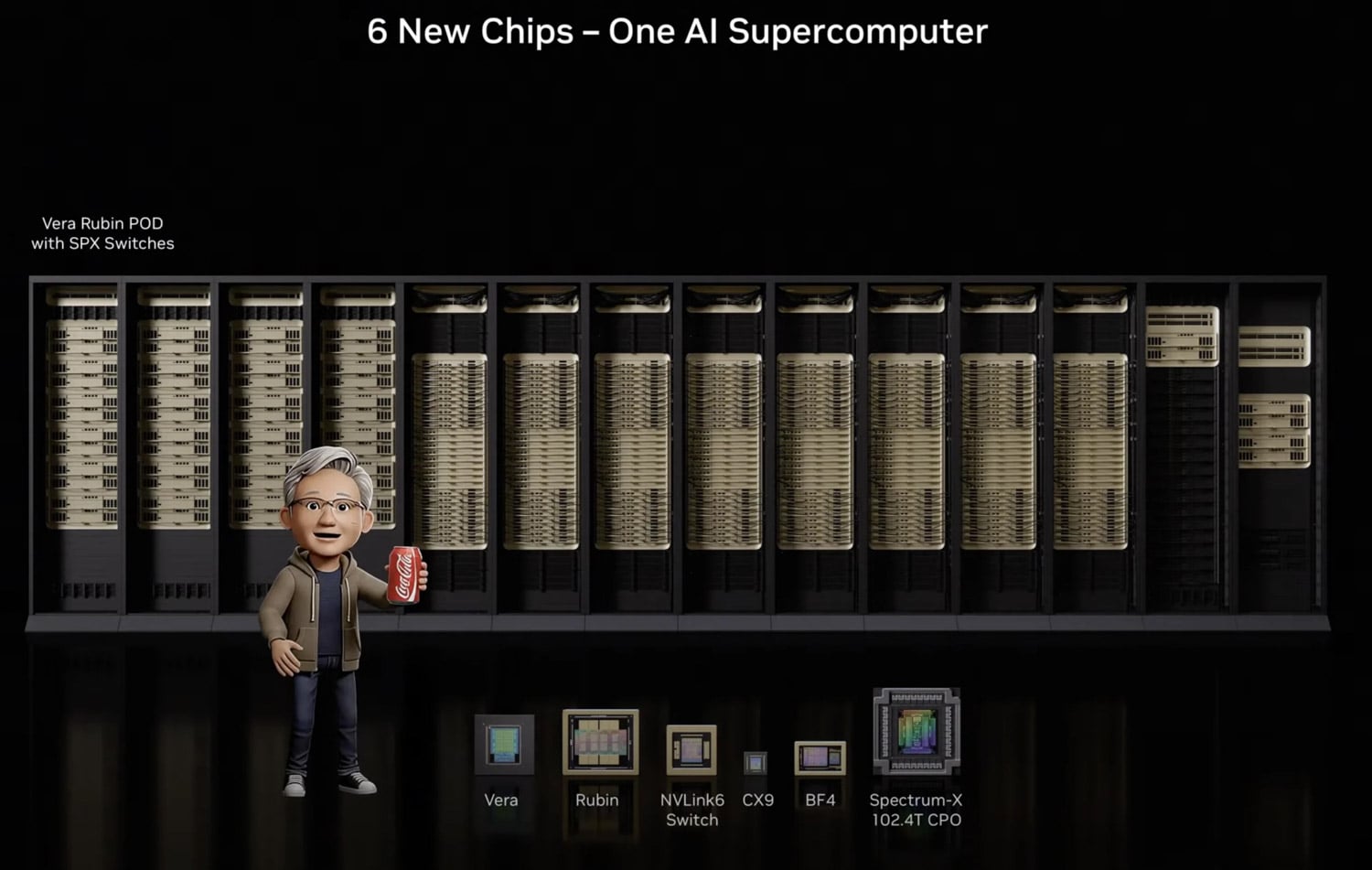
For agentic AI workloads, the 2U ASUS XA P2N-E2 uses the NVIDIA MGX architecture with two NVIDIA Vera CPUs and support for up to two dual-slot NVIDIA GPUs. ASUS lists agentic reasoning, data processing, and orchestration among the intended workloads for the system.
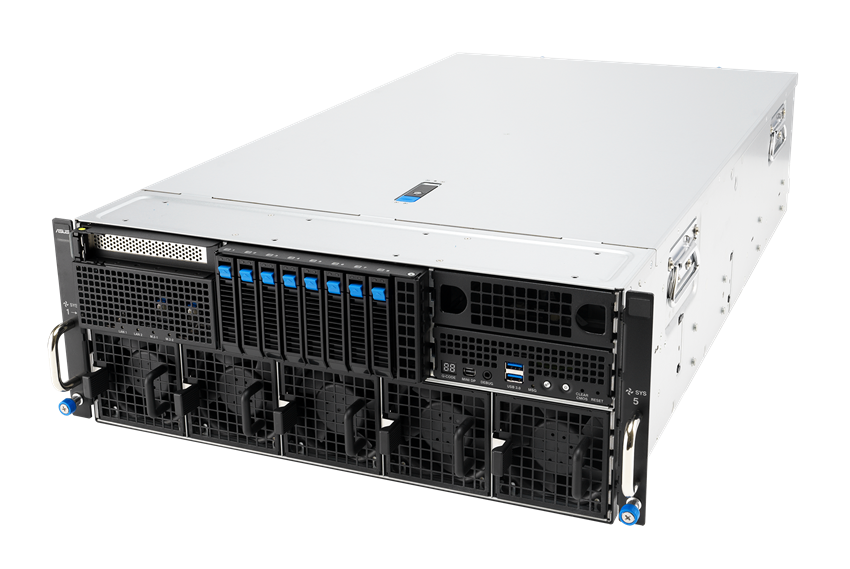
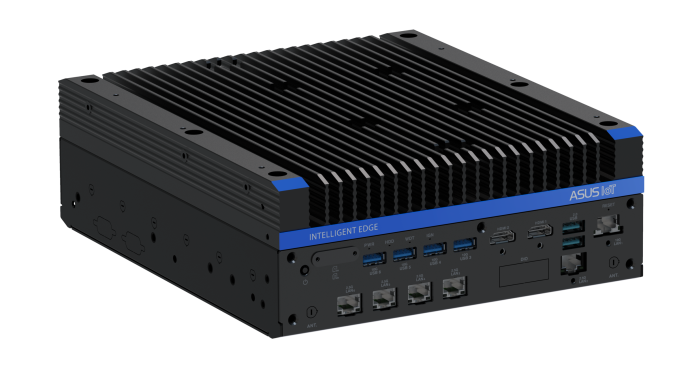
The ESC8000-E12P supports NVIDIA RTX PRO 6000 and RTX PRO 4500 Blackwell Server Edition GPUs for enterprise inference, vision AI, and visual computing. ASUS is also taking the NVIDIA platform to the edge with the PE3000N, which uses the NVIDIA Jetson Thor T5000 module for real-time inference, sensor fusion, robotics, and industrial automation.
Storage and Partners Broaden the AI Factory Platform
Storage is being integrated directly into ASUS’s AI factory platform. The UF920-E3-RS24 is based on the NVIDIA STX modular foundation for AI-native storage and is joined by the ASUS OJ340A-RS60 object storage system and VS320D-RS26N storage system.
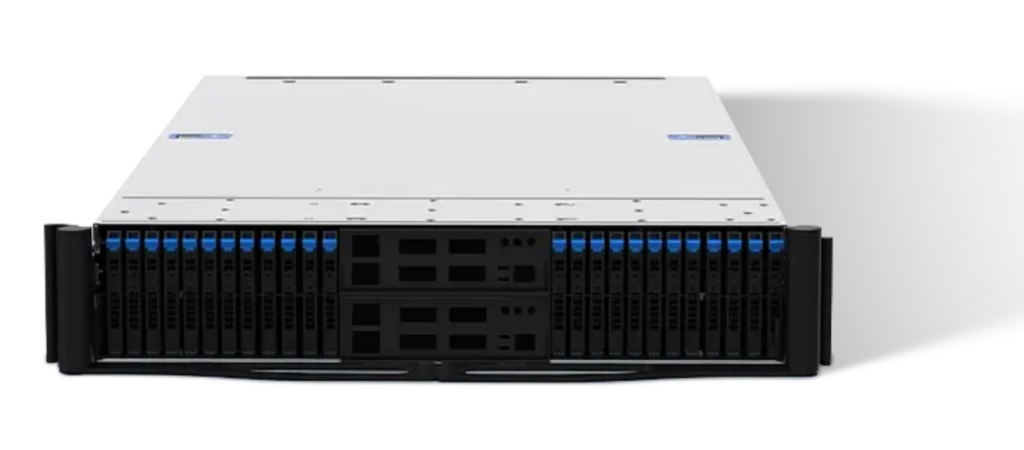
The systems are intended to address the capacity, availability, and data management requirements of AI pipelines, spanning AI-native storage, object storage, and broader storage infrastructure. This also brings storage into the same infrastructure strategy as ASUS’s compute, networking, deployment, and management products.
The partner roster also shows how far ASUS is extending its infrastructure strategy. Samsung and WD are both named storage partners, while NVIDIA, AMD, and Intel cover major compute platforms. IBM, Schneider Electric, Crusoe, Foxlink, Aleria, and others are involved across software, facilities, infrastructure, and deployment.
ASUS is positioning itself closer to large infrastructure providers that can supply more than compute servers, including storage, software, deployment tools, and operational management.
Intel and AMD Expand the Server Portfolio
NVIDIA isn’t the only compute platform involved in ASUS’s AI infrastructure plans. The company also showed new Intel and AMD systems covering AI, HPC, and more traditional enterprise workloads.
The RS700-E12-RS4U and RS720-E12-RS12U use Intel Xeon 6 processors, while the 6U XA P8I-E13A uses Intel’s next-generation Xeon processor platform with support for GPU acceleration.
On the AMD side, the RS720A-E14B-R32U and RS500A-E14B-R12U use AMD EPYC 9006 Series processors. ASUS recently expanded its EPYC 9006 server portfolio around AMD’s efficiency-focused SP8 socket, and these systems extend that platform into its broader AI infrastructure lineup.
The ESC8000A-E13P pairs AMD server hardware with AMD Instinct MI350P PCIe accelerators. ASUS is positioning the system for inference, agentic AI, and HPC workloads.
ASUS Extends AI Infrastructure to the Edge
ASUS also introduced the RUC-2000 series for industrial edge AI. The systems use Intel Core Ultra Series 3 processors and offer up to 180 AI TOPS, with ASUS targeting machine vision, video analytics, industrial automation, and in-vehicle applications. The rugged, fanless design is intended for environments where hardware may need to operate across wider temperature and voltage ranges and tolerate electrical noise.
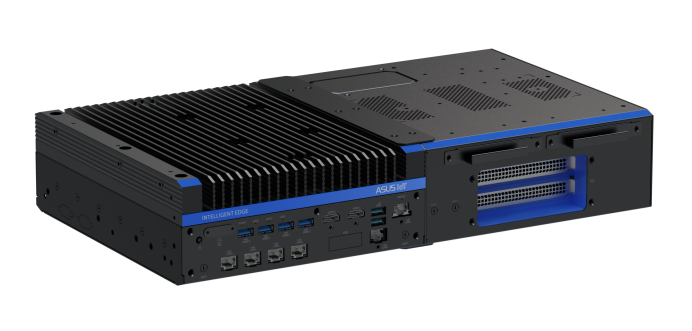
ASUS’s industrial edge portfolio extends the AI factory strategy to manufacturing, transportation, public safety, healthcare, and other environments where data is generated outside centralized infrastructure.
ASUS is effectively broadening its role from supplying the servers that run AI workloads to supplying more of the surrounding infrastructure. With Vera Rubin rack-scale systems, Intel and AMD servers, dedicated AI storage, edge hardware, digital-twin planning, management software, and governance tools, ASUS is covering more of the infrastructure required to build and operate an AI factory.
ASUS AI Infrastructure Availability
ASUS servers are available worldwide. Availability of individual systems and other products varies by region and local regulatory requirements, and ASUS directs customers to regional representatives for specific availability information.


 Amazon