

CoreWeave said on August 5 that it has signed a multi-year agreement with Solidigm for priority access to enterprise SSD capacity. Storage has become the second component after GPUs that an AI cloud has to contract for years in advance, and CoreWeave has now done for flash what cloud providers spent the first half of 2026 doing for DRAM.
What the Agreement Says, and What It Does Not
The disclosed terms amount to three things: the agreement is multi-year, it covers priority access to enterprise SSD capacity, and it is meant to keep storage scaling with customer demand on CoreWeave’s integrated AI cloud platform.
What both executives chose to talk about is telling. Sachin Jain, chief operating officer at CoreWeave, framed it entirely around supply certainty: the agreement “gives us priority access to the storage our roadmap depends on, allowing customers to focus on what they are building instead of the infrastructure underneath it.” Paul Palonsky, executive vice president and head of global sales at Solidigm, said that the agreement “reflects the confidence Solidigm has in CoreWeave’s growth and its position as a full-stack AI cloud provider.” CoreWeave’s own framing in the release is that storage has become a critical constraint in capacity planning as enterprise AI adoption accelerates and industry-wide storage supply tightens.
Why Flash Allocation Became a Scheduling Problem
The memory market explains the deal better than the press release does. TrendForce projects NAND flash contract prices rising 10 to 15 percent quarter over quarter in the third quarter of 2026, with conventional DRAM up 13 to 18 percent, and describes the DRAM market as extremely tight. Enterprise SSD supply is the one bright spot in that picture, improving as vendors shift capacity away from consumer segments. However, TrendForce still expects a clear NAND shortage across 2026, with meaningful capacity expansion unlikely before late 2027 or 2028.
Buried in the same forecast is the mechanism behind this announcement. TrendForce notes that price gains are moderating in part because long-term supply agreements now govern a portion of procurement, and its earlier take on the year was that cloud providers are willing to accept higher prices and sign LTAs to secure stable supply. An LTA is what a buyer signs when the binding constraint is allocation rather than price. CoreWeave is not trying to get cheaper SSDs; it’s just trying to be first in line.
The pattern is not confined to flash. Western Digital told investors last week that its hard drive long-term agreements now extend into calendar 2029 through 2031, which we covered in our look at WD shipping 40TB UltraSMR drives. On the supply side, SK hynix is committing KRW 100 trillion to its Cheongju fabs precisely because AI has pushed NAND demand past supply. Every layer of the storage stack is being contracted forward at once.
What CoreWeave Is Actually Buying
CoreWeave is large enough that a supply agreement is a major commitment on Solidigm’s side. First quarter 2026 revenue was $2.078 billion, up 111.6 percent year over year, against a revenue backlog of $99.4 billion as of March 31. The company spent $7.695 billion on property, equipment, and capitalized software in that quarter alone, guided full-year 2026 capital expenditures to a range of $31 billion to $35 billion, and crossed 1GW of active power with more than 3.5GW contracted. Storage is a small slice of that capex next to GPUs and buildings, but the absolute number is still large, and it has to arrive on the same schedule as everything else.
An AI cloud consumes enterprise SSD capacity in three places. Checkpointing during training writes enormous files at high frequency. Object storage tiers feed data to GPU nodes fast enough to keep them busy, which is the problem CoreWeave was addressing when it removed egress fees from data migration in its zero egress migration push. The third is newer and growing fastest: KV cache offload during inference.
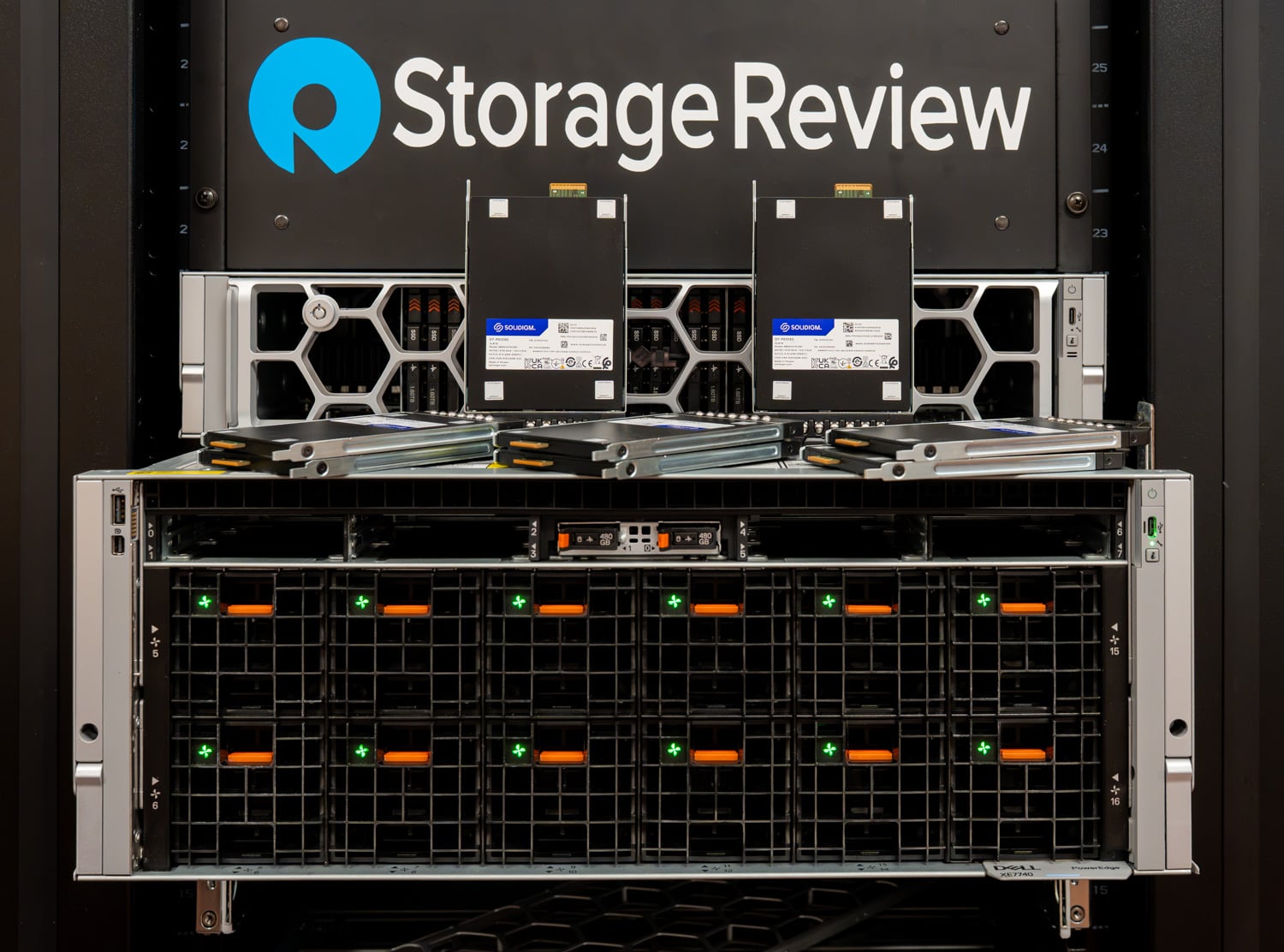
We have measured that last one directly on Solidigm hardware. In our testing of KV cache offload to flash, a Dell PowerEdge XE7740 with four NVIDIA RTX PRO 6000 Blackwell GPUs and eight Solidigm D7-PS1030 12.8TB drives cut worst-case time to first token on resumed sessions from 13.9 seconds to 3.2 seconds. It held roughly 30,000 tokens per second at sustained load, 2.2 times the VRAM-only baseline. Moving KV cache off VRAM onto flash converts a memory capacity ceiling into a storage capacity purchase. Every AI cloud that adopts it needs more SSDs than it did the year before, and that ramp isn’t slowing.
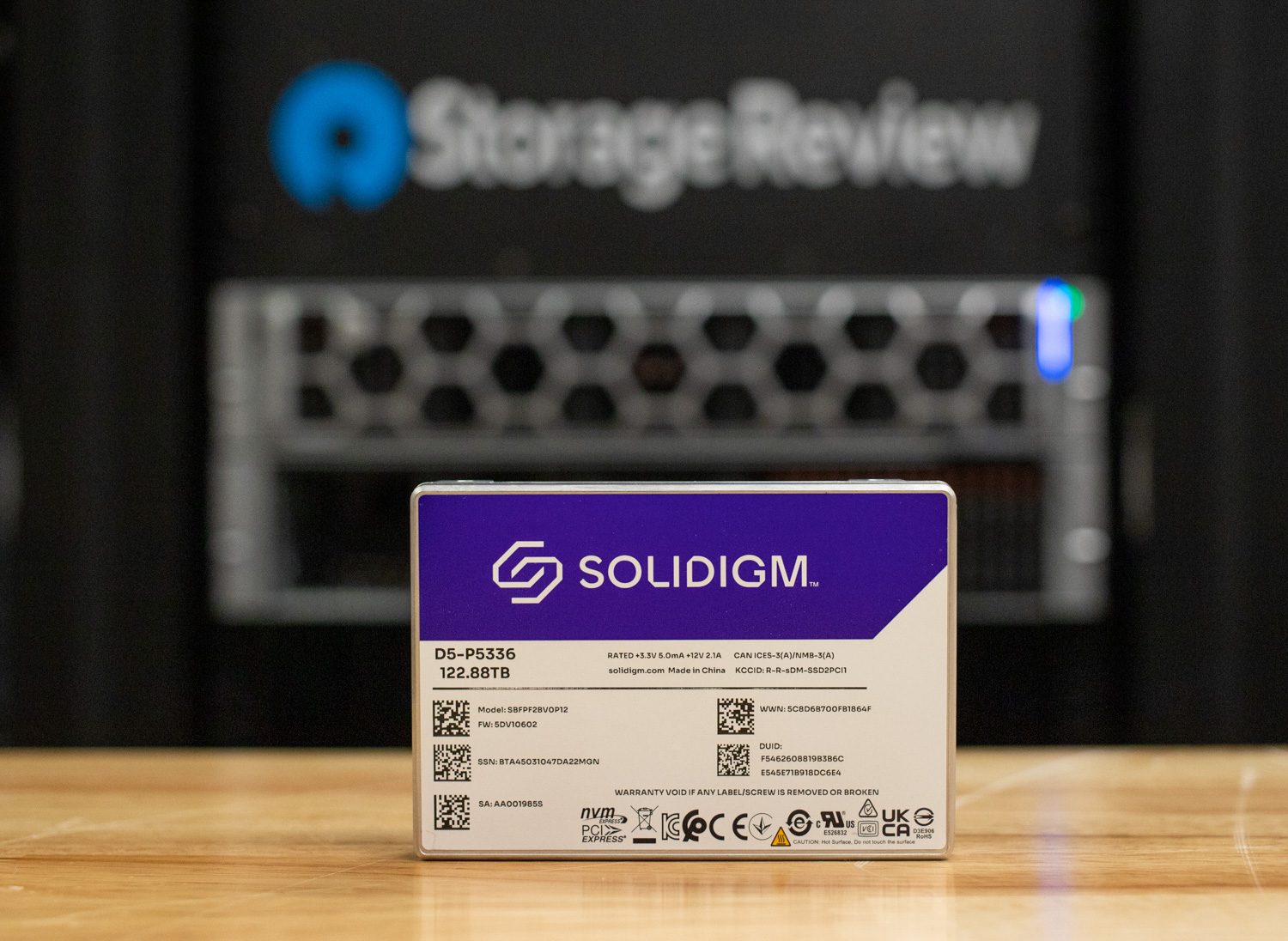
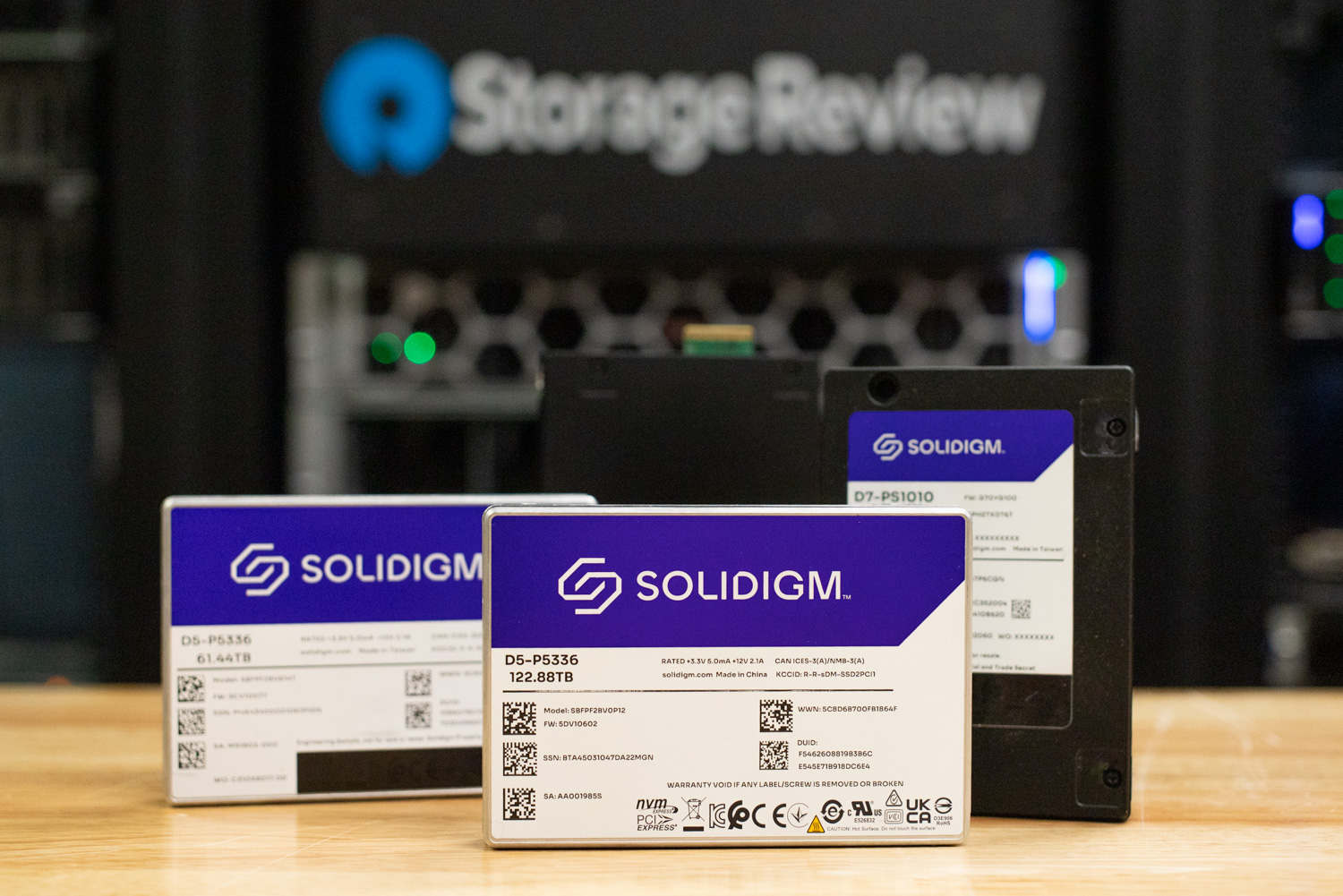
Density is the other half of the argument. Solidigm’s current flagship is the D5-P5336, a 122.88TB drive built on 192-layer QLC NAND, which we reviewed last year at 7GB/s sequential reads and 900,000 IOPS on 4K random reads, drawing 24W active with a 0.6 DWPD endurance rating. In a Dell PowerEdge R7725xd, that capacity point puts nearly 3PB in a single chassis. For an operator filling gigawatts of contracted power, the difference between 61.44TB and 122.88TB per bay is measured in racks, floor space, and switch ports, not just in dollars per terabyte.
Solidigm’s Side of the Timing
The same day CoreWeave published this release, the Korea Economic Daily reported that Solidigm was pursuing a pre-IPO capital raise ahead of a possible Nasdaq listing, with figures in the coverage ranging from roughly 5 trillion to 10 trillion won. SK hynix responded the next day in a regulatory filing, saying that its overseas subsidiary “is reviewing various measures to strengthen its competitiveness” but that “no matters have been determined as of the date hereof.” The company committed to disclosing details either when they are confirmed or within one month of that August 6 filing.
So the raise is unconfirmed, and the reported figures do not agree with each other. What is on the record is that SK hynix reorganized its wholly owned US NAND unit under a new California entity in January, with Solidigm described as the anchor asset of a $10 billion American AI investment vehicle, and that the company now has a self-imposed September deadline to say more. A marquee multi-year supply agreement with the highest-profile AI cloud on the market is a useful item to have on the sheet during a month like that. Neither company drew the connection, and we are not suggesting the announcement was timed to anything, but the sequence is worth considering when reading a release this light on specifics.
Solidigm has also said where its capacity ceiling is headed. Roger Corell, the company’s senior director of AI and leadership marketing, has stated publicly that Solidigm plans to ship 245TB-class drives before the end of 2026. That would match the density Micron reached with the 6600 ION, which we put through the lab in June at a quarter petabyte per drive bay and measured against hard drives in September. Solidigm does not pre-announce products, so there is no SKU or date beyond that statement.
What to Watch
Three things will show whether this release is a milestone or a placeholder. The first is whether either company ever attaches a number to it. Multi-year with no capacity, no term, and no value is a signal to customers and investors rather than a contract disclosure. If a figure surfaces later in a CoreWeave filing, it will be worth comparing against the language used here.
The second is whether the 245TB-class Solidigm drive ships on the stated timeline and whether CoreWeave is an early taker. Priority access matters most at the top of the capacity stack, where allocation is tightest, and the rack math changes the most.
The third is whether other AI clouds follow with named SSD supply agreements of their own. Power contracts are already standard disclosure for this class of operator. If flash allocation joins them, this announcement will signal the first of a pattern rather than a one-off. There is a nearer date than that, too: SK hynix has told regulators it will say more about Solidigm’s capital plans by early September, and whatever it discloses will set the context for how much weight this agreement was meant to carry.



 Amazon