

Supermicro announced an expanded line of Open Compute Project Accepted systems, racks, and rear door heat exchangers, all delivered through its Data Center Building Block Solutions (DCBBS) program and on display at booth B4 at the OCP Global Summit in San Jose through October 15. The common element is the rack: the 21-inch ORv3 and the wider ORW both replace per-server power supplies and cabling with a centralized 48V DC busbar, which frees the space a conventional server spends on redundant power supplies for compute and cold plates.
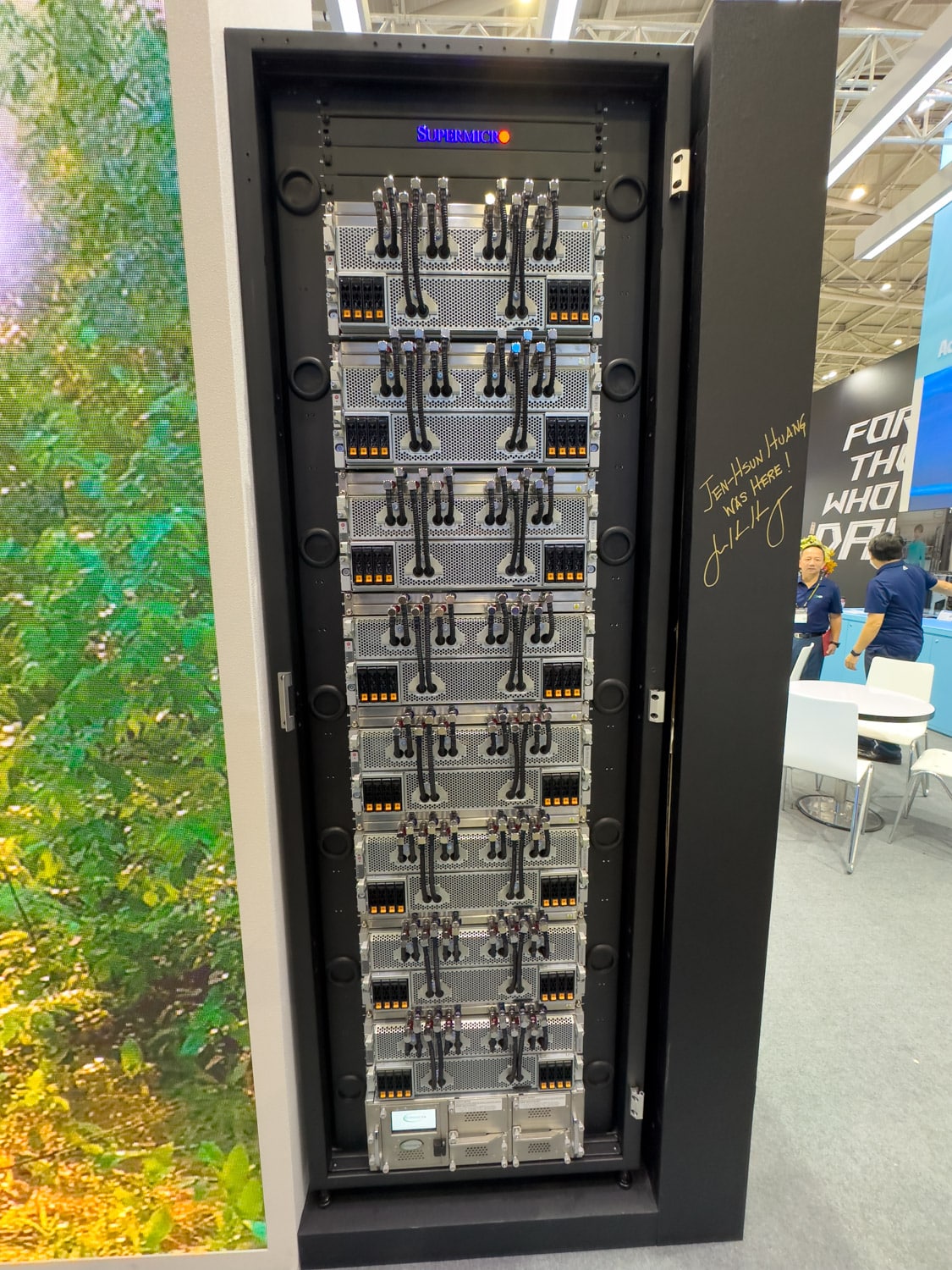
Centralized 48V Power and Multi-Stage Liquid Cooling
The ORv3 rack series comes in 44OU and 48OU heights with integrated busbars, a certified static load of 5,000 lb (2,268 kg), and a liquid-cooling-ready mechanical design that now includes MGX 1.2 (Gen 3) racks. Two propylene glycol coolants cover the technology cooling system loop, DLC-1 for standard liquid-cooled racks and an ultra-low-conductivity DLC-2 fluid for specialty cold plates, and both align with the OCP PG25 base specification so racks, in-rack CDUs, RDHx units, and cold plates run as a single cooling stack.
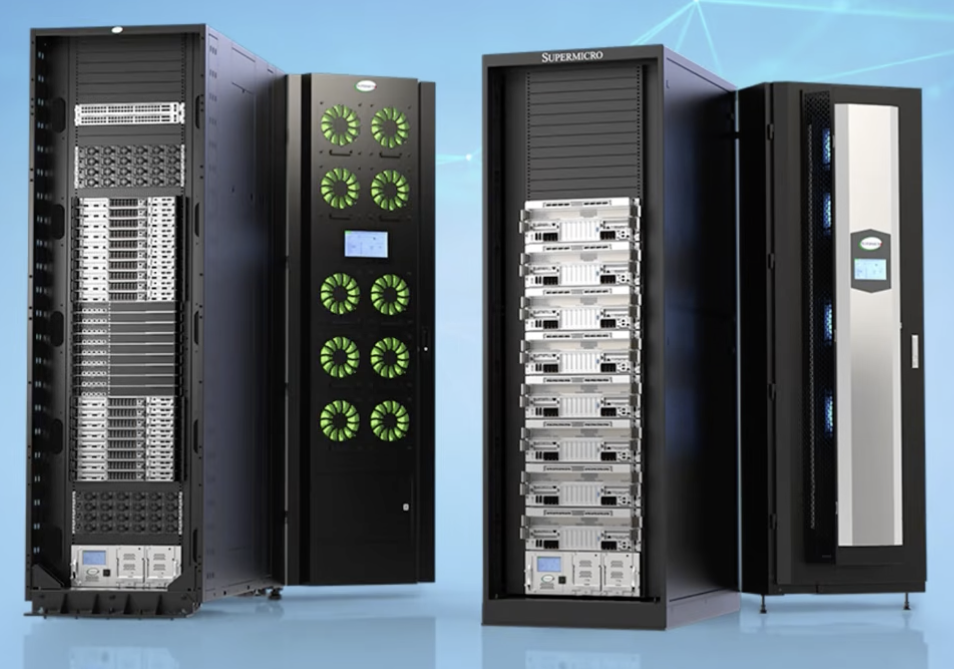
Residual heat is handled at the rack by a 4U in-rack coolant distribution unit rated for up to 250 kW on 45°C warm water, a smaller sibling to the 1.8MW in-row CDUs Supermicro ships with its Vera Rubin NVL72 racks, and six rear door heat exchangers span 10 kW to 120 kW in AC and DC versions, with the DC models fed from the busbar, N+1 redundant fans, and an anti-condensation control. Chiller doors cover the ORv3 rack at 20 kW to 100 kW and the ORW rack at 60 kW, managed over Redfish, SNMP, a web UI, and Modbus.
Supermicro’s argument for the RDHx is that it removes server exhaust heat before it reaches the data center, so an existing facility can raise rack density without retrofitting its air handling. The company has not published a density figure for a fully loaded ORv3 rack under that combination, so how far an older facility can go stays a site-by-site calculation.
High-Density Compute Implementations
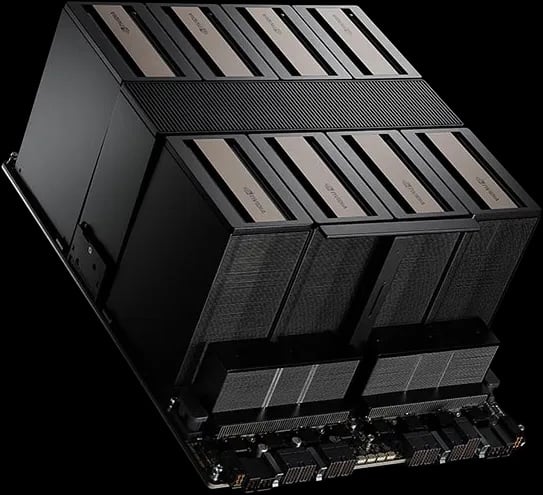
On the compute side, the 2 OU NVIDIA HGX B300 node puts eight liquid-cooled GPUs in the 21-inch ORv3 envelope for up to 18 nodes and 144 GPUs per rack, following the HGX B200 system we ran through Supermicro’s JumpStart program. The 1 OU FlexTwin packs two Intel Xeon 6 or AMD EPYC nodes into a single OU for HPC, and a 2 OU four-node design reaches up to 45,696 Arm AGI CPUs per rack, which Supermicro aims at always-on agentic AI. The AMD Helios platform arrives as an ORW rack built for high-volume inference, frontier-model training, fine-tuning, and sovereign AI.
The NVIDIA MGX 1.2 rack series Supermicro contributed to OCP is built for NVIDIA Vera Rubin NVL72 and Vera CPU platforms with the DLC-2 stack already integrated, and 1 OU power shelves and 2 OU battery backup units slot into the same racks to feed and hold up the 48V busbar.
Co-Packaged Optics and Switching Silicon
The networking line sits on the same busbar and coolant loop. A 2 OU co-packaged optics switch built on Broadcom’s Tomahawk 6 delivers 102.4 Tbps across 128 800G ports, takes 40 to 60 VDC from the ORv3 busbar, connects to the rack loop through blind-mate QD08 couplings, and runs Supermicro Enterprise Advanced SONiC. It sits at the top of a switch range that also covers air-cooled and liquid-cooled 800G and 1.6T Ethernet for EIA and ORv3 racks, and it lands the same week Micas Networks put Tomahawk 6 CPO in a 1RU box.

DCBBS will also carry NVIDIA Spectrum-X Ethernet Photonics, the co-packaged Ethernet switch built on the 102.4 Tb/s Spectrum-6 ASIC with 200 Gb/s SerDes, which is in production now. NVIDIA’s figures for it against pluggable-transceiver networks are 5x better power efficiency, 10x greater MTBI, 5x longer uptime for AI applications, and 1.3x faster time to deployment. These are vendor results, and we did not run or audit them.
SuperCloud Composer monitors and manages every DCBBS component over standard protocols, with SuperCloud Director, SuperCloud Automation Assistant, and SuperCloud Developer Console layered above it for AI factory, enterprise, and NeoCloud operations. The management stack supports Redfish APIs and OpenBMC, and Supermicro lists hardware attestation and post-quantum cryptography algorithms for compliance with OCP security standards. Supermicro says the OCP portfolio is available now.


 Amazon