

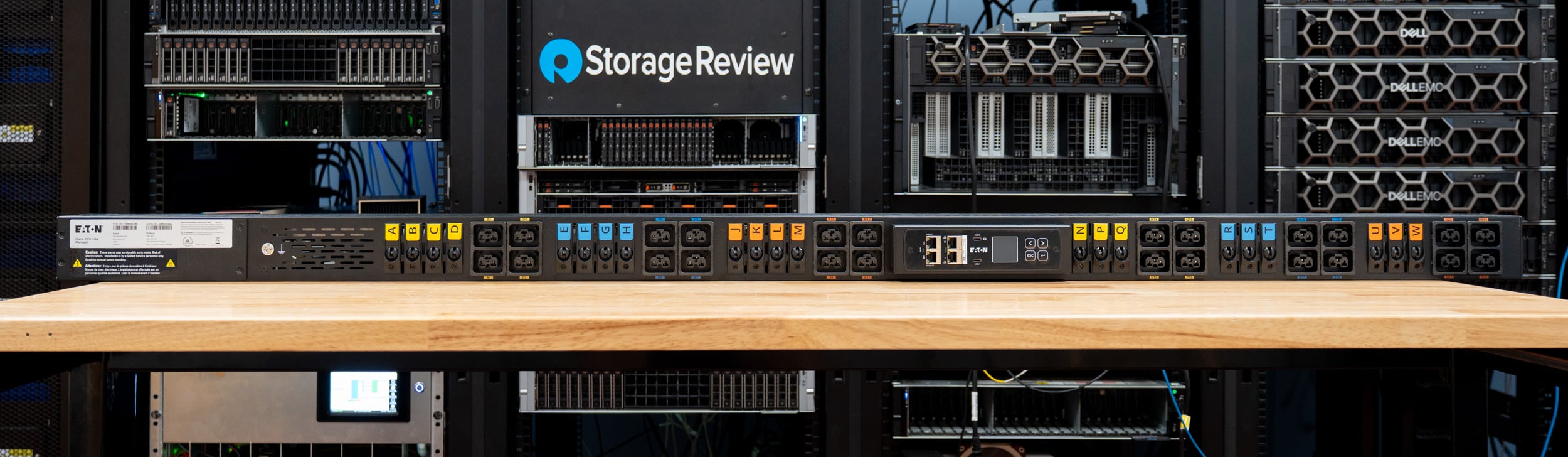
Eaton is getting ready to ship the kind of PDU that didn’t need to exist five years ago. The HDXL Rack PDU G4, arriving in the fourth quarter of 2026, delivers 56-81kW from a single zero-U unit, with 24 outlets, 21 branch breakers, and a 100A corded or 140A terminal-block input. Four models launch in the second half of the year as standard offerings. Eaton sent us two units, and while our lab doesn’t have the 480V high-voltage three-phase service these are built for, the conversation right now is why PDUs in this class suddenly matter and what changed between this and the G3 platform we reviewed in 2023.
The Power Problem Dense AI Racks Created
The electrical math that justifies an 81kW PDU starts with a GPU single server. Dell’s PowerEdge XE7745, the 4U air-cooled GPU box we have covered extensively in our work with Oregon State, carries dual 5th-gen AMD EPYC processors and up to eight double-wide 600W PCIe accelerators, such as the NVIDIA RTX PRO 6000 Blackwell Server Edition, NVIDIA’s H200 NVL, or AMD’s Instinct MI350P. Dell feeds that with up to eight 3200W power supplies per chassis, split across two power zones: two for the server sled and six for the GPUs, and its configuration matrix disqualifies the smaller 2400W supply once eight 600W cards are involved. That’s up to 25.6kW of supply capacity, and eight power cords per 4U server, with 277 VAC and HVDC supply variants tailored to the exact class of high-voltage feeds the HDXL is designed to distribute. The Xeon 6-based XE7740 sibling matches the same eight-PSU, two-zone design. Run N+N redundancy across A/B feeds, and each server presents four cords per side; six of them consume all 24 outlets on each of a pair of HDXLs.
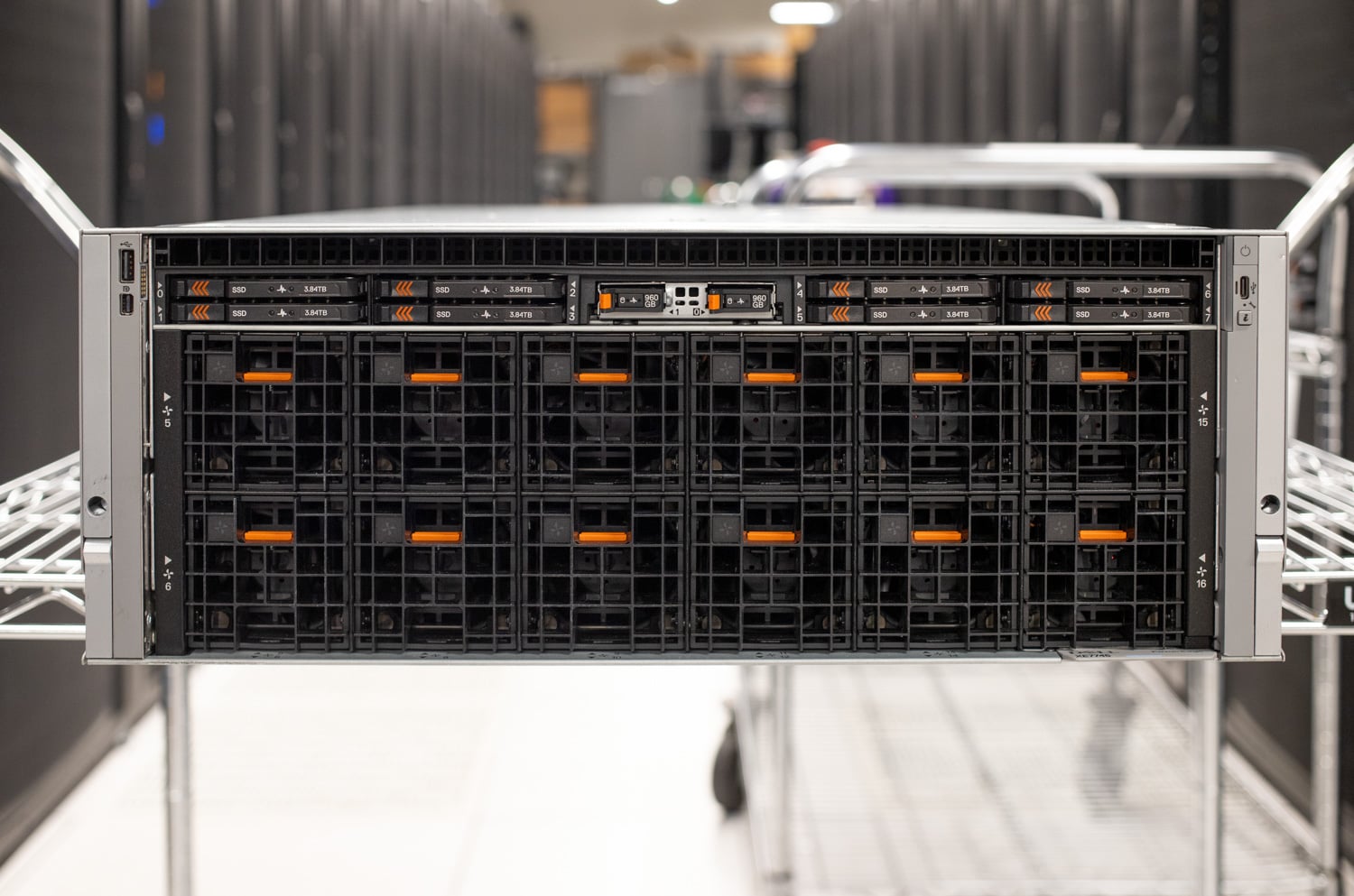
Stack those in a rack, and the power consumption and distribution get significant fast. Six XE7745-class systems consume 24U and, fully populated, 48 power cords: 24 per feed, which is precisely the outlet count of one HDXL per side. Accelerator load alone on those six systems runs 28.8kW before the CPUs, fans, memory, and storage do anything. Six systems are the outlet ceiling: 24 cords per feed against 24 C39 positions. Six systems’ worth of feed-side PSU capacity is 76.8kW, sitting just inside the 81kW model’s rating, so on the top HDXL, the electrical limit and the outlet limit converge on the same rack. The 56kW model carries the same six systems against realistic draw, with less margin for a single-feed failover event. Either way, this is exactly the “assuming you have enough power to the rack” scenario: the building feed, not the distribution, becomes the constraint, which is a common problem to have in 2026.
The alternative is what dense deployments do today: gang multiple mid-capacity PDUs per rack. Our Eaton G3 Universal PDU review unit topped out at 23kVA with its largest input cord, designed more for switches, storage hardware, and general-purpose servers without dense GPUs. Feeding six fully loaded XE7745s from a G3-class distribution means three or four PDUs per feed, each with its own input whip, network drop, and management. The HDXL’s value is one unit per feed, one 100A or 140A input, and one management plane.

Inside the HDXL
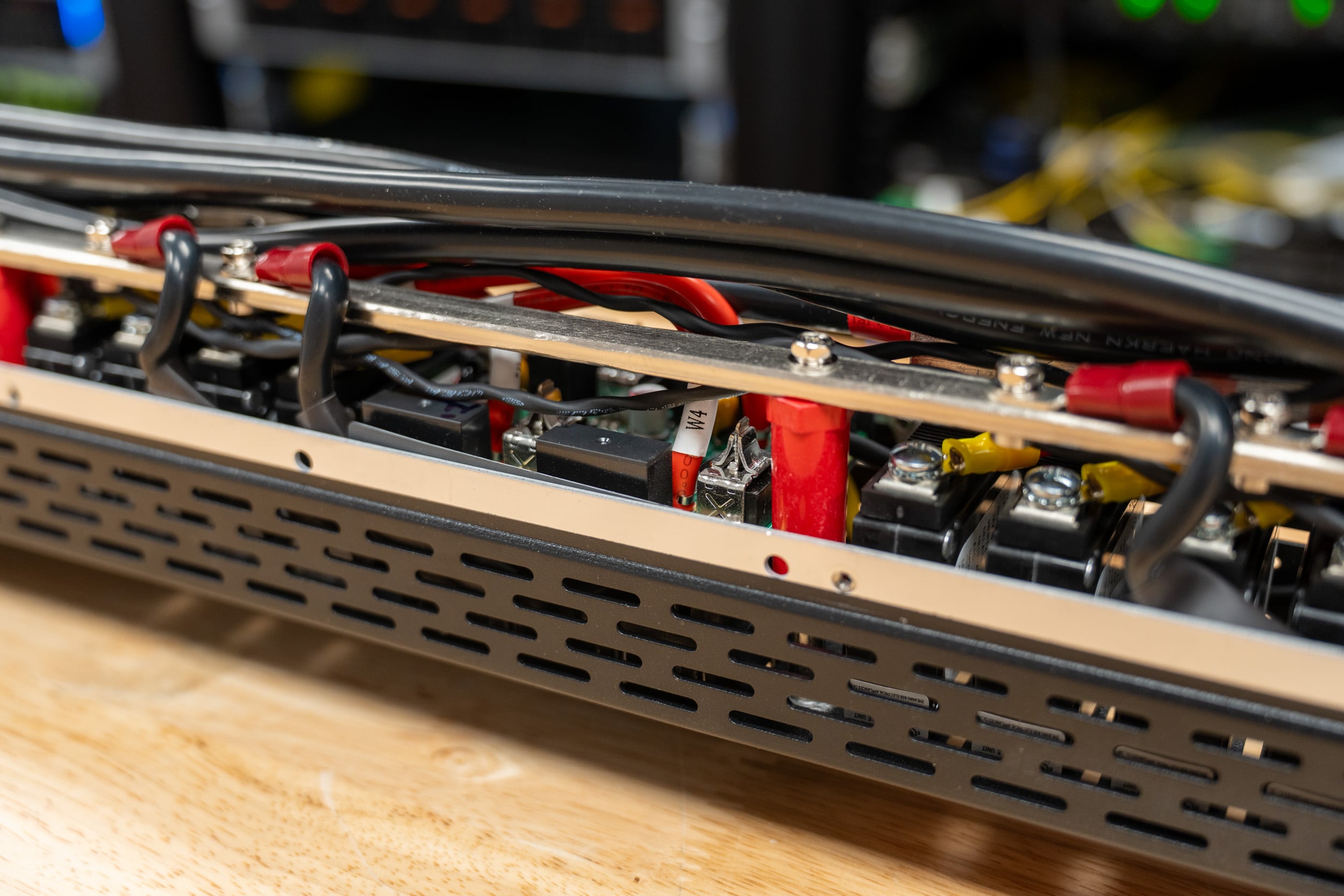
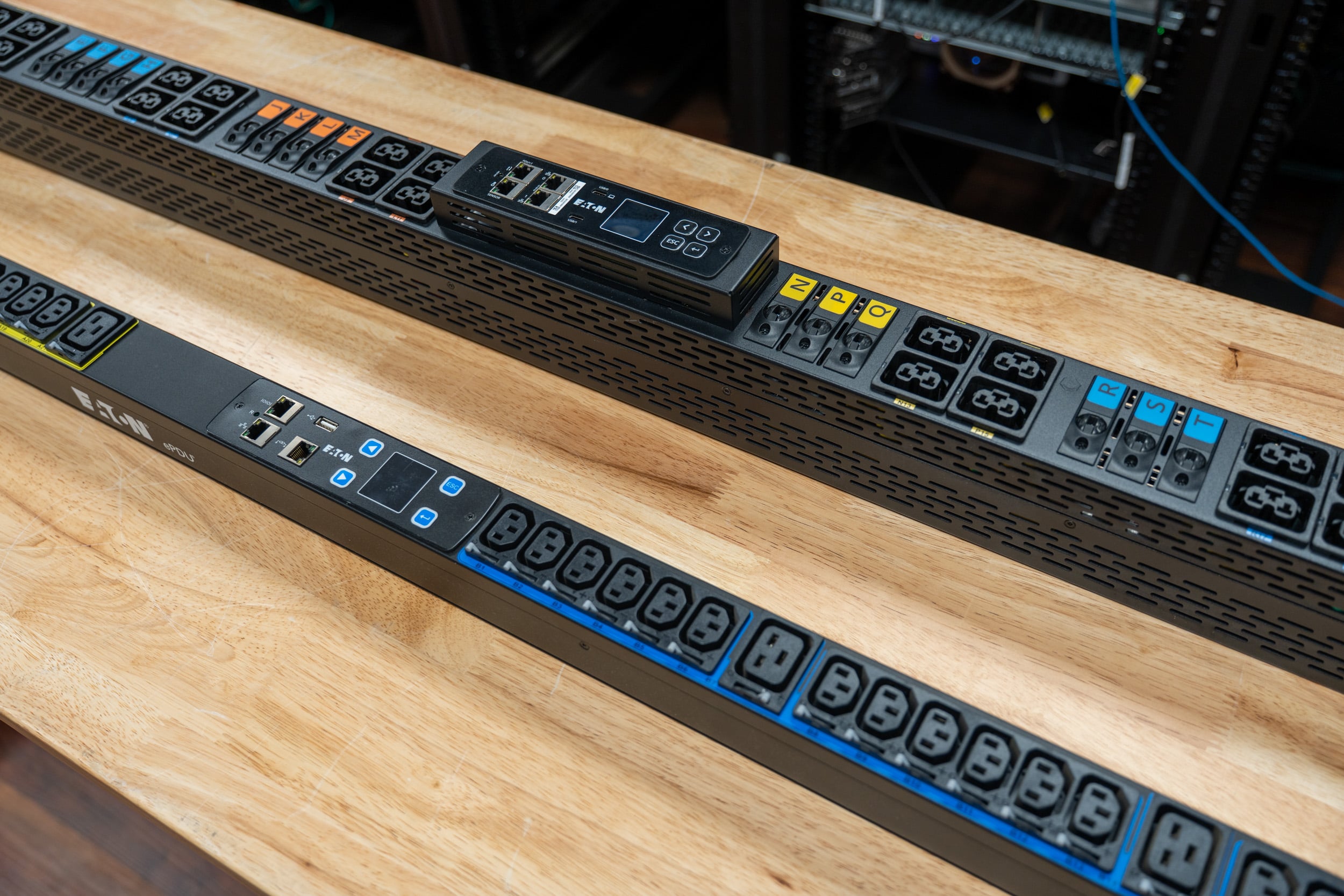
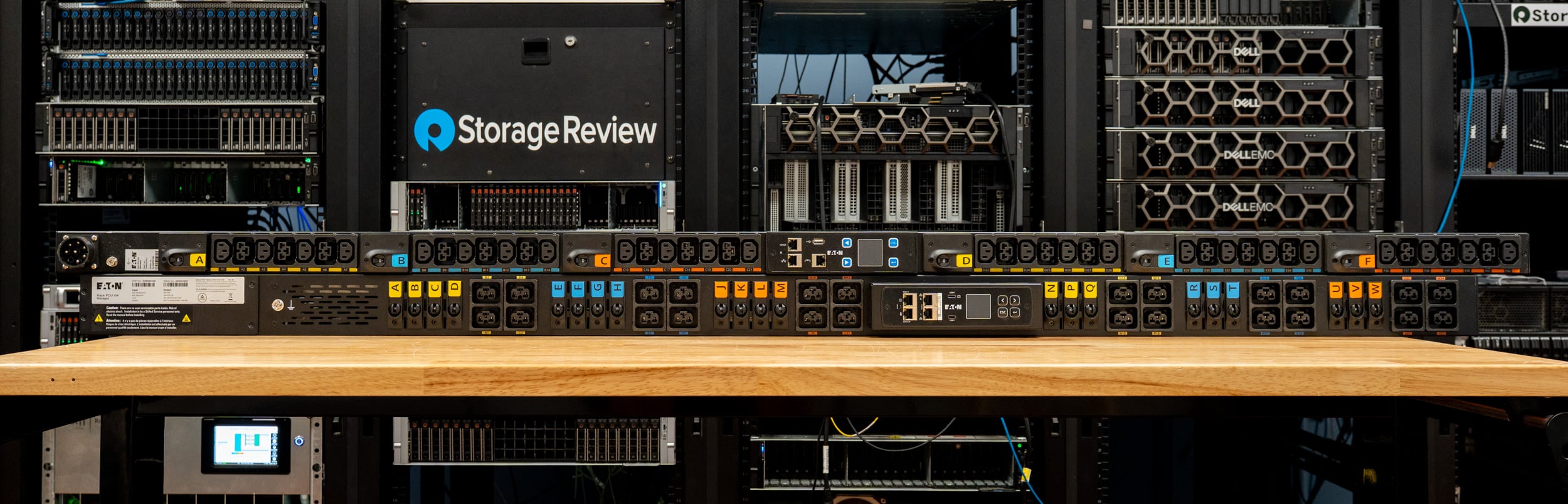
All models are three-phase Wye designs with what Eaton calls a near 1:1 outlet-to-breaker configuration: 21 branch breakers protecting 24 outlets. Outlets 1 through 12 each have a dedicated breaker (lettered A through M, skipping I and O). In the remaining twelve, three breakers each cover a pair of adjacent outlets: N for 13 and 14, R for 17 and 18, and U for 21 and 22, while the other six positions keep their own. So 18 of the 24 outlets are on a breaker of their own, and six share in pairs, which means a trip takes down one device, or at most two, rather than a six-outlet bank. Two input styles are offered: a corded model terminating in a 100A IEC-style 5100P6W connector (the EVMAXL100 in the manual) and a terminal-block model for permanently connected 140A service (EVMAXL140). Eaton specifies 100A or 140A branch-circuit protection upstream. With the cover off, the current this class is built to carry is obvious: heavy-gauge conductors and bus work feed each branch breaker, sized for a 100A or 140A three-phase input rather than the 30A-class internals most rack PDUs still use.
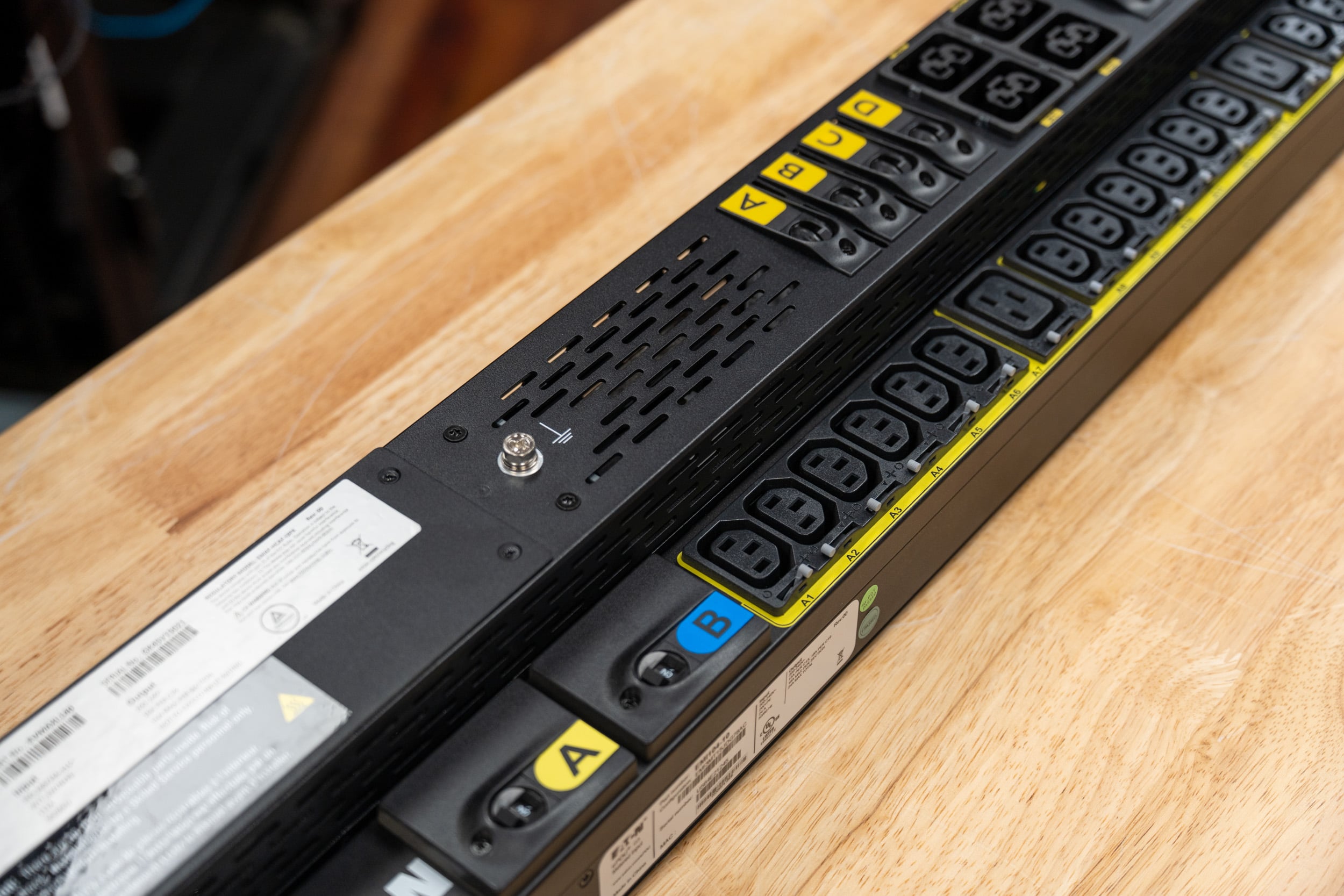
Every outlet is Eaton’s C39, the combination receptacle the company introduced on the G3 Universal PDU, which merges the C13 and C19 outlet styles into one high-retention opening that accepts both C14 and C20 plugs. On the G3, Eaton split the loadout into 21 C14 and 21 C39; here, all 24 positions take either plug, which matters when a rack mixes 3200W server supplies with smaller items like switches. Branch breakers are rated to trip at 20A in US trim (16A EU), comfortably above the roughly 14A that a 3200W Titanium supply pulls at 230V. Inside, every outlet position sits behind a branch breaker, and because our units are the Managed version, each outlet also has its own relay for remote switching, so switching stays per outlet even on the three shared-breaker pairs.
Two management topologies span the four launch models. Metered Outlet (MO) units monitor at the input, branch, and individual outlet levels; Managed (MA) units add per-outlet switching on top of the same monitoring stack. Both carry Eaton’s Gigabit Network Module with an LCD, per-outlet status LEDs, and support for the optional Environmental Monitoring Probe, which reads temperatures from 0°C to 70°C with ±2°C accuracy, tracks humidity, monitors two dry-contact devices, and can be installed up to 50 meters away over Cat5. The units are rated IP20 and operate at ambient temperatures up to 60°C at altitudes below 1,000 meters, derating to 50°C at 3,000 meters.
HDXL vs. G3 Universal PDU
| Specification | Eaton HDXL Rack PDU G4 | Eaton G3 Universal PDU |
|---|---|---|
| Power | ||
| Capacity per PDU | 56kW to 81kW | 5kVA to 23kVA |
| Input | 100A corded (5100P6W) or 140A terminal block | Universal input, 12 cord options up to 60A |
| Phase configuration | Three-phase Wye, 415/240V class | Single-phase or three-phase by cord |
| Outlets and Protection | ||
| Outlets | 24x C39 (accepts C14 and C20) | 42 total: 21x C14, 21x C39 |
| Branch protection | 21 breakers, near 1:1 per outlet | 6 color-coded outlet banks with breakers |
| Management | ||
| Topologies | Metered Outlet (MO), Managed (MA) with per-outlet switching | Single universal SKU; monitoring via EMP Gen2 |
| Network and sensors | Gigabit Network Module, LCD, optional EMP | Daisy chaining, EMP Gen2 |
| Availability | ||
| Launch | 4 models, 2H 2026, standard from-stock offering | Shipping (reviewed October 2023) |
The spec sheet above makes it pretty clear that the G3 universal was geared toward mixed-rack environments where a variety of servers, storage, and switches may be involved. The HDXL, on the other hand, is a highly focused PDU that’s going after the high-power profile that GPU servers demand.
What We Can and Can’t Say Yet
Here’s the caveat we started with up top: our lab doesn’t have the high-voltage three-phase service these units require, so this isn’t our typical lab test. The HDXL Eaton sent has been racked, photographed, and inspected, but until we can put real load through them, we can’t speak to metering accuracy, breaker behavior, thermal performance under sustained draw, or the management experience under production conditions. We have, however, tested that with Eaton’s other PDUs and would expect that everything performs as advertised.

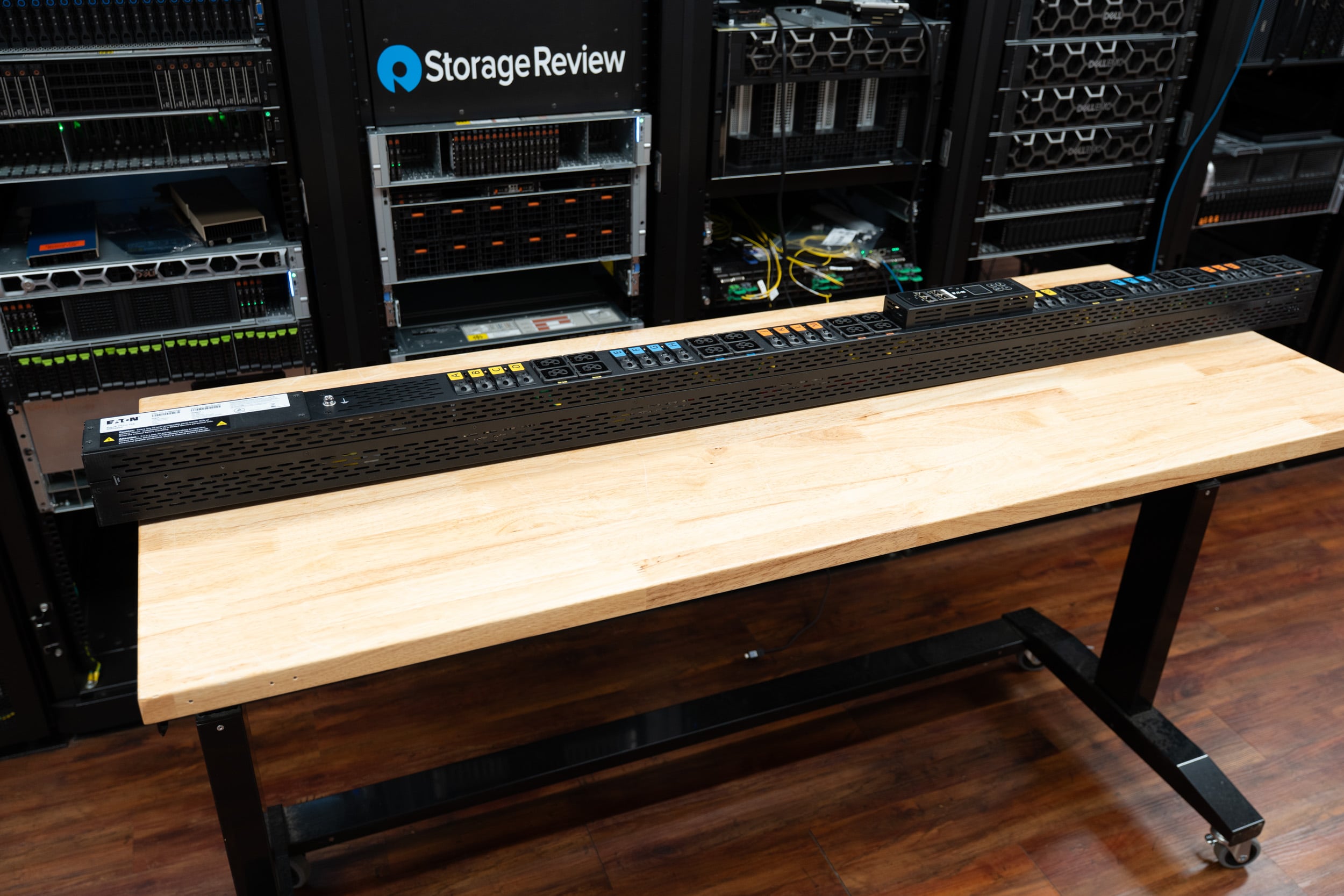
One thing besides the design and build quality we can evaluate is the fit; these sit nicely in our older 42U Eaton racks without a problem, staying entirely out of the way.
Final Thoughts
The HDXL is power infrastructure catching up to what compute is already consuming. Enterprise AI systems now ship as 4- and 8-GPU servers that draw kilowatts instead of watts. When a single 4U server can carry more than 25kW of power supply capacity and eight power cords, the 23kVA PDU generation becomes the bottleneck. That’s the deployment this family was designed and built for. Eaton’s HDXL is dense, breaker-per-outlet (mostly), and standardized on an outlet that accepts both plug types a modern rack uses. If you’re speccing racks for dense enterprise AI, four or eight GPUs per box, the HDXL family belongs on the evaluation list, provided your facility can deliver the 100A-plus feeds it’s designed to distribute.



 Amazon