

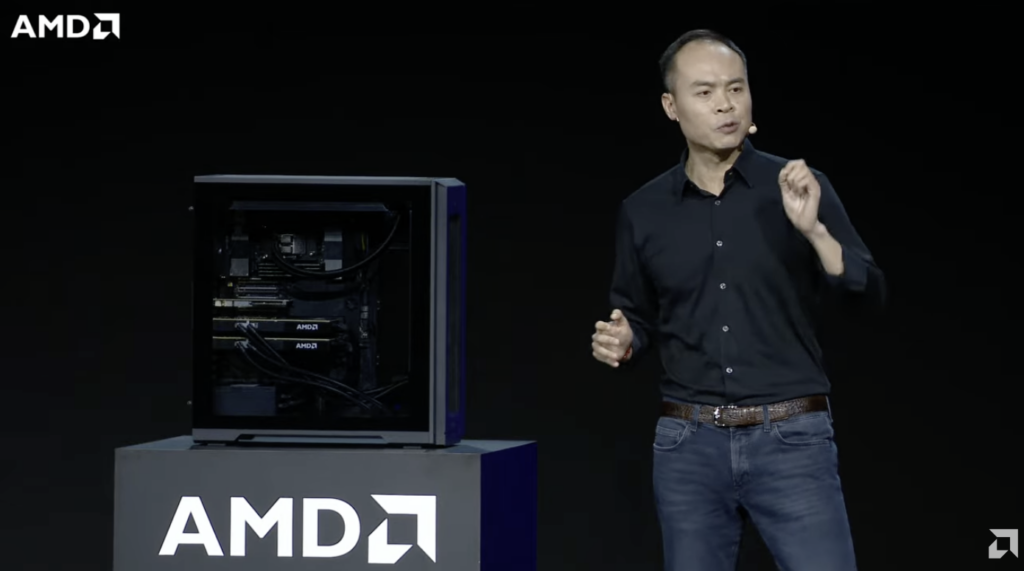
AMD used its IFA 2026 opening keynote to reveal the Threadripper Halo Station, a liquid-cooled workstation pairing a 96-core Threadripper PRO with a pair of Instinct MI350P accelerators, and the pitch could not be more direct: this is AMD’s answer to NVIDIA’s GB300 DGX Station. “This is the most powerful workstation in the world,” said Jack Huynh, AMD’s senior vice president and general manager of Computing and Graphics, calling it “capable of running AI models with more than a trillion parameters.”
What AMD Showed on Stage
Huynh never named the CPU beyond “96 cores of Threadripper Pro,” so we’re assuming it’s the Threadripper PRO 9995WX, the only 96-core part in the lineup, a 192-thread Zen 5 “Shimada Peak” chip that goes to 5.4GHz per AMD’s specs, on a platform carrying up to 2 TB of eight-channel DDR5 and the 128 PCIe 5.0 lanes the Threadripper PRO platform provides. Beside it sit two Instinct MI350P accelerators, the 600W PCIe CDNA 4 cards AMD introduced for enterprise inference, “with the path to four,” as Huynh put it. Each MI350P carries 144GB of HBM3E at 4TB/s, so the show configuration holds 288GB of accelerator memory, and a fully built-out unit reaches the 576GB figure Huynh quoted on stage.
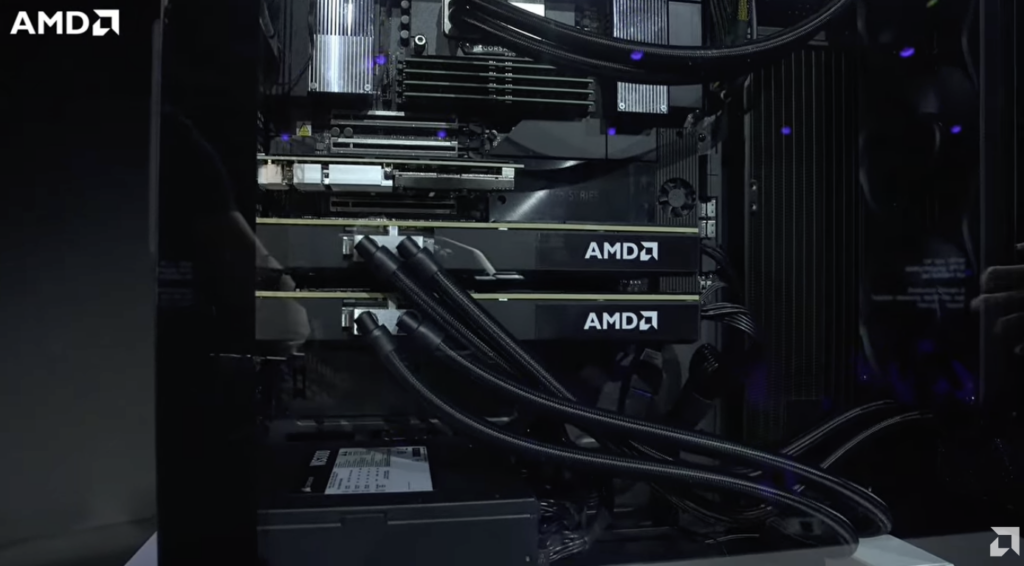
The whole system is liquid-cooled, CPU and accelerators both, “because we want all that power to stay super quiet,” Huynh said. For deskside AI, that’s a critical point: two 600W accelerators plus a 350W CPU equals 1,550W of silicon, which can produce aggravating noise levels if not managed correctly. Huynh closed the segment with the line that will follow this product around: “This is about as close as you can get to a personal supercomputer.”
The DGX Station Fight It’s Picking
The system AMD is targeting is the one we just finished testing. NVIDIA’s GB300-based DGX Station, which we reviewed as the MSI XpertStation WS300, takes the opposite architectural bet: one B300 GPU and one Grace CPU sharing a 748GB coherent memory pool over a 900GB/s NVLink-C2C link. AMD’s answer is discrete and expandable: less unified memory, but up to four accelerators, 2TB of host DRAM, and an x86 host that sidesteps the Arm toolchain problems we flagged in the WS300 review. The trillion-parameter claim rests on that split pool; a 1T-parameter model at 4-bit precision needs roughly 500GB for weights alone, which the four-accelerator, 576GB configuration would hold in HBM, with the 2TB of DDR5 and NVMe storage behind it for everything else. AMD hasn’t shown a token of benchmark data yet, so how well models straddle four PCIe-attached cards against NVIDIA’s coherent pool is exactly the battle we look forward to testing.
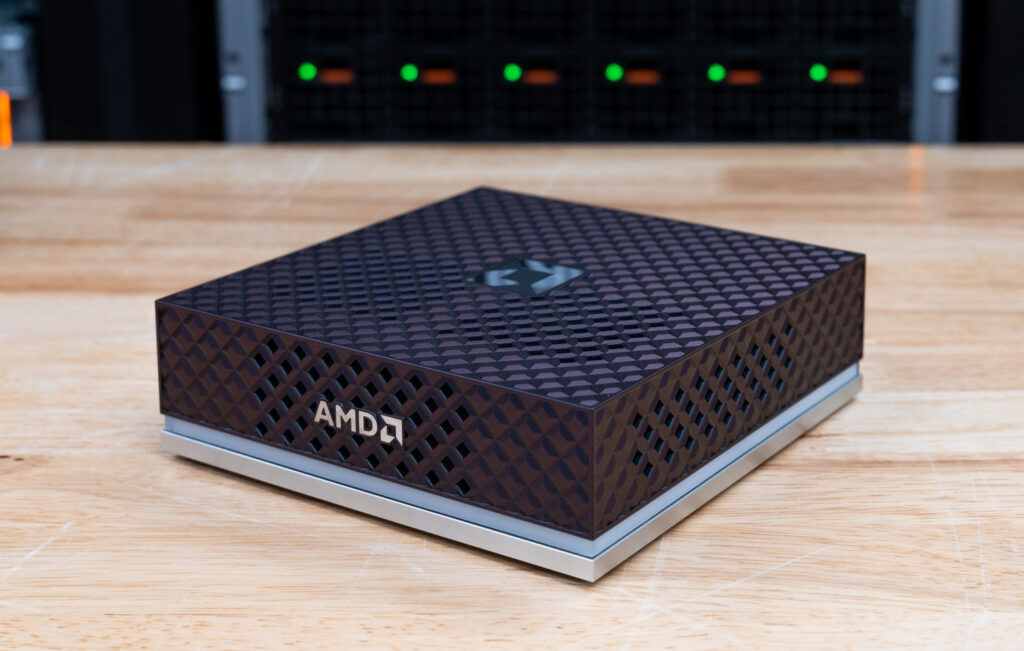
The Station also completes a ladder AMD spent the year assembling. At the small end sits the Ryzen AI Halo we reviewed this summer, a compact dual-OS desktop that runs 200B-parameter models locally and squares up against the DGX Spark, with the Ryzen AI Max PRO 400 machines from earlier in the keynote filling the laptop and mini-PC tiers. The Halo Station caps the range, and the portfolio point is hard to miss: AMD now fields an answer at every rung of NVIDIA’s personal AI hardware ladder, from a box that fits in a hand to a workstation that claims a trillion parameters.
What AMD Didn’t Say
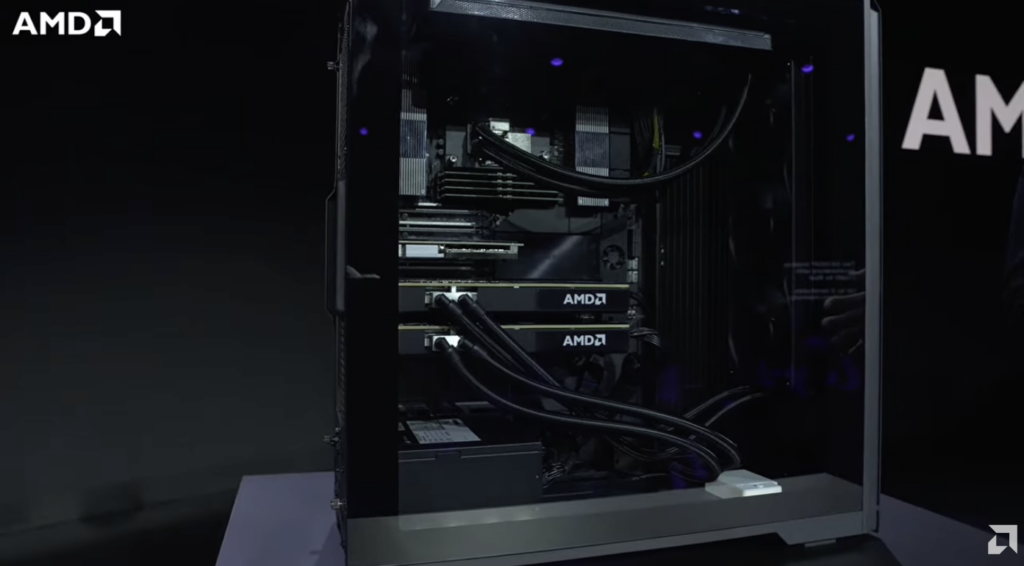
There’s no pricing, no availability window, no named OEM partners, and no word on whether AMD sells this directly or hands the design to system builders, as it did with the Ryzen AI Halo and Ryzen AI Max PRO 400 machines announced earlier in the same keynote. The show unit itself hints at how early this is: AMD’s own preview shows a conventional tempered-glass enthusiast tower with a standard ATX power supply and custom loops on each card. There’s also little detail on the interconnect between accelerators, storage configuration, or power requirements, and given two 600W cards plus a 350W CPU, the wall-side story is a legitimate issue.
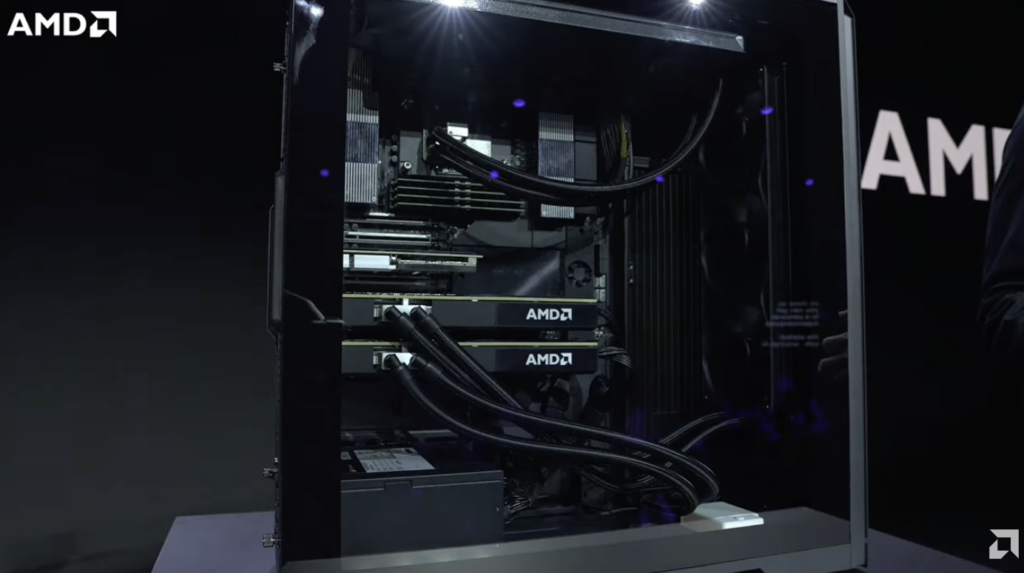
The reveal segment runs from 35:41 to 38:20 in AMD’s keynote replay, and it’s worth the three minutes if this kind of product speaks to you.



 Amazon