

SC26 is under way at McCormick Place in Chicago, and behind the headline launches we have already covered, a second tier of announcements fills in the storage, server, and networking picture. The TOP500 turned over fewer systems than in any prior edition, Aurora took the IO500 production list by a wide margin, Supermicro began shipping a PCIe Gen6 all-flash server, VAST Data tied storage QoS to the job scheduler, and eight server vendors are showing the hardware that sits around the GPUs. This SC26 roundup collects the items that did not get a standalone story, and the Hammerspace Data System launch is covered separately.
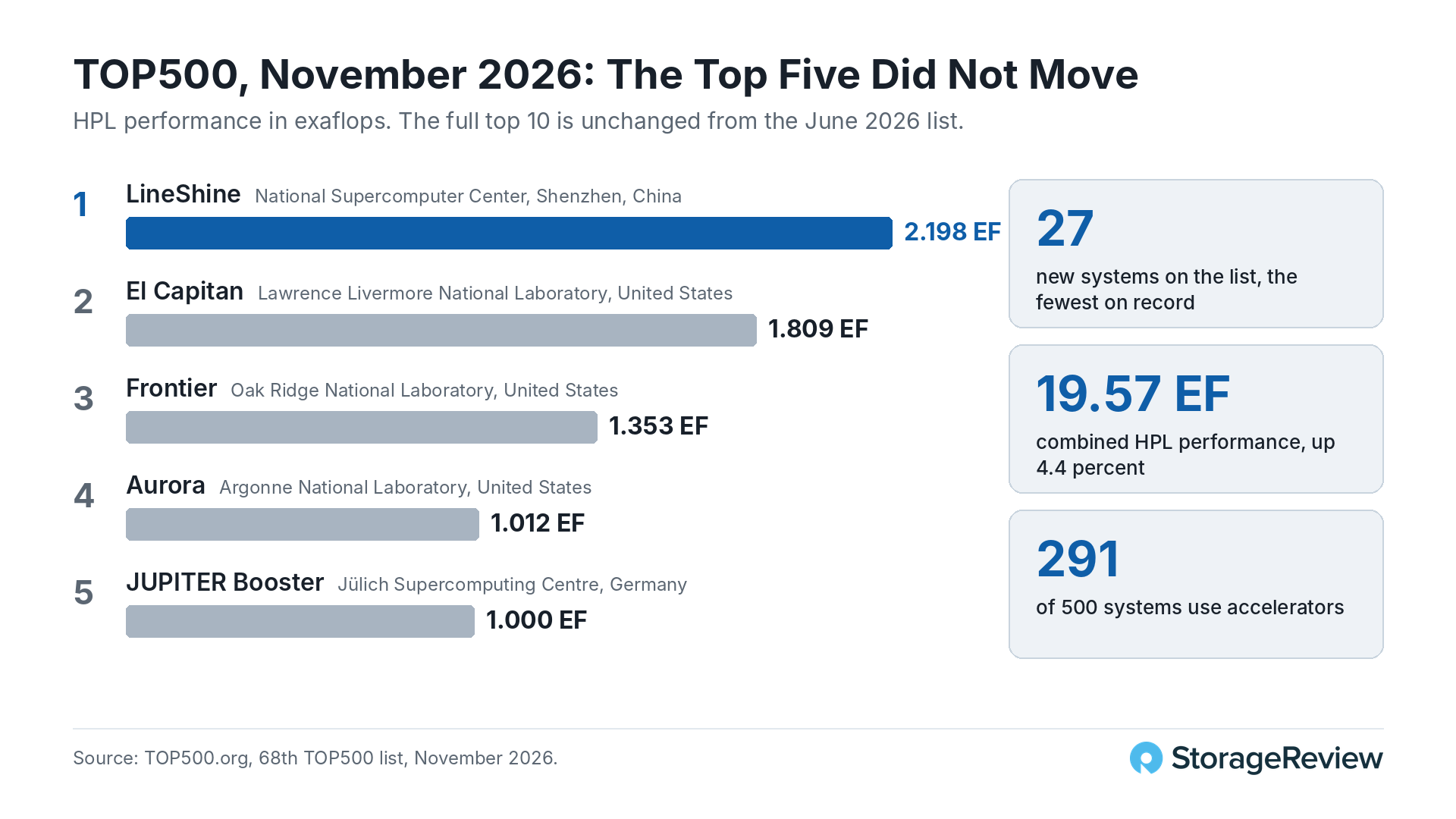
TOP500: An Unchanged Top 10 and the Fewest New Systems on Record
The 68th TOP500 list left the top 10 unchanged from the June list. China’s LineShine at the National Supercomputer Center in Shenzhen holds No. 1 at 2.198 exaflops on HPL, followed by El Capitan at 1.809, Frontier at 1.353, Aurora at 1.012, and JUPITER Booster at 1.000. Only 27 systems are new, 5.4 percent of the list, which the organizers call the lowest turnover in its history. Combined performance rose 4.4 percent to 19.57 exaflops, the entry point at No. 500 moved up to 2.857 petaflops, and 291 systems now use accelerators.
The highest-ranked newcomer is HANGANG at KISTI in South Korea, an HPE Cray EX254n built on NVIDIA GH200 Superchips that enters at No. 12 with 342.6 petaflops. HPE’s Lux system at Oak Ridge, which we covered separately, debuted two places lower at No. 14. LineShine also leads the HPCG benchmark at 22.00 petaflops, and El Capitan leads the mixed-precision HPL-MxP test at 16.7 exaflops. The Green500 top 10 is unchanged as well, with France’s KAIROS first at 73.28 gigaflops per watt on a BullSequana XH3000 with GH200 Superchips.
TOP500 November 2026 List
IO500: Aurora Tops the Production List at 13 Times the Runner-Up
Argonne’s Aurora leads the SC26 IO500 production list with a new DAOS submission that scored 46,192.01 from 4,096 client nodes, at 12,296 GiB/s of bandwidth and 173.5 million metadata operations per second. That is about 13 times the score of LRZ’s SuperMUC-NG Phase 2 in second place at 3,470.22. KISTI’s HANGANG, the HPE Cray system that led the TOP500 newcomers, enters third on Lustre at 1,155.89. Eight of the 52 production entries are new, including IBM’s Blue Vela on Storage Scale System 6000, Georgia Tech’s Nexus on VAST, and two DDN EXAScaler systems at Purdue.
The research list has no new entries in its top five, which Pengcheng Cloudbrain-II still leads at 210,255. Vendor labs account for much of the new activity among 10-node submissions: Hammerspace entered a Tier 0 configuration over pNFS at No. 29 with a score of 688.01 and 449.86 GiB/s of bandwidth, Dell’s Lightning File System scored 568.66 at No. 37, and DDN’s AI400X3M with EXAScaler scored 317.47 at No. 53. IBM added several Storage Scale System 6000 results, and Korea’s Telecommunications Technology Association placed a 10-node DAOS system from Gluesys at No. 19 with 1,242.79.
IO500 SC26 Production List

AIC Shows a Four-DPU JBOF and a PCIe Gen6 All-Flash Server
AIC is showing a system for each storage tier of an inference cluster, on the premise that KV cache is moving to shared flash near the GPUs with capacity storage behind it. The F2026 is a 2U PCIe Gen5 JBOF with 26 dual-port NVMe bays, dual canisters, and support for up to four DPUs, serving flash over NVMe-over-Fabrics, and MangoBoost builds its Mango KESAR-E enclosure on it. The HA2026-HC puts two active-active AMD EPYC nodes behind the same 26 bays. AIC’s newest system, the SB103-JP, is a 1U server with up to 16 E3.S PCIe Gen6 NVMe bays and a single EPYC 9006 processor.
The capacity tier is covered by the SB407-ID, a 4U server with 60 hot-swap 3.5-inch bays, six rear PCIe Gen5 NVMe bays, and dual Intel Xeon 6 processors, and by the J4078-02-04X, a 4U 78-bay 24Gb/s SAS JBOD. On the compute side, the 5U CB502-NM takes dual EPYC 9004 or 9005 processors and up to eight dual-slot GPUs at up to 600W each. AIC did not give availability or pricing for any of the systems.
AIC
MSI Brings PCIe 6.0 E3.S Bays to EPYC 9006 Servers
Much of MSI’s SC26 lineup has been shown before, including the liquid-cooled CG681-S6093 MGX rack with up to eight RTX PRO 6000 Blackwell Server Edition GPUs per 6U system and the XpertStation WS300, the GB300 desktop we reviewed, which MSI says will support Windows. The EPYC 9006 servers are the part of the lineup we had not covered. The 2U dual-socket CX272-S6082 has 32 DDR5-8000 RDIMM slots and 32 front E3.S 1T bays on PCIe 6.0 x4, and the 1U single-socket CX172-S4081 has 16 of each.
For multi-node deployments, the ORv3 CD182-S6091-X2 packs two direct liquid-cooled, dual-socket nodes into 1OU with 32 DDR5-8000 slots and four E1.S PCIe 6.0 bays per node, and the air-cooled CD281-S4091-X2 puts two single-socket nodes in 2OU with eight E3.S 1T bays each. MSI lists CPU TDPs of up to 600W on the Open Compute platforms. The Xeon 6 versions stay on PCIe 5.0 U.2 bays, and MSI also lists Instinct MI350P-based configurations without model details or availability dates.
Supermicro Ships a PCIe Gen6 Petascale Server With 32 E3.S Bays
Supermicro says its first PCIe Gen6 all-flash storage servers are shipping, starting with a Petascale system on AMD EPYC 9006 SP7 processors. The 2U chassis takes up to 32 E3.S NVMe SSDs, which comes to 3.93PB with 122.88TB drives, and has room for up to four x16 network cards. Supermicro claims up to 100 percent more sequential read bandwidth than PCIe Gen5 and gives no test configuration behind the figure. More models are due as AMD releases SP8 versions of the processor.
Supermicro lists Hammerspace, IBM, MinIO, Nutanix, Scality, VAST Data, VDURA, and WEKA as software-defined storage partners validated on the platform, which also spans its CloudDC, GrandTwin, and Hyper families. IBM said Storage Scale runs on the new server for inference pipelines that include KV cache, a pairing the two companies introduced on earlier Supermicro hardware. With AIC and MSI showing 16-bay and 32-bay E3.S designs on the same processor, three vendors at SC26 have PCIe Gen6 storage servers on EPYC 9006, and Supermicro is the one that says its system is shipping.
Phison Targets 28GB/s With a PCIe Gen6 SSD Controller and Shows Computational and Mixed-Media Designs
Phison used SC26 to preview three storage technologies. Its X3 (PS5303) enterprise SSD controller targets up to 28GB/s of sequential throughput and 6.8 million IOPS over PCIe Gen6 x4 with NVMe 2.3, close to twice what Gen5 drives deliver, and the company’s PS7161 is the first PCIe 6.0 redriver on the PCI-SIG Integrators List. A computational storage design puts an NPU rated at 36,800 DMIPS and 64GB of memory inside the drive, with support for PyTorch, vLLM, OpenVINO, and llama.cpp, and Phison estimates it can cut data transfers by 10 to 100 times for workloads that suit it.
The third, Mixed Media, puts high-endurance pSLC and high-capacity QLC flash behind one 16-channel controller, so a system needs no dedicated cache drives and every bay adds usable capacity. Phison notes that losing one of 24 such drives removes about 4 percent of the cache, where a design with dedicated cache drives would lose 25 percent. Phison gave no product names, capacities, or dates for the computational or mixed-media drives.
Phison also launched the Phison AI Data Platform with generative BI, an on-premises system sold in four-GPU or eight-GPU configurations and available now. It pairs the company’s aiDAPTIV cache memory with Wren AI, which turns natural-language questions into SQL-backed dashboards, and TrueNAS as a storage target for backup and restore. In Phison’s lab testing with the Wren AI agent, aiDAPTIV supported twice the concurrent sessions on the same GPUs with 3.7 times faster time to first token.
Phison AI Data Platform
TRUSTA Debuts ADATA’s Enterprise Brand With vLLM KV Cache Offload to PCIe Gen5 SSDs
TRUSTA, the enterprise storage brand of ADATA, is exhibiting at SC for the first time with an upgraded AI Scaler Toolkit. The software integrates vLLM and spreads its KV cache across three tiers, with GPU memory for active requests, DRAM as a fast cache, and TRUSTA PCIe Gen5 SSDs as a large tier that persists across restarts. Long contexts reload from flash and conversations resume after a reboot without being recomputed. TRUSTA published no time-to-first-token or throughput figures for the offload, unlike Lightbits Inferra, which launched with session-density claims.
The toolkit supports llama.cpp and the Strata inference engine, and TRUSTA’s Strata build uses Intel AMX to speed prompt prefill by up to 25 percent over upstream Strata v0.2.11. That figure comes from TRUSTA’s testing on a Xeon w5-3535X with one RTX 6000 Ada GPU, where the gain was about 11 percent on a single 8K-token input and about 25 percent in multi-turn conversations, and it found no gain for inputs above 12K tokens. The drives behind it are the TD7P51 ECO and T7P5, PCIe Gen5 SSDs at up to 15.36TB in U.2, E1.S, and E3.S with up to 3 DWPD, Flexible Data Placement, and power draw under 20W.
VAST Data Adds Job-Level QoS Tied to Slurm, PBS Pro, and LSF
VAST Data announced Job-Level Quality of Service for the VAST AI Operating System, a control that carries a job’s identity from the workload manager into the storage layer. The VAST NFS client tags I/O requests with configurable job identifiers from Slurm, PBS Pro, or LSF, and administrators set separate bandwidth and IOPS policies per job, including for several jobs on one node. Policies can be changed while jobs run, with no restart, application change, or remount. An optional open-source VNFS Collector reports per-job bandwidth, IOPS, and errors to Prometheus, Grafana, or the VAST DataBase.
The feature targets shared clusters where one I/O-heavy job can starve the others on the same file system, and VAST’s pitch is that limits can be applied without interrupting the job that is causing the contention. VAST plans general availability with VAST AI OS 5.6 by February 2027, and the feature requires VAST NFS 4.8 or later. The company is demonstrating it at SC26, says the design also supports Kubernetes and other orchestrators, and published no performance figures.
Hitachi Vantara Cuts VSP One Object to a Four-Node Start and Adds In-Place Lakehouse Queries
Hitachi Vantara lowered the entry point for VSP One Object to a four-node starting configuration with a simplified deployment process, and it says continued small-object tuning delivers up to 5.5 times faster data access for AI, analytics, and S3 workloads. The object store can now run analytical queries directly against Iceberg, Parquet, JSON, and CSV data, which Hitachi Vantara puts at up to 5 times faster with 80 percent fewer CPUs. The company gave no baseline or test configuration for any of the three figures, and it also expanded multisite replication and regional capabilities.
On the software side, Hitachi iQ Studio adds filesystem and NFS knowledge sources for retrieval-augmented generation, a Model Gateway for governed access to local and external models, governed Model Context Protocol connectivity, and ServiceNow support. Hitachi Vantara is demonstrating iQ Studio agents and analytics running against VSP One Object data at SC26. The update puts the company alongside Dell ObjectScale and MinIO AIStor in on-premises object storage aimed at AI data, and Hitachi Vantara listed no node specifications, capacities, pricing, or availability dates.
Hitachi Vantara VSP One
Google Cloud Lists Managed Lustre at Up to 10TB/s and Opens A5X Bare Metal on Vera Rubin NVL72
Google Cloud’s SC26 summary puts Managed Lustre at up to 10TB/s of read throughput, with GPUDirect Storage over RDMA and an 80PB Dynamic Tier that mirrors to Cloud Storage. Managed Lustre is one of the cloud routes to EXAScaler that DDN cited in its software-defined EXAScaler 7 announcement, and Google gave no configuration behind the throughput figure. On the compute side, A5X bare metal instances on NVIDIA Vera Rubin NVL72 are newly available alongside the A4 and A4X Blackwell instances, and Google’s Batch service now supports single-host TPU slices.
Marvell Demos Photonic Fabric Memory and 1.6T Active Electrical Cables
Marvell announced no new products at SC26 and is using the show for demonstrations built on one argument, that AI clusters are now held back by memory and connectivity as much as by compute. The demos include a Photonic Fabric memory module, Structera CXL add-in cards for memory expansion and compression, Alaska A active electrical cables at 800G and 1.6T, and Teralynx 10 and T100 switch silicon, with OCTEON DPU storage designs and Bravera SSD controllers alongside. Marvell gave no performance, reach, or power figures for the demonstrations, and it did not name the partners involved.
Compal Shows HGX Rubin NVL8 and a Vera CPU Compute Tray
Compal is showing three NVIDIA-based servers: the air-cooled SGX30-2 and the direct liquid-cooled OG430-2-L1, both built on HGX B300, and the OG231-2-L1 on HGX Rubin NVL8. It is also displaying an NVIDIA Vera CPU compute tray alongside BlueField-4 DPUs, ConnectX-9 SuperNICs, and Spectrum-6 Ethernet switches, and NVIDIA detailed its Vera CPU racks at the show. Compal published no specifications, availability, or pricing for the systems. It pointed to its Daxi AI server manufacturing center in Taiwan, which opened in August 2026, and to added capacity in Texas and Vietnam.
Compal OG231-2-L1
ASUS Ramps Vera Rubin NVL72 Shipments and Shows HGX Rubin NVL8 Systems
ASUS says it is ramping volume shipments of NVIDIA Vera Rubin NVL72 racks in the fourth quarter. Its AI POD XA VR721-E3 holds 72 Rubin GPUs and 36 Vera CPUs in a fully liquid-cooled rack, and ASUS is showing it with NVIDIA Groq 3 LPX and Vera CPU trays, a Spectrum-X SN6600 switch, and NVIDIA CMX context memory. Two HGX Rubin NVL8 systems are on display as well, the 3U hybrid-cooled XR R1I12B-M1BHFS and the 2U liquid-cooled XR R1I12B-M1BLFS. ASUS gave no shipment volumes or customer names.
On the storage side, ASUS is showing the VS320D-RS26N enterprise storage platform, the OJ340A-RS60 object storage system, and the RS500A-E14B-R12U, a 1U EPYC 9006 server with PCIe 6.0 and NVMe storage, without publishing specifications for them. The company describes automated L10 and L11 manufacturing and a six-layer validation process that runs from node-level checks to full-rack testing, and it uses NVIDIA’s Omniverse DSX Blueprint with Schneider Electric, AVEVA, and IBM to simulate facilities before deployment. A second ASUS release adds the RS700A-E14B-R16U, a dual-socket 1U EPYC 9006 server with PCIe 6.0 and up to 16 E3.S drives, and previews the ESC8000-E13P on Diamond Rapids with Intel GPU D-series accelerators.
Giga Computing Shows a 5,120-Core Liquid-Cooled Blade Chassis and Its First HGX Rubin NVL8 Server
Giga Computing’s new 6U liquid-cooled blade chassis puts cold plates on the CPUs, memory, and NICs to capture what the company says is nearly 90 percent of system heat. The B685-D80-LS1 version takes AMD EPYC 9006 processors for up to 5,120 cores in one chassis, and the G684-A80-LAS1 uses Xeon 6 in the same form factor. The H295-D80-CS1 is a 2U four-node server with closed-loop liquid cooling and two EPYC 9006 processors per node, up to 2,048 cores, built for data centers without facility water.
On the GPU side, the G3L4-SD5-LA08 is GIGABYTE’s first server for NVIDIA HGX Rubin NVL8, a 3U design that adds U.2 drives for KV caching, and the G494-AB0 is a prototype for Intel’s Diamond Rapids Xeon with 16-channel memory and PCIe Gen6 GPUs. The R164-SG6-AAJ1 fits 16 E3.S drives in a 1U Xeon 6 server. Giga Computing’s GIGAPOD management rack is shown with VAST and WEKA storage and UfiSpace switches, and the company gave no availability dates.
MiTAC Proposes Split Prefill and Decode Servers and Shows a 96-GPU Liquid-Cooled Rack
MiTAC and Skymizer are proposing an on-premises inference design that runs prefill on GPUs and decode on Skymizer’s HTX301 accelerator cards. Prefill runs on the 8U G8825Z5 with AMD EPYC 9575F or 9755 processors and Instinct MI350X GPUs, which passes the KV cache over the network to the 4U air-cooled G4520G6, a Xeon 6 server with eight HTX301-4S cards at 256GB each for 2TB of accelerator memory. MiTAC says the decode server is designed to run models as large as the 2.8-trillion-parameter Kimi K3, and it published no throughput or latency results.
On the show floor, a 52U liquid-cooled rack holds 12 G4826Z5 servers with 96 Instinct MI355X GPUs, which MiTAC puts at 50 percent higher GPU density than conventional deployments without defining the baseline. A proof of concept with ZutaCore applies waterless two-phase direct liquid cooling to the same server, rated for more than 4,000W of thermal design power and an annualized partial PUE of 1.03. A storage rack runs DDN Infinia on seven GC68C-B8056 1U servers, and MiTAC is developing the ORv3 44OU Helion rack with AMD for up to 32,768 Zen 6 cores.
Pegatron Shows a 256-CPU Vera Rack and a 32-Bay E3.S Storage Server
Pegatron’s NVIDIA Vera CPU Rack follows the MGX reference design with 256 liquid-cooled Vera CPUs, more than 22,500 cores, and up to 300TB/s of aggregate LPDDR5X memory bandwidth, the same CPU count as Supermicro’s Vera CPU rack. Its Vera Rubin NVL72 rack is the RA4803-72N3, and the 2U AS210-2T1-8H3 is a liquid-cooled HGX Rubin NVL8 system with a choice of Xeon 6 or EPYC 9006 host processors. For EPYC 9006, Pegatron is introducing the MS310-2A2E, a 2OU two-node server fed from a 48V busbar, alongside the GS203-2A2 and GS205-2A2E dual-socket servers and the SS201-1A1 storage platform with up to 32 E3.S NVMe bays.



 Amazon